

Every major trade agreement reshapes far more than import duties.
In practice, it influences where manufacturers expand, how supply chains evolve, where infrastructure investment accelerates, and ultimately which regions attract new commercial and residential development.
Over the coming decade, the newly implemented UK–India Comprehensive Economic and Trade Agreement (CETA) has the potential to dictate each of these capital decisions.
Economic policy rarely stays on paper.
As exports grow, manufacturers expand. As production rises, logistics networks become larger. Those changes eventually reshape infrastructure, commercial development, and real estate demand.
Understanding this sequence helps businesses and investors make better long-term decisions.
Executive Summary
- Beyond Tariffs: The agreement acts as a catalyst for industrial expansion, opening zero-duty access for Indian exports while granting UK firms entry into Indian government procurement.
- The Supply Chain Impact: A projected US$40 billion increase in bilateral trade will require millions of square feet of new distribution centres, cold chain facilities, and 3PL warehousing.
- Why Delhi NCR Matters: As corporate leasing expands, strategically zoned export hubs—including the DMIC and peripheral expressways—are positioned to absorb significant institutional capital.
While the agreement affects the entire country, its impact is likely to be particularly visible across the Delhi NCR region due to its concentration of industrial corridors, expressways, logistics parks, and export-oriented manufacturing clusters.
1. What is the UK–India Trade Deal?
The UK–India Trade Deal is a comprehensive economic agreement designed to increase bilateral trade from its historic baseline of approximately US$60 billion to US$100 billion by 2030.
The agreement reshapes trade across four key areas:
- Exports: Secures zero-duty market access for nearly 99% of Indian exports to the UK.
- Imports: Reduces tariffs on British goods, enabling smoother entry for UK automotive engineering, precision technology, and consumer goods.
- Services & Mobility: Relaxes visa constraints for intra-corporate transfers, facilitating the movement of IT professionals and corporate executives.
- Sovereign Investment: British infrastructure and green energy firms are now permitted to bid on high-value Indian central and state government procurement contracts.
At a Glance
- Trade Target: US$100 Billion by 2030
- Export Access: 99% of Indian exports receive tariff benefits
- Sovereign Access: UK government procurement opened to Indian businesses
- Expected Sectors: Manufacturing, Logistics, Engineering, IT, Food Processing
2. How the Trade Deal Creates Economic Growth
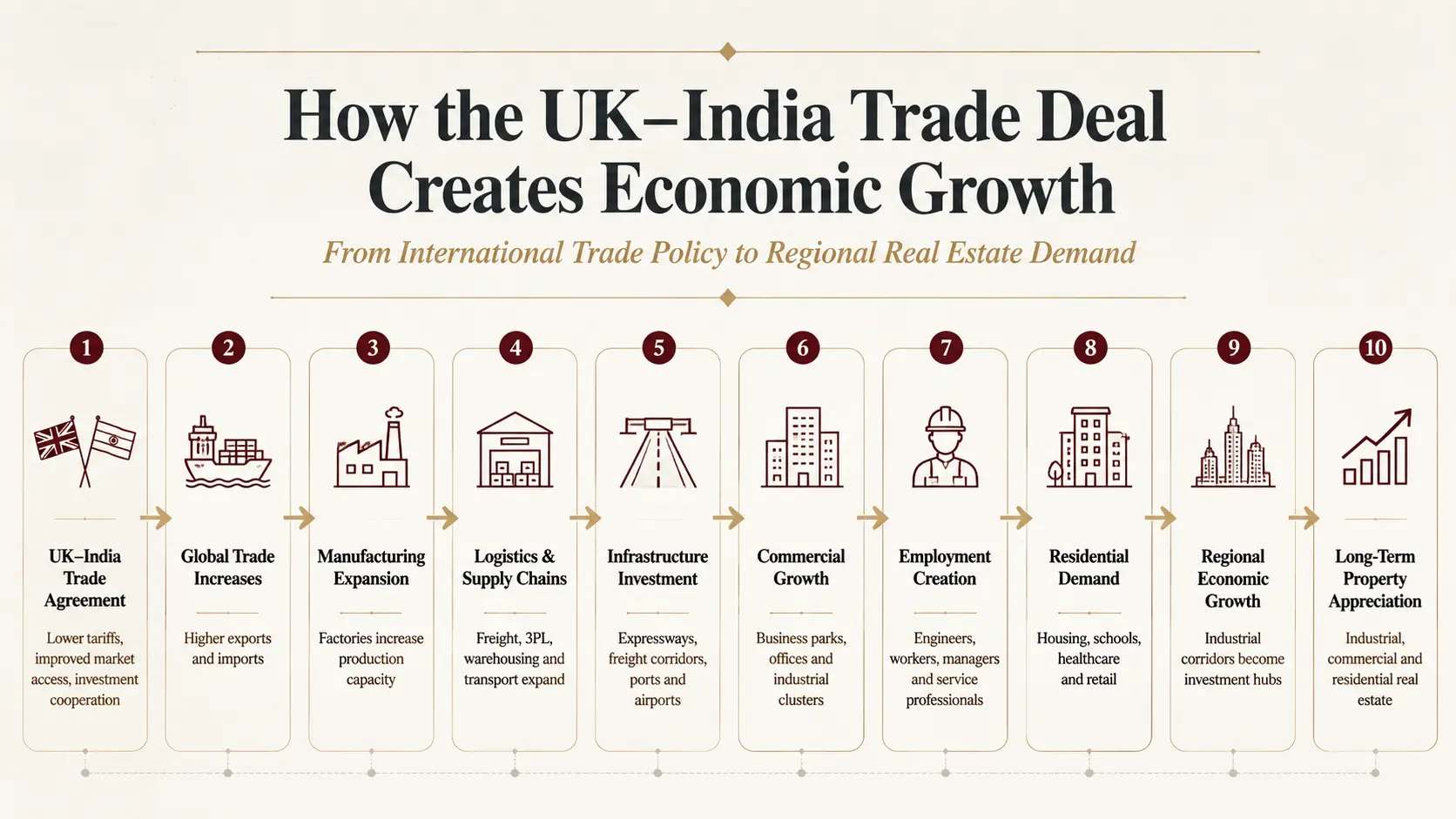
From an investor’s perspective, macroeconomic policy does not exist in a vacuum.
The reduction of a single tariff percentage point can stimulate a multi-year domino effect. This structural pipeline demonstrates exactly how a geopolitical signature translates into rising regional land values.
Most people assume trade agreements only affect exporters. In reality, every additional shipping container needs a factory to produce it, a warehouse to store it, trucks to move it, highways to carry it, offices to manage it, and ultimately homes for the people employed throughout that supply chain.
“Trade agreements don’t create demand for real estate overnight—they create demand for businesses, and businesses create demand for space.”
Understanding this sequence helps investors identify opportunities before markets fully price them in.
3. Industries Likely to Benefit the Most
To predict where land values and leasing rates will rise, investors must track the capital. The zero-tariff environment disproportionately benefits specific industrial sectors. When export margins improve, these businesses are the first to expand their physical footprint.
🚗 Automobile & Auto Components
The UK remains a primary market for precision Indian engineering. Zero-duty access allows domestic component manufacturers to scale their output rapidly to supply British automotive assembly lines.
The business impact is a direct surge in demand for heavy manufacturing facilities near dedicated freight corridors, particularly in established hubs like Greater Noida and Manesar.
👕 Textiles & Apparel
Historically operating on thin margins, labor-intensive export sectors are the immediate winners of tariff eliminations. Exporters suddenly find their products highly competitive on British high streets.
The infrastructure impact requires consolidating scattered urban workshops into modern, compliant facilities within designated economic zones to meet strict UK labor standards.
⚙️ Engineering Goods
India’s engineering exports represent a strong growth vector under CETA. From industrial machinery to electrical components, the removal of non-tariff barriers accelerates cross-border procurement.
The real estate impact means manufacturers scaling to meet this demand will require specialized production corridors that offer robust power grids and access to multimodal logistics.
💻 IT & Professional Services
Easier visa regulations and mutual recognition of professional qualifications streamline cross-border operations. The UK is already one of the largest consumers of Indian tech talent.
The investment impact drives financial, legal, and tech consultancy firms to lease Grade-A office spaces in commercial hubs to accommodate increased bilateral deal flow.
💊 Pharmaceuticals & Chemicals
India is a global pharmacy, and the UK’s National Health Service (NHS) represents a massive procurement pipeline. Fast-tracked approvals mean faster market entry for Indian bulk drugs.
The operational impact necessitates highly regulated, specialized industrial corridors equipped for chemical refinement, strict effluent treatment, and cold-chain transport.
🍽️ Food Processing
Improved market access for agricultural products and processed foods forces the domestic industry to upgrade its compliance and packaging standards to meet UK supermarket regulations.
The zoning impact dictates that processors will migrate from unapproved agricultural zones into sanctioned sectors that support advanced cold-storage logistics.
4. The Manufacturing Expansion
In reality, tariff reductions immediately alter supply chain math. When an exporter saves 10% to 15% on border duties, they generally reinvest that capital into capacity.
An engineering exporter in Faridabad or an auto-component supplier in Greater Noida faces an immediate need for larger facilities to increase production. However, to secure long-term UK contracts, they must meet strict Environmental, Social, and Governance (ESG) mandates, which cannot be achieved in congested city centres with inconsistent power grids.
This forces a migration into master-planned manufacturing ecosystems equipped with high-tension utilities and heavy transport access. Institutional occupiers conduct rigorous due diligence before acquiring these sites, making Section 80 compliance a non-negotiable prerequisite.
As production capacity expands, another challenge immediately appears. Finished goods need to be stored, consolidated, and transported efficiently. That is where logistics becomes the next critical link in the growth chain.
5. Warehousing & Logistics
You cannot digitize a shipping container.
A US$40 billion increase in bilateral trade translates to a vast physical volume of goods moving between ports, factories, and distribution hubs. India’s logistics market is already experiencing rapid absorption rates, and this geopolitical shift accelerates it further.
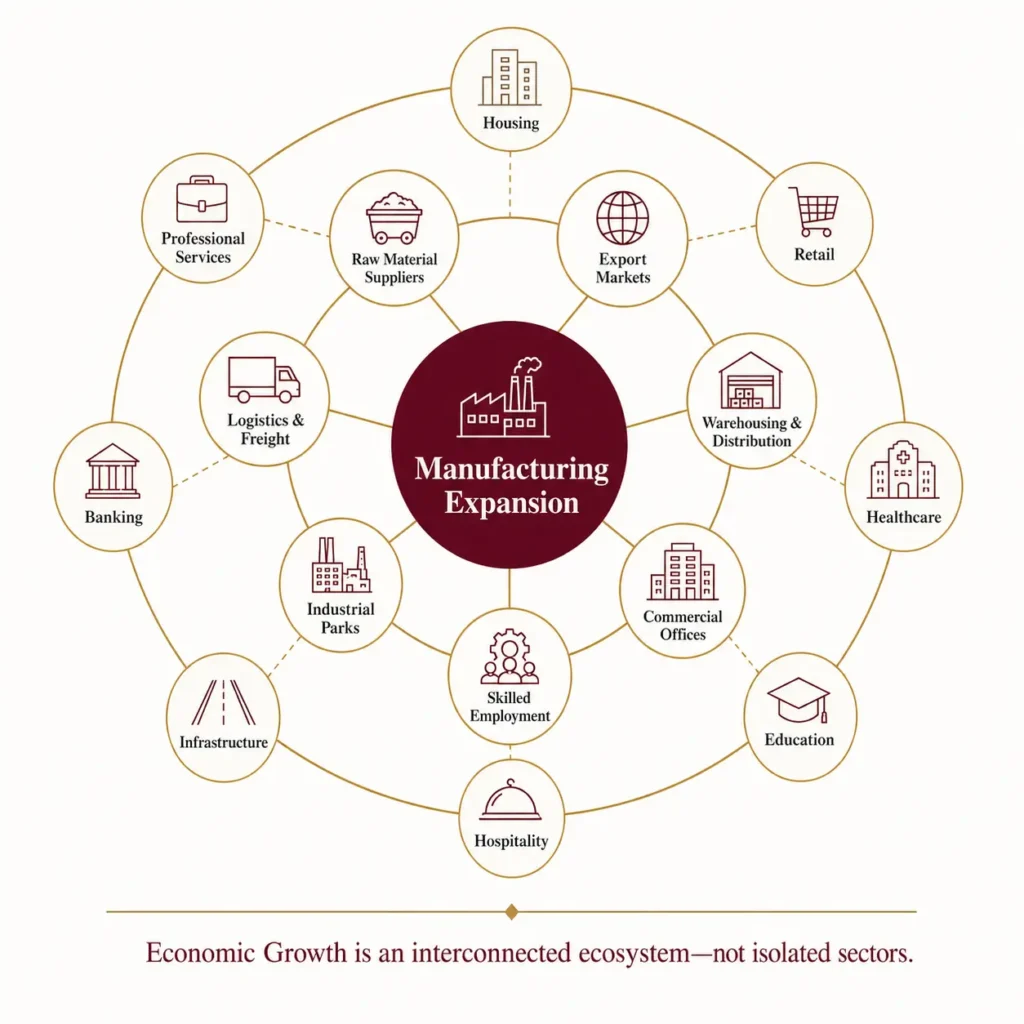
Consequently, the logistics sector serves as the physical artery for this trade agreement. Third-Party Logistics (3PL) providers, freight forwarders, and cold chain operators anticipate the supply increase. They require millions of square feet of Grade-A warehousing to buffer the expanded export and import flows efficiently.
This drives expansion near emerging industrial corridors and multimodal logistics parks. However, logistics developers cannot operate on legally ambiguous ground. To secure institutional financing and satisfy foreign corporate clients, they require sites with flawless title verification and pristine revenue records.
Key Takeaway
The UK–India Trade Deal is not a real estate policy. It is an economic policy that creates demand for manufacturing, logistics, commercial offices, infrastructure, and eventually housing. Understanding that sequence helps investors identify growth corridors before they mature.
Every warehouse ultimately depends on the physical network connecting it. Without efficient highways, freight rail, airports, and seaports, supply chains become expensive and unreliable.
6. The Infrastructure Pipeline
Imagine a gearbox manufactured in Greater Noida for a customer in Birmingham. Before it reaches the UK, it travels through an industrial road, joins an expressway, moves onto the Dedicated Freight Corridor, reaches a Multi-modal Logistics Park (MMLP), clears customs, and finally boards an international flight or maritime vessel. Every minute saved on this journey improves India’s competitiveness in global trade.
“Investors tracking infrastructure development are essentially tracking future land values.”
Over the next decade, to support this expanded trade volume, the government and private sector are aggressively scaling infrastructure. Expressways are evolving from simple transit routes into integrated economic corridors. Assets like the Yamuna Expressway and the Eastern Peripheral Expressway are no longer just roads; they are the backbones of new manufacturing clusters.
Simultaneously, the Dedicated Freight Corridor (DFC) is reducing the time it takes for a container to travel from northern hubs to western ports. Heavy engineering goods and bulk textiles that once spent days in transit can now be moved with high-velocity rail efficiency via MMLPs.
For high-value, time-sensitive exports like pharmaceuticals, electronics, and fashion apparel, air cargo is critical. The upcoming Jewar International Airport is positioned to become a dominant air freight hub, effectively anchoring the industrial expansion of the entire Yamuna Expressway region.
As infrastructure compresses travel times, corporate hubs cluster around these transit arteries.
7. Commercial Real Estate & Corporate Leasing
While physical production absorbs manufacturing and logistics spaces, the services sector manages the capital and operations.
As cross-border trade expands, multinational manufacturers, exporters, logistics companies, financial institutions, legal firms, and consulting businesses all require larger operational teams in India.
As British firms expand operations in India, demand isn’t limited to factories. Legal services, financial institutions, engineering consultancies, certification agencies, and technology providers also require office space, increasing absorption in Grade-A commercial districts.
These international firms do not operate out of secondary real estate. They mandate LEED-certified, Grade-A commercial spaces that align with their global corporate standards.
And as these corporate and industrial hubs attract thousands of professionals, they trigger the final phase of real estate appreciation.
8. Why Housing Becomes the Final Beneficiary
Real estate sectors are deeply interconnected. An expansion in manufacturing and commercial office space directly translates to large-scale job creation.
When a new multinational corporation leases 100,000 square feet of office space, or a logistics firm opens a massive distribution centre, they bring thousands of employees to that specific geographic node. This migration triggers a predictable sequence of demand.
➔
New Jobs
➔
Population Growth
➔
Housing Demand
➔
Retail & Schools
➔
Higher Land Values
Executives relocating for new corporate roles demand premium apartments and gated communities. Simultaneously, mid-level management and industrial workers require accessible housing near the manufacturing hubs.
A manufacturer choosing between two locations rarely bases the decision on land price alone. Access to expressways, freight rail, utilities, labour availability, export infrastructure, and future government investment often determines long-term operating costs. As international trade expands, these locational advantages become increasingly valuable.
“The catalyst may be a trade agreement signed in London, but the outcome is a thriving residential community in Delhi NCR.”
The UK–India trade agreement may begin as a policy decision between two governments, but its long-term effects are ultimately visible on the ground—in expanding factories, busier logistics parks, new commercial districts, growing residential communities, and the infrastructure that connects them all.
9. Why Delhi NCR is Uniquely Positioned
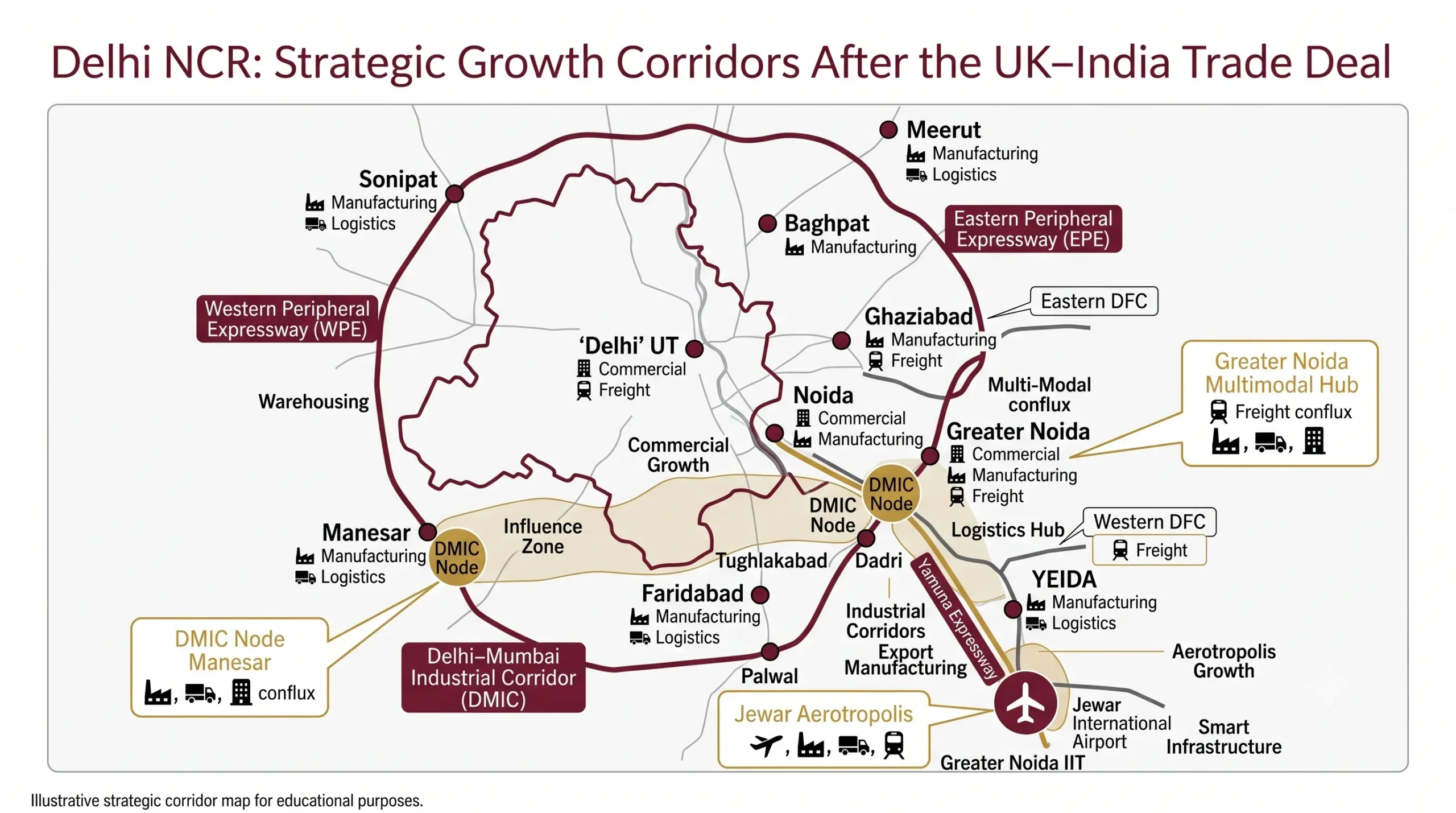
While the trade agreement benefits the entire nation, institutional capital is inherently geographic. It flows toward regions that offer a convergence of policy support, infrastructure, and a massive consumer base. Delhi NCR stands out as the prime beneficiary.
Few regions combine airports, freight corridors, expressways, manufacturing clusters, and one of Asia’s largest consumer markets within a single economic region.
Geographically, the National Capital Region is the starting point of the Delhi-Mumbai Industrial Corridor (DMIC). It sits at the convergence of the Eastern Peripheral Expressway (EPE) and the Western Peripheral Expressway (WPE), offering unparalleled bypass routes for heavy freight. Furthermore, the development of Jewar International Airport provides the critical air-cargo infrastructure required for high-value exports.
Combined with a robust professional workforce and one of the largest domestic markets in Asia, NCR provides multinational corporations and local manufacturers with an end-to-end ecosystem. They can manufacture, store, and export within a single contiguous geography.
10. Where Growth is Most Likely to Concentrate
Within the broader NCR, specific corridors are strategically positioned to absorb the physical expansion generated by the UK-India trade agreement.
Noida & Greater Noida
The established epicenter for electronics, IT services, and auto components. Greater Noida provides immediate access to the DFC and functions as the primary commercial and manufacturing anchor of the region.
YEIDA (Yamuna Expressway)
The future of logistics and heavy industry. Anchored by the upcoming Jewar Airport, this corridor is capturing institutional investments for mega-factories, data centres, and specialized economic zones.
Manesar & Gurugram
An established manufacturing powerhouse heavily integrated into global automotive supply chains. Manesar is perfectly positioned to capture expanding UK automotive and precision engineering procurement.
Baghpat & Sonipat
As Tier-1 hubs become congested, these peripheral corridors offer cost-effective, expansive land parcels ideal for warehousing, food processing, and large-scale manufacturing, supported by the EPE.
Faridabad & Ghaziabad
Traditional manufacturing powerhouses undergoing modernization. These sectors are vital for MSMEs, engineering goods, and textiles looking to scale operations and improve export compliance.
11. Challenges and Risks
Opportunity is rarely without friction. While the macroeconomic outlook is robust, businesses and real estate investors must navigate several structural challenges.
Not every business will benefit equally. Companies unable to meet international quality standards, ESG requirements, or supply chain expectations may find the competitive environment becoming more demanding despite improved market access.
Furthermore, currency fluctuations and initial supply chain adjustments will create short-term volatility. Real estate investors must also be hyper-vigilant regarding land titles; acquiring unconverted agricultural land in hopes of a quick logistical flip remains a high-risk gamble if Master Plan zoning does not align and the physical registry checks fail.
12. The Long-Term Outlook
Over the coming decade, the UK-India trade deal will shift from a diplomatic framework to a localized physical reality. To understand the trajectory, investors must look at the timeline in two distinct phases.
The Next 2–3 Years: The Production Phase
The immediate wave of capital will flow directly into physical supply chains. We will see accelerated absorption of industrial land for manufacturing expansion, a surge in demand for Grade-A warehousing and cold-storage facilities, and an intensive government focus on completing multimodal logistics parks and expressway infrastructure.
The 5–10 Year Horizon: The Urbanization Phase
As initial industrial investments mature, the secondary effects take hold. Expanded corporate operations will drive up commercial office leasing across Tier-1 hubs. Consequently, the massive influx of professional and industrial workforce will trigger sustained demand for residential housing, ultimately leading to significant land value appreciation across surrounding zoned corridors.
13. Who Should Pay Attention?
- Manufacturers & Exporters: Evaluating capacity expansion and compliance upgrades to capture UK market share.
- Logistics & Warehouse Operators: Securing strategic land banks near the DFC and peripheral expressways before institutional capital prices them out.
- Commercial Investors: Tracking leasing absorption rates and yields across Grade-A office districts and business parks.
- Industrial & Commercial Developers: Anticipating the demand for Grade-A industrial parks and premium office spaces.
- Institutional & HNI Investors: Identifying properly zoned, legally compliant land parcels with long-term infrastructure connectivity.
Planning an Industrial or Commercial Investment?
Whether you’re evaluating land for manufacturing, logistics, warehousing, commercial development, or long-term investment, VaEdifice helps businesses identify strategically located properties aligned with infrastructure growth and future demand.