
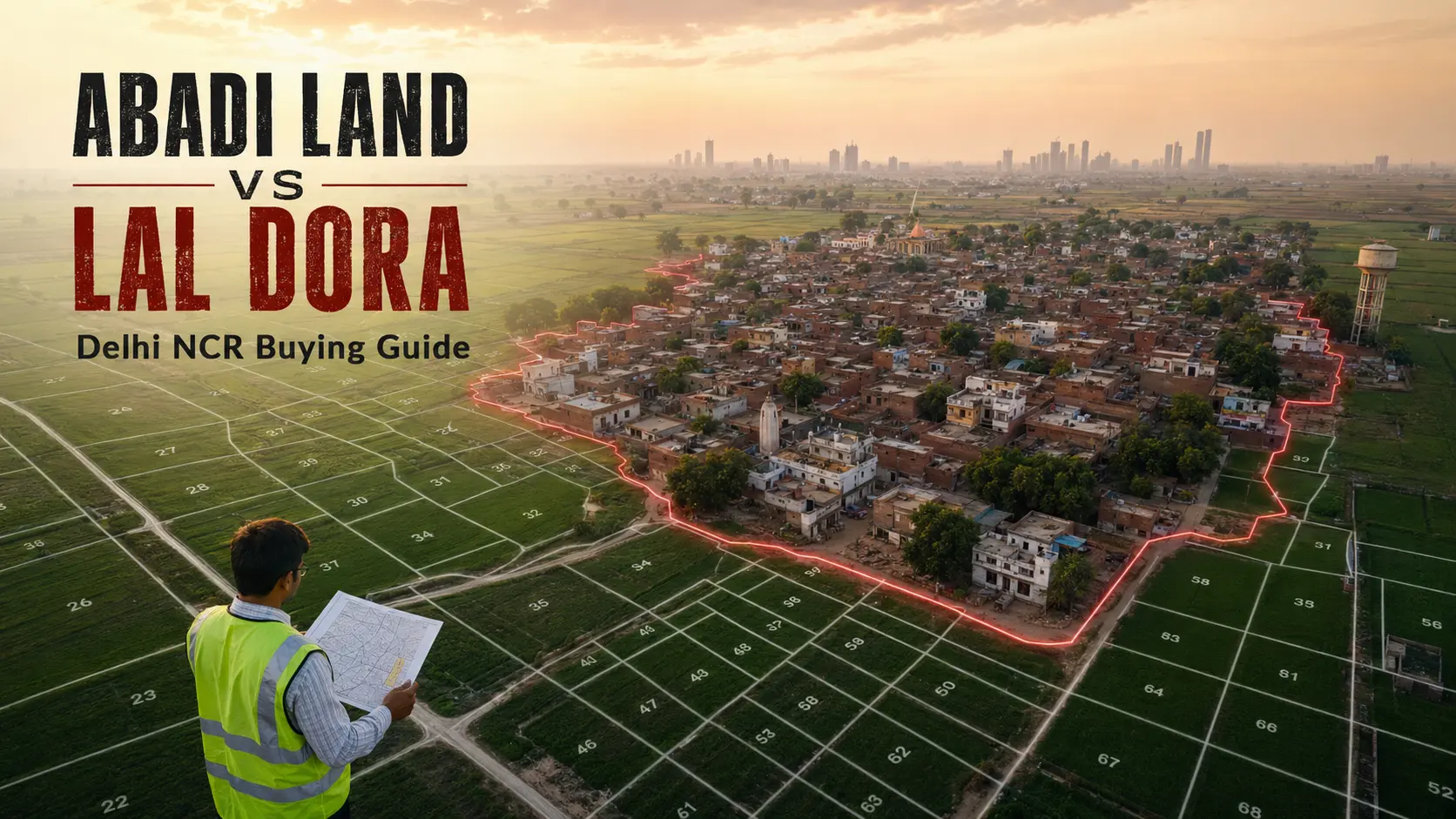
You find two nearly identical properties in Delhi NCR. One advertisement calls it Abadi Land, another says Lal Dora, while a local property dealer simply calls it “Red Tape.”
One seller insists you can build immediately, another warns banks won’t finance it, and online articles offer conflicting explanations. While these terms are often used interchangeably, they do not always mean exactly the same thing. So what do these terms actually mean—and should they influence your decision to invest?
Understanding these terms before you buy can help you avoid costly legal mistakes, financing problems, and future ownership disputes.
Executive Summary
- ✅ Abadi Land, Lal Dora, and Lal Lakir are closely related terms, but their usage varies by state and local revenue administration.
- ✅ Whether you can build, obtain financing, or transfer ownership depends on the property’s legal status, documentation, and local regulations—not simply on whether it is called “Abadi” or “Lal Dora.”
- ✅ Before purchasing, always verify ownership records, jurisdiction, access roads, and applicable development rules to avoid costly legal and financial issues.
Why This Guide Matters: Unlike many online articles that explain these terms separately, this guide compares them strictly from a buyer’s perspective—covering ownership, financing, construction, legal risks, and the practical checks you should perform before investing in village property in Delhi NCR.
Why These Terms Cause So Much Confusion
Although these terms are widely used today, they originated from an old revenue system introduced during the British administration in the early 20th century. Understanding that background helps explain why Delhi, Haryana, Uttar Pradesh, and Punjab still use different terminology for similar village land.
Historically, revenue officials needed a way to clearly separate agricultural land (which was taxed) from village habitation areas. Many village habitation areas inside these designated boundaries were subject to different administrative and building regulations than the surrounding agricultural land. Over time, different states adopted their own terminology and administrative practices for these village habitation areas.
What is Abadi Land? (Uttar Pradesh & Delhi NCR)
In standard real estate and revenue terms—particularly under the Uttar Pradesh Revenue Code—Abadi Deh refers to the inhabited residential area of a village. It is the land primarily used for villagers to build their homes and establish community utilities. Today, Abadi land may fall under different local authorities depending on urban expansion and the applicable laws.
What is Lal Dora? (Delhi & Haryana)
“Lal Dora” literally translates to “Red Thread.” This terminology is heavily used in Delhi and Haryana. In parts of Delhi NCR, some buyers and property dealers informally refer to Lal Dora properties as “Red Tape” land. Over the decades, it became famous because land within this boundary historically enjoyed certain exemptions from the strict building bylaws of urban municipal corporations.
What is Lal Lakir? (Punjab & Chandigarh)
“Lal Lakir” translates directly to “Red Line.” This is the localized terminology used across Punjab and Chandigarh. It designates the exact same concept: the habitation area of the village separated from the agricultural fields.
Although these three terms share common historical roots, they are not identical. The differences become much more important when you plan to buy, finance, or develop a property. Let’s compare them side by side.
The Master Comparison: Abadi vs Lal Dora vs Lal Lakir
To make a secure investment, you need to see exactly how these property types differ across legal, financial, and administrative lines. Here is the complete breakdown.
| Feature | Abadi Land | Lal Dora (Red Tape) | Lal Lakir |
|---|---|---|---|
| Primary States | Uttar Pradesh, Delhi NCR | Delhi, Haryana | Punjab, Chandigarh |
| Core Meaning | Inhabited residential area of a village. | Red thread boundary separating village from farmland. | Red line boundary separating village from farmland. |
| Typical Documentation | Registry / Panchayat Records / Property Card (where applicable) | Lal Dora Certificate / Property Card / Registry (where applicable) | Local Revenue Records / Property Card (where applicable) |
| Revenue Record | Historically, records and documentation varied by village and state. | Historically, records and documentation varied by village and state. | Historically, records and documentation varied by village and state. |
| Registry Status | Registry may be possible depending on state policy, documentation, and local authority requirements. | Registry may be possible depending on state policy, documentation, and local authority requirements. | Restricted; heavily reliant on unregistered agreements or consensus. |
| Mutation (Dakhil Kharij) | Depends on the applicable revenue records and digitization status. | Depends on the applicable revenue records and digitization status. | Historically very difficult without formal title documentation. |
| Building Rules | Subject to local Panchayat or Development Authority rules. | Historically exempt; now increasingly regulated by MCD/MC. | Limited regulation, but crackdowns on commercial use are rising. |
| Property Tax | Historically treated differently from surrounding urban properties; current taxation depends on local authority rules. | Historically treated differently from surrounding urban properties; current taxation depends on local authority rules. | Historically treated differently; current taxation depends on local authority. |
| Bank Finance | Difficult; relies heavily on clear registry and lender policy. | Highly restricted for major banks unless a digitized Property Card exists. | Restricted; cooperative banks may lend at higher rates. |
| Can NRI/Foreign Buyers Purchase? | Subject to applicable Indian property laws and land type. | Subject to applicable Indian property laws and land type. | Subject to applicable Indian property laws and land type. |
| Gov. Digitization | Covered under SVAMITVA Scheme (Gharauni cards). | Covered under Haryana’s “Lal Dora Mukt” and SVAMITVA. | Covered under Punjab’s “Mera Ghar Mere Naam” scheme. |
| Resale Value | Generally lower than fully approved freehold land. | Volatile; highly dependent on exact location and road width. | Low to moderate. |
| Biggest Risk | Documentation gaps and ownership disputes. | Documentation gaps and ownership disputes. | Inability to secure formal institutional financing. |
Which Government Authority Has Jurisdiction?
One of the biggest mistakes buyers make is assuming that because a property is “Abadi” or “Lal Dora,” it falls outside of government control. This is a common misconception.
Jurisdiction depends entirely on urban expansion. As cities grow, villages are absorbed into municipal limits. Depending on the exact location of the land, it will be controlled by one of the following:
- The Gram Panchayat: If the village is still rural, the Panchayat maintains the Abadi records, issues certificates, and resolves local disputes.
- Municipal Corporations (e.g., MCD in Delhi): When a village becomes “urbanized,” the Panchayat is dissolved. The Municipal Corporation takes over building regulations, taxation, and infrastructure.
- Development Authorities (e.g., DDA, Noida Authority): These bodies manage the master plan. If your Lal Dora property borders an authority’s designated development zone, their rules on right-of-way and commercial usage will apply to you.
- The Revenue Department: The Tehsildar and Patwari maintain the overall maps (Bhu Naksha) and digitization records (SVAMITVA) across all these jurisdictions.
Can You Legally Buy, Sell, and Transfer These Properties?
Yes, but the transaction process is significantly different from buying an approved city plot.
Historically, many Abadi and Lal Dora properties were transferred through informal documentation such as GPA (General Power of Attorney), Agreement to Sell, and Will rather than a registered sale deed. (Note: In 2011, the Supreme Court of India ruled that GPA sales do not convey legal title, making this method highly risky today).
Today’s Buying Standard: As a buyer, you should strongly prefer properties that can be transferred through a registered Sale Deed supported by clear ownership documentation. To execute a Registry on village land today, the seller typically must possess a clear Lal Dora Certificate, a Panchayat-issued NOC, or ideally, a modern digitized Property Card issued by the government.
Can You Build on Them? (The “No Rules” Myth)
Many buyers are attracted to Lal Dora properties because brokers tell them, “You don’t need a map approval to build.” This is only a half-truth.
If you are building a small, personal residential house inside a traditional rural Abadi, the applicable building requirements depend on the village, local authority, and current regulations.
The Commercial Trap: However, if you plan to build a commercial godown, a multi-story PG (Paying Guest) accommodation, or a factory in an urbanized Lal Dora village, you are typically not exempt. Municipal Corporations may seal, penalize, or take enforcement action against structures that violate applicable building, fire safety, or land-use regulations.
Should You Buy Abadi or Lal Dora Property?
✓ Suitable for:
- End users looking for affordable housing
- Long-term investors
- Buyers paying from their own funds
- Buyers familiar with village properties
✗ Less suitable for:
- Buyers needing immediate bank finance
- Buyers wanting zero due diligence
- Large institutional developments
Can Banks Finance Abadi & Lal Dora Properties?
This is perhaps the most searched question regarding village properties. The answer is not a simple yes or no.
Financing depends heavily on factors such as title clarity, documentation, lender policy, and the specific legal status of the property.
- Many Major Banks: Historically, major national banks have stringent collateral policies and generally do not finance properties that lack a formalized, sovereign chain of title. If the property is only backed by a Panchayat certificate or an old GPA, mainstream financing is highly unlikely.
- The SVAMITVA Impact: The landscape is changing. As states issue official digitized Property Cards (Gharauni) to villagers under the SVAMITVA scheme, these assets are slowly becoming bankable. Banks are beginning to accept these government-issued cards as valid collateral for mortgages.
- NBFCs and Cooperative Banks: Non-Banking Financial Companies (NBFCs) and local cooperative banks are often more flexible. They may offer loans on traditional Lal Dora properties if the local registry is clear, though this usually comes at a significantly higher interest rate and lower Loan-to-Value (LTV) ratio.
Understanding the legal position is only half the process. Before paying a token amount or signing any agreement, you must verify that the property’s documents, boundaries, ownership history, and local approvals match what the seller is claiming. The next section explains exactly how to do that.
How to Verify a Property Before Buying
Do not rely solely on a seller’s verbal assurances or a decades-old GPA. To safely acquire an Abadi, Lal Dora, or Lal Lakir property, you must cross-reference the physical land with local administrative records.
- Verify the Village Map (Bhu Naksha): Visit the local Tehsil or check the state’s online land records portal to ensure the specific plot actually falls inside the demarcated Lal Dora/Abadi boundary. Some sellers falsely market agricultural land on the village outskirts as “Abadi” to inflate the price.
- Check for a Property Card: Ask if the village has undergone a SVAMITVA drone survey. If it has, the seller should be able to produce an official, government-issued Property Card matching their identity.
- Verify the Chain of Ownership: Ask for previous sale deeds, inheritance documents, or family settlement records (where applicable). Ensure the current seller has a clear legal right to transfer the property.
- Confirm Jurisdiction & Zoning: Visit the local municipal corporation or development authority. Verify whether the village has been urbanized and if the land falls under a designated green belt, road-widening zone, or commercial exclusion zone.
- Assess Physical Road Access: Village properties often suffer from narrow, encroached, or unpaved approach roads that do not appear on official maps. Physically measure the access road and confirm it meets your requirements.
- Examine Utility Connections: Legitimate residential properties inside these zones should have authorized electricity meters and water connections in the current seller’s name. These bills often serve as secondary proof of historical possession.
The 4 Biggest Risks for Buyers
Even if a property looks perfect on the surface, village land carries unique operational and financial risks that standard city plots do not.
⚖️ Ownership Risk
- Disputed inheritance
- Multiple claimants
- Reliance on old GPAs
- Missing historical chain
🏦 Financing Risk
- Tier-1 loan rejection
- Poor formal documentation
- Lower bank valuation
- Higher interest rates
🏗 Development Risk
- Commercial building restrictions
- Future road widening plans
- Authority approval delays
- Lack of municipal utilities
📈 Exit Risk
- Difficult future resale
- Limited pool of buyers
- Reduced market liquidity
- Lower capital appreciation
Recent Government Initiatives Affecting Buyers
For decades, Lal Dora and Abadi lands were trapped in an informal economy. Today, state and central governments are actively trying to integrate these properties into the formal real estate market.
Through initiatives such as the SVAMITVA Scheme and similar state programs, the government is deploying Drone Mapping to establish exact physical property boundaries within village habitation zones. This massive Digitization effort allows local authorities to finally issue official, digitized Property Cards to the rightful owners.
How this affects YOU:
If the property you are evaluating has an official Property Card, it drastically reduces your legal risk. It proves the government recognizes the seller’s possession, allows you to execute a formal Sale Deed (Registry), and significantly improves your chances of securing a bank loan.
Busting the 4 Biggest Market Myths
❌ Myth: Lal Dora means there are absolutely no building rules.
✅ Reality: Building regulations depend entirely on the applicable local authority, urban expansion limits, and current zoning laws.
❌ Myth: Abadi land cannot be legally sold.
✅ Reality: It can absolutely be transferred, but the documentation requirements vary heavily depending on state policy and local records.
❌ Myth: A registered GPA (General Power of Attorney) equals ownership.
✅ Reality: The Supreme Court has explicitly ruled that a GPA alone does not legally transfer sovereign ownership of immovable property.
❌ Myth: Village land is always a safer, cheaper investment.
✅ Reality: The upfront cost may be lower, but out-of-pocket infrastructure needs and higher-interest private loans can quickly erode those savings.
The Final Buyer Checklist
If you are preparing to finalize a deal in Delhi NCR, ensure you can check off every single item on this list:
- ✓ Verify the exact chain of ownership
- ✓ Verify the registry status and history
- ✓ Verify the Property Card (if issued)
- ✓ Verify the physical approach road width
- ✓ Verify active electricity and utility connections
- ✓ Verify the current governing jurisdiction
- ✓ Verify the master plan zoning (Commercial vs Residential)
- ✓ Verify financing eligibility with your specific bank
- ✓ Verify there are no boundary encroachments
- ✓ Verify the future resale potential of the location
Acquire Premium, Legally Cleared Land with VaEdifice
At VaEdifice, we specialize in selling premium agricultural and industrial plots in Baghpat and the broader NCR. And residential plots in Noida (leasehold).
Stop risking your capital on unverified land. Secure a 100% legally cleared asset today. Call us directly at +91 92205 94889.
Frequently Asked Questions (FAQs)
What is Abadi Land?
Abadi Land refers to the residential or inhabited area of a village. Unlike surrounding agricultural land, it is traditionally used for homes and community purposes. The exact legal status, documentation requirements, and development rules vary by state and local authority.
What is the difference between Abadi Land and Lal Dora?
Abadi Land refers to the inhabited residential area of a village. Lal Dora is a term primarily used in Delhi and Haryana for village habitation areas that historically enjoyed certain administrative exemptions. While the concepts are closely related, the terminology, documentation, and applicable regulations vary by state.
Can outsiders buy Abadi or Lal Dora property?
In many parts of Delhi NCR, outsiders can purchase Abadi or Lal Dora property if the transaction complies with applicable laws and the seller has valid ownership documents. However, buyers should verify title, jurisdiction, local restrictions, and documentation before completing the purchase.
Can I get a home loan on Abadi or Lal Dora property?
Financing depends on the property's documentation, title clarity, lender policies, and legal status. Some banks and financial institutions may finance eligible properties with proper documentation, while others may decline applications for properties with unclear ownership or incomplete records.
Can I build a house on Lal Dora or Abadi Land?
Building permissions depend on the property's location, local authority, urbanization status, and applicable building regulations. Historical exemptions do not automatically allow unrestricted construction. Always verify the current rules before starting any development.
Is Lal Dora property freehold?
Not necessarily. Whether a property is freehold depends on its title, documentation, and applicable laws—not simply because it lies within a Lal Dora area. Buyers should verify the property's ownership documents and legal status before proceeding.
Is a GPA enough to buy Lal Dora property?
A General Power of Attorney (GPA) does not by itself transfer ownership. Buyers should verify that the transaction is supported by legally valid documentation appropriate to the property's circumstances rather than relying solely on a GPA.
What documents should I verify before buying Abadi or Lal Dora property?
Buyers should verify the registered sale deed (where applicable), previous ownership documents, available revenue records, jurisdiction, road access, utility connections, applicable approvals, and any Property Card issued under government digitization initiatives, where available.
Is buying Abadi or Lal Dora property safe?
Yes—provided thorough due diligence is completed. Buyers should verify ownership, jurisdiction, documentation, road access, financing eligibility, and applicable development rules before making any payment. The level of risk depends on the individual property's legal status rather than whether it is called Abadi Land or Lal Dora.