
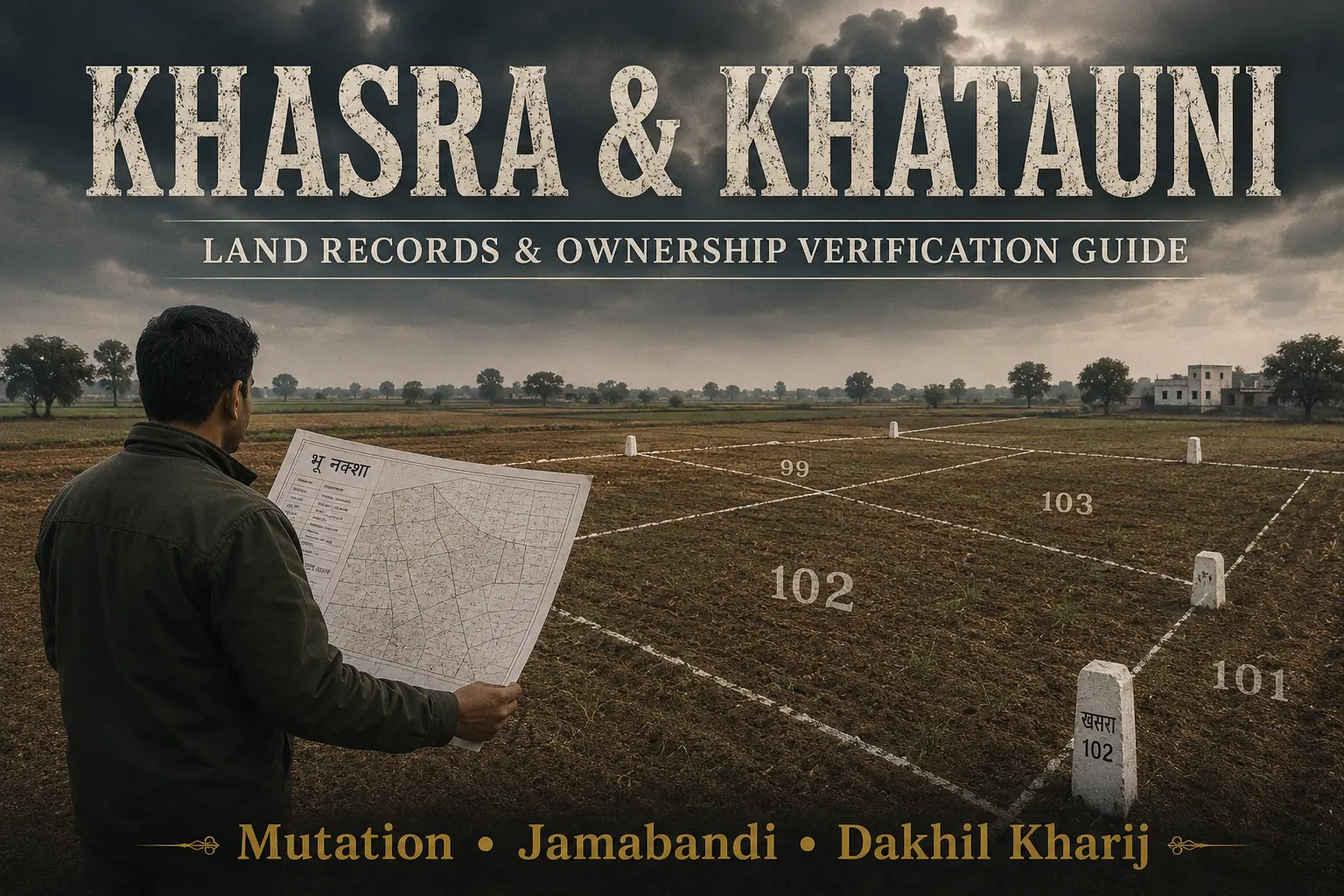
Imagine you’ve just purchased a plot of land. The registered sale deed is safely in your hand, but months later, you discover the seller’s name still appears in the government’s revenue records. At that point, selling the land, obtaining financing, or applying for Section 80 conversion can become difficult, leading to delays, disputes, and additional costs.
During land transactions, buyers often hear terms like Khasra, Khatauni, Jamabandi, and Dakhil Kharij (also known as Intkal in many states). Many assume these are just routine paperwork. In reality, these land revenue records determine whether your asset can legally be sold, developed, financed, or converted for future use. Together, these documents form part of the state’s Record of Rights (RoR), the official system used to record land ownership and related revenue details.
Although different states use different terminology for land revenue records and mutation processes—such as Khasra, Khatauni, Jamabandi, Record of Rights (RoR), Dakhil Kharij, and Intkal—the underlying objective remains the same: to accurately identify land, record ownership, and maintain the legal history of property transfers.
Key Property Ownership Records You Need to Know:
- Khasra: The official survey number assigned to a specific parcel of land. It identifies the land’s exact location, boundaries, and area.
- Khatauni / Jamabandi: The government’s official ownership record showing exactly who owns each Khasra number and related land details.
- Dakhil Kharij (Mutation): The legal process of updating the government’s revenue records with your name after a property transfer.
One of the most common—and expensive—mistakes land buyers make is assuming that a registered sale deed is the final step in a transaction. In reality, a registered sale deed alone does not prove that every revenue record has been correctly updated.
Whether you’re buying agricultural land, a farmhouse plot, an industrial site, or an investment property, these records should always be verified before paying any advance or signing an agreement. Understanding these records is one of the most effective ways to avoid expensive legal disputes and ownership complications.
At VaEdifice, verifying revenue records is a standard part of our land due diligence before we recommend any transaction to a client. Whether you are a first-time buyer, an investor, or a business acquiring land, understanding these records can save months of legal complications and unexpected costs.
In this guide, you will learn:
- How to independently verify the Khasra (Physical Reality) and Khatauni (Ownership Ledger).
- A complete pre-acquisition due diligence checklist to avoid hidden liens and zoning traps.
- Why Dakhil Kharij (Mutation) is a critical, non-negotiable step after the registry.
- The exact legal differences between a Registered Sale Deed and Mutation.
- How these foundational revenue records dictate your Section 80 (Change of Land Use) approval.
Executive Summary: Verifying Your Land Records
- Verify the Land Records (Khasra & Khatauni/Jamabandi): You must verify through the official revenue records that the land’s physical boundaries match its recorded ownership details before paying any token amount.
- Complete the Transfer (Dakhil Kharij): Holding a registered sale deed is not enough. The mutation process must be completed in the state’s revenue records. Until then, the previous owner’s name may continue to appear in the official records.
- The Section 80 Connection: Accurate and up-to-date Khatauni records, along with a completed Dakhil Kharij, are generally required before a Section 80 application can proceed. If these records are outdated, local authorities are likely to reject or delay any application to convert the land for non-agricultural use until the records are corrected.
1. How to Verify Khasra and Khatauni Before Purchasing Land
Before buying any land, never rely solely on what a seller or broker tells you. Always verify the two most important records yourself: the Khasra, which identifies the land parcel, and the Khatauni (or Jamabandi), which records its ownership.
Verifying the Khasra Number (The Physical Reality)
Sometimes a property may be advertised as perfectly rectangular or located on a main road. Always verify these claims using the Khasra number and the official cadastral map (Bhu Naksha).
By independently checking the Khasra on the state’s digital maps, you might discover that the plot is actually triangular, significantly smaller than advertised, or overlaps with a proposed government highway alignment.
The Ecological & Zoning Warning: Verifying the Khasra number is one of the most important steps in confirming whether the land falls within environmentally restricted or regulated areas (such as the Yamuna or Hindon floodplains). Purchasing land in restricted ecological zones can expose buyers to serious legal restrictions, enforcement action, and, in some cases, demolition of unauthorized structures.
Auditing the Khatauni / Jamabandi (The Ownership Record)
While the Khasra defines the land, the Khatauni (or Jamabandi in states like Haryana and Punjab) defines the ownership. It is the official government record of ownership for that land. Whether using portals like UP Bhulekh or checking physical records, every buyer should verify these critical details:
- The True Khatedar (Owner): Does the name on the Khatauni exactly match the name of the person trying to sell you the land? If there are multiple co-owners listed, you must secure legally binding consent from every single one of them.
- Hidden Liens (Pravishthi / Remarks): The remarks column of a Khatauni will indicate if the land has been pledged as collateral for a bank loan (often marked as Rahannama). The existence of a charge or mortgage can significantly affect your rights and should be resolved before completing the transaction.
- Active Legal Disputes: Beyond the ledger, buyers should use systems like the Revenue Court Management System (RCMS) to ensure there are no active stay orders or Gram Samaj (village council) disputes tied to the property.
- Land Classification: The ledger will state whether the land is classified as agricultural (Krishi) or non-agricultural (Gair-Krishi / Abadi). Never assume the current use of the land matches its legal classification. Always verify the revenue records.
The Pre-Acquisition Due Diligence Checklist
Before paying any advance or signing an agreement to sell, verify the following. No single document is sufficient on its own. A complete due diligence process involves verifying all of these records together before committing to a purchase.
- ✓ The Khasra number geometry via Bhu Naksha (Cadastral Map).
- ✓ The physical area matches the sale documents perfectly.
- ✓ The Seller’s name is actively listed in the latest Khatauni.
- ✓ Consent is available from all listed Co-owners (if any).
- ✓ The Mortgage/Remarks column is clear of active bank loans.
- ✓ The official Land Classification (Krishi vs. Gair-Krishi) is confirmed.
- ✓ The latest mutation status is up to date.
If the Khasra details match the land on the ground and the Khatauni accurately reflects ownership, you can move to the next stage of due diligence with greater confidence. But holding a clean Khatauni before purchase is only half the battle.
What happens after you sign the registry? This brings us to the most dangerous assumption in Indian real estate: the “Unregistered Owner” fallacy.
2. The “Unregistered Owner” Fallacy: Why Dakhil Kharij is Non-Negotiable
You have verified the Khatauni, verified the Khasra, and successfully registered the sale deed at the Sub-Registrar’s office. You have paid the stamp duty, and the registered sale deed has your name on it. Many buyers believe the transaction is now 100% complete.
This is a critical misunderstanding of Indian property law. A registered sale deed transfers the title, but it does not automatically update the government’s revenue records. Until your name replaces the seller’s name in the state’s official ledger, you are vulnerable to the “Unregistered Owner” trap.
What is Dakhil Kharij (Mutation)?
Dakhil Kharij (often called Intkal or Mutation) literally translates to “entering and striking out.” It is the legal, bureaucratic process where the Revenue Department strikes out the previous owner’s name from the Khatauni and enters your name as the new rightful owner. This process ensures that the government’s revenue records accurately reflect the current owner of the property.
Registry vs. Dakhil Kharij (Mutation): What’s the Difference?
| Feature | Registered Sale Deed (Registry) | Dakhil Kharij (Mutation) |
|---|---|---|
| Purpose | Legally transfers the property title from seller to buyer. | Updates the state’s revenue ledger to reflect the new owner. |
| Where it happens | Sub-Registrar’s Office | Tehsildar / Revenue Department |
| Section 80 Impact | Not sufficient on its own for land conversion. | Revenue records generally need to be updated before Section 80 applications can proceed. |
In simple terms, the Registry transfers ownership between the buyer and seller, while Dakhil Kharij updates the government’s revenue records to reflect that transfer. Both are essential parts of a complete property transaction.
The Risk of Delay: If mutation is delayed, outdated revenue records can create confusion regarding ownership and may increase the risk of disputes or fraudulent transactions. Completing Dakhil Kharij promptly helps reduce these risks.
The Mutation Process and Timeline
The exact procedure differs by state, but generally involves submitting the registered sale deed, identity documents, and the prescribed mutation application to the local revenue authority.
In many cases, the mutation process includes a public notice period during which objections may be invited before the revenue records are updated. The exact procedure and timelines vary by state and local revenue rules.
One of the clearest indicators that the mutation process has been completed is being able to obtain an updated Khatauni showing your name as the recorded owner.
The Prerequisite for Transformation
Beyond protecting against fraud, completing Dakhil Kharij is an operational necessity if you plan to develop the land. Many government approvals and land-related applications require the applicant’s name in the revenue records to match the ownership details. Completing Dakhil Kharij helps prevent unnecessary delays.
For example, in Uttar Pradesh, an incomplete mutation may prevent or delay a Section 80 application because the revenue records must accurately reflect the applicant’s ownership.
3. The Final Step: Why Section 80 Matters After Khasra, Khatauni, and Dakhil Kharij
Verifying the Khasra and executing the Dakhil Kharij are not the final destinations; they are the mandatory prerequisites for the ultimate goal: officially changing the land’s legal use where required.
As explained in our detailed Section 80 guide, agricultural land in Uttar Pradesh must now be converted under Section 80 of the Uttar Pradesh Revenue Code, 2006, before it can legally be used for many non-agricultural purposes. Because this process relies on the revenue records, errors in the Khatauni or an incomplete Dakhil Kharij can delay or prevent the application.
If the revenue records are incomplete or inaccurate, the application may be delayed, returned for correction, or rejected until the issues are resolved. The revenue timeline is a strict domino effect—a failure at the foundational level jeopardizes the final conversion.
What Happens After Khasra, Khatauni, Mutation, and Section 80?
Once the Khasra is verified, the Khatauni is confirmed, the registry is completed, the mutation (Dakhil Kharij) is updated, and Section 80 is approved (where required), the property is generally better positioned for:
- Residential development
- Industrial and commercial use
- Securing financing and bank loans
- Future resale
- Inheritance planning
If you’re considering industrial investment after completing the legal due diligence described in this guide, you may also find these resources useful:
- The Ultimate Guide to the Baghpat Industrial Area
- Sahibabad Site 4 Construction Costs
- India Real Estate Institutional Capital Cycle
Buying land is not just about signing a registry. Think of the process as a chain: Khasra identifies the land, Khatauni confirms ownership, the registered sale deed transfers title, Dakhil Kharij updates the revenue records, and Section 80 (where applicable) enables lawful land use. Breaking any link in this chain can create costly delays, disputes, or restrictions later.
Acquire Premium, Legally Cleared Land with VaEdifice
You shouldn’t have to navigate the complex web of revenue records, mutations, and hidden title traps alone. At VaEdifice, we specialize in selling premium agricultural and industrial plots in Baghpat and the broader NCR.
Stop risking your capital on unverified land. Secure a 100% legally cleared asset today. Call us directly at +91 92205 94889.
Frequently Asked Questions (FAQs)
Can land be legally sold if the mutation (Dakhil Kharij) is still pending?
A registered sale deed may still be executed in some situations even if mutation is pending. However, buyers should proceed with caution. Before completing the transaction, verify the seller's ownership, the latest revenue records, and whether the pending mutation creates any legal or practical issues for the property.
I hold the registered sale deed. Does that serve as absolute proof of ownership?
No. While a registered sale deed legally transfers the title from the seller to you, it does not by itself update the government's revenue records. Completing Dakhil Kharij ensures the revenue records reflect the ownership transfer, making it easier to complete future land-related applications, financing, and due diligence.
Can I apply for Section 80 land conversion before completing Dakhil Kharij?
In Uttar Pradesh, accurate revenue records are generally required before a Section 80 application can proceed. If the mutation has not been completed or the Khatauni contains errors, the application may be delayed or returned until the records are corrected.
What is the difference between Khatauni and Jamabandi?
Both documents serve a similar purpose by recording land ownership and related revenue details. The terminology varies by state. Uttar Pradesh commonly uses Khatauni, while Haryana and Punjab generally use Jamabandi. Although the names differ, their purpose is broadly the same.
What is the difference between Registry and Mutation?
A Registry (Registered Sale Deed) is the legal document that transfers property title from the seller to the buyer. Mutation (Dakhil Kharij) is the subsequent administrative process of updating the government's revenue records to reflect that new ownership.
Is Khasra the same as Khatauni?
No. A Khasra identifies a specific parcel of land, while a Khatauni records ownership details for one or more Khasra numbers. Both documents are important during land verification.
Can I buy land if there are multiple owners listed in the Khatauni?
Yes, but only after confirming that all recorded owners have legally consented to the transaction or have properly authorized the sale. Purchasing land without the necessary consent from all owners can lead to ownership disputes and future legal complications.
How do I verify Khatauni and Khasra online in Uttar Pradesh?
For properties in UP, you can verify the official Record of Rights (Khatauni) by searching the owner's name or plot number on the state's UP Bhulekh portal. To verify the physical plot geometry, you must cross-reference that specific Khasra number on the state's digital Bhu Naksha portal. Always verify that the information matches the registered sale documents and the physical property before completing the transaction.
How long does the mutation (Dakhil Kharij) process usually take?
The timeline varies by state and local revenue procedures. In many cases, the process includes a public notice period during which objections may be invited before the revenue records are updated. Buyers should check the applicable rules in their jurisdiction.