
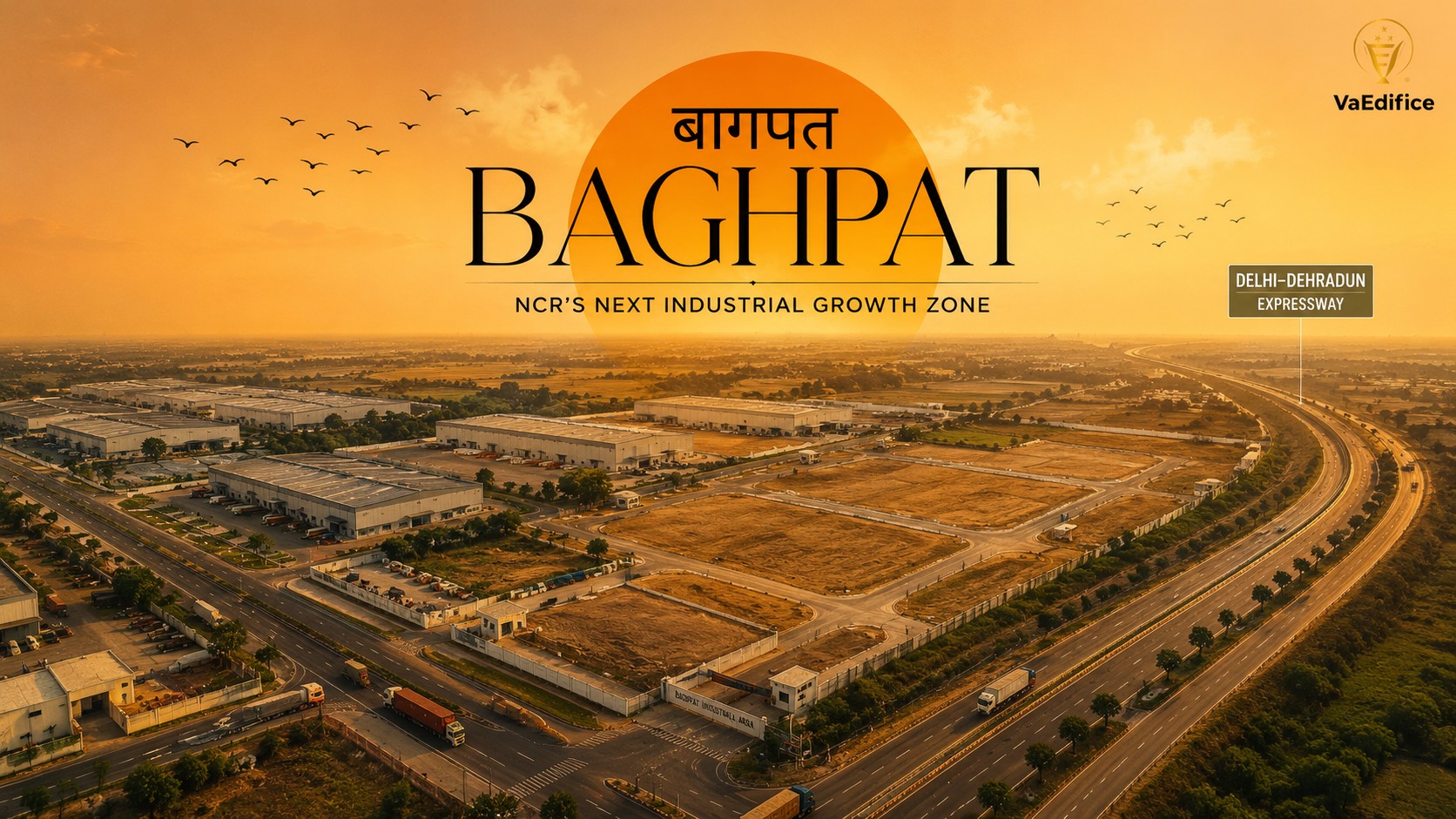
A structural shift is remapping the industrial geography of the National Capital Region. With core corridors reaching pricing maturity, institutional capital is aggressively opening a new, high-yield logistics frontier: the Baghpat Industrial Area. Driven by the inauguration of the Delhi-Dehradun Expressway, industrial land valuations in this micro-market have already surged 20% to 30%. Financial forecasts project an explosive 50% to 60% capital appreciation within the next 12 months.
Positioned directly on the eastern bank of the Yamuna River, this district is transitioning rapidly from an agrarian baseline into a high-throughput manufacturing hub. Anchored by billions in corporate acquisitions and massive state infrastructure spending, it offers a rare commodity in the modern NCR: unencumbered, sovereign freehold land at scale.
This guide completely decodes the region, detailing the exact 2025 Building Byelaws, the mechanics of freehold land banking.
Geographic Validation & The Expressway Catalyst
The Strategic Pivot: Baghpat vs. Noida
The foundational question for foreign and domestic investors mapping this territory is straightforward: Is Baghpat in the NCR? Yes. Baghpat is officially a notified district within the National Capital Region. It shares immediate, porous borders with Delhi, Ghaziabad, and Meerut, placing it directly within the infrastructure pipeline of the NCR Planning Board. Specifically, nodes like the Khekra industrial area are absorbing the immediate overflow of capital exiting the congested capital core.
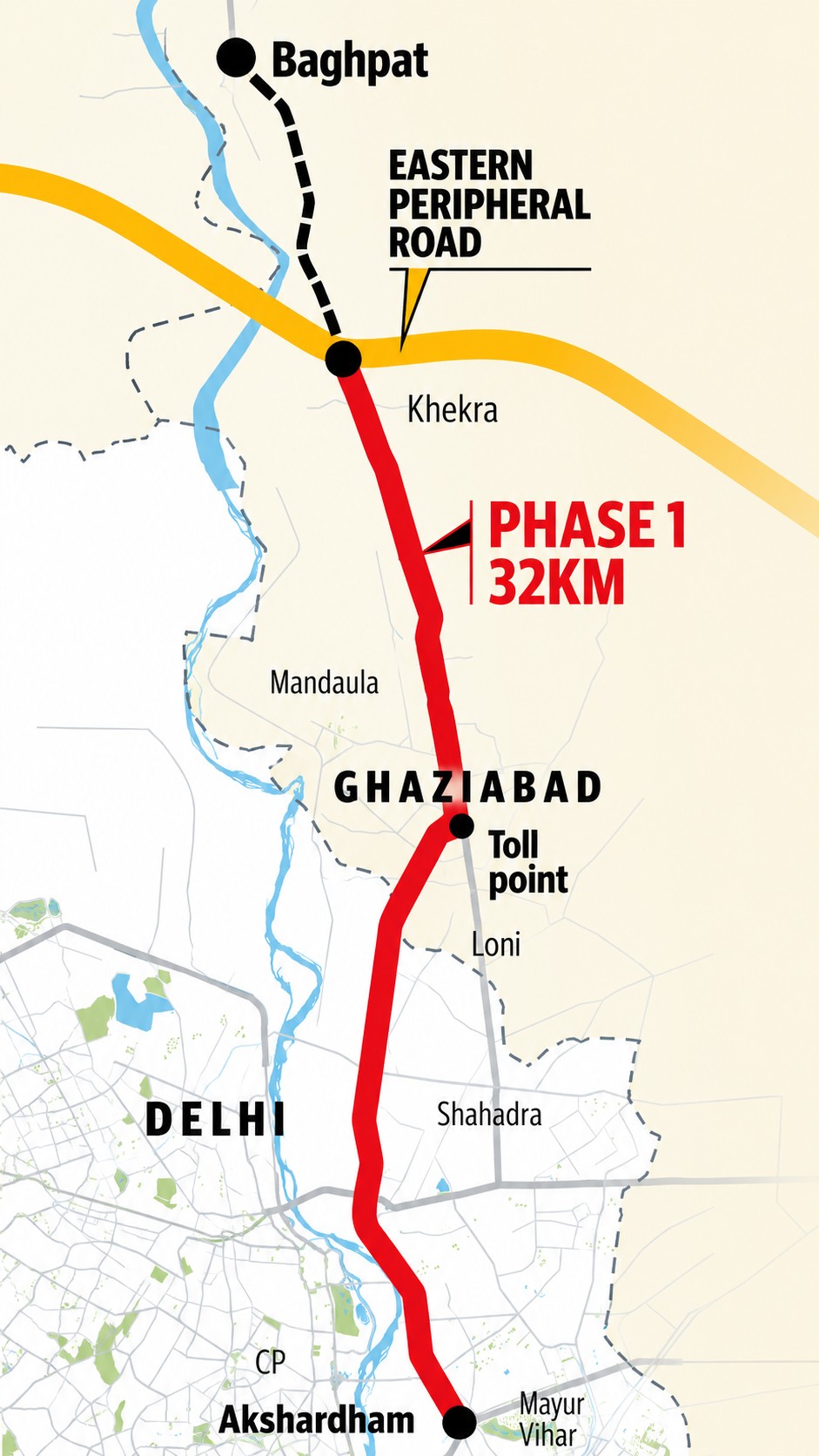
The true catalyst driving the projected 60% valuation surge is the Delhi-Saharanpur-Dehradun Economic Corridor (NH-709B). This multi-thousand-crore expressway alters the logistics of freight movement across North India, bringing Baghpat to within a mere 40 kilometers of the Delhi core.
| Expressway Phase | Section Details | Strategic Relevance for Baghpat |
|---|---|---|
| Phase 1 | Akshardham (Delhi) to Baghpat (32 km) | 12-lane stretch providing heavy-freight connectivity. Cuts transit time from Delhi to under 40 minutes. |
| Phase 2 | Baghpat to Saharanpur (118 km) | 6-lane spine with seven interchanges, opening vast tracts of land for warehousing and 3PL staging. |
By utilizing the NH-709B corridor, manufacturers and fast-moving consumer goods (FMCG) operators can now execute daily replenishment cycles into the Delhi consumer market without facing the severe bottlenecks historically associated with western UP transit routes.
NH-709B Infrastructure Yield Metrics
Delhi-Baghpat Expressway Corridor Data (2025-2026)
Transit Time to Delhi
40 Mins
▼ 88% Reduction via Phase 1
Current Value Surge
+25%
Post-Inauguration Baseline
12-Month Projection
+60%
Fiduciary Capital Appreciation
VaEdifice Inventory: Plot Sizes & The Aggregation Strategy
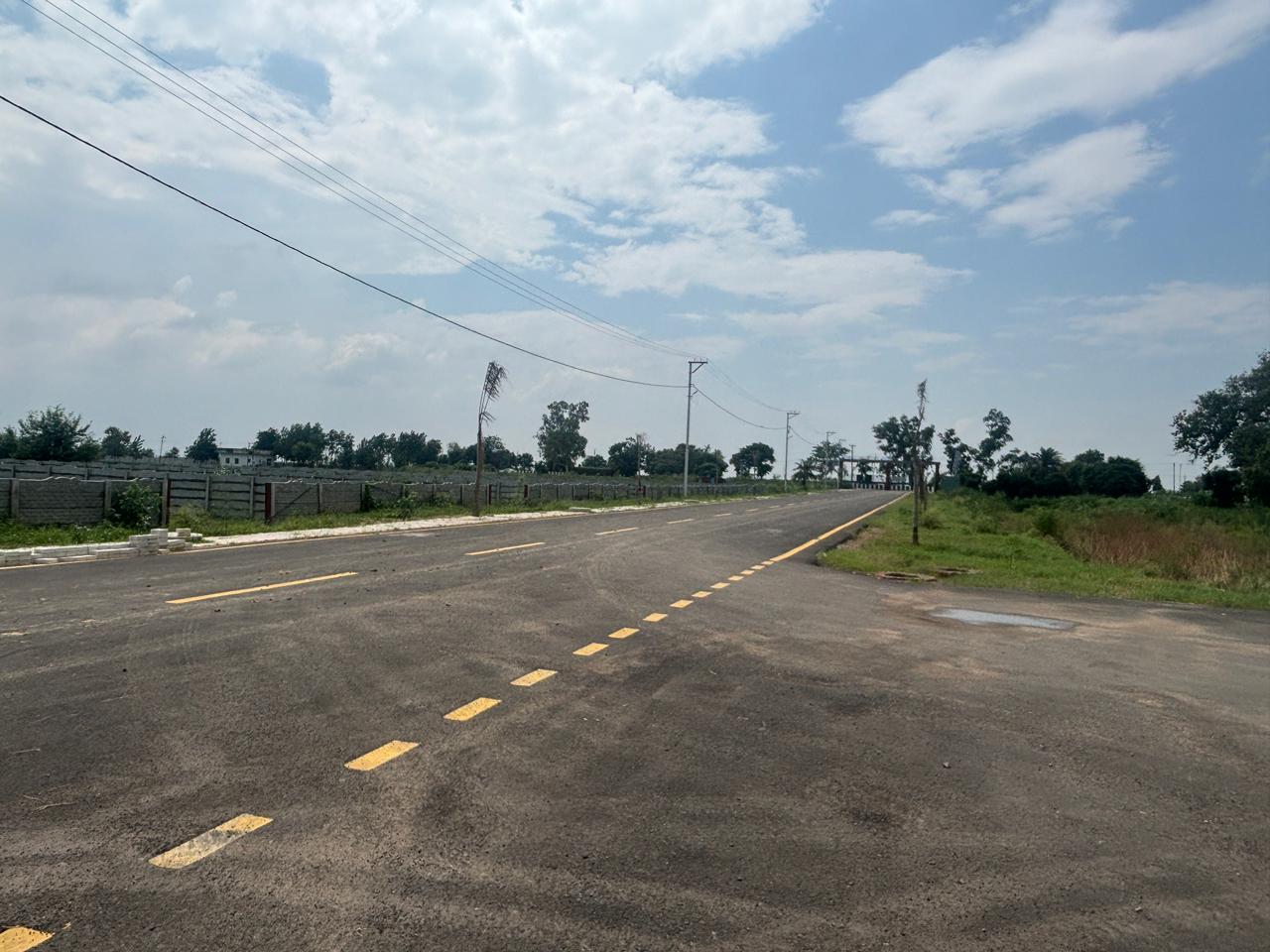
Before analyzing the regulatory byelaws, investors must understand the acquisition reality on the ground. To accommodate the heavy logistics required by modern manufacturing, premium developers and institutional land bankers are exclusively cutting industrial plots on broad 12-meter (40 ft), 18-meter (60 ft), and 24-meter (80 ft) internal roads.
While the development authorities stipulate no maximum cap on plot size, acquiring massive, unbroken tracts of prime notified land in a single transaction can be complex. Consequently, institutional buyers frequently employ a strategic aggregation maneuver. For instance, if a corporate manufacturer requires an 1,800 sq. yard footprint, the most viable and legally secure path is to acquire and merge adjacent modular plots.
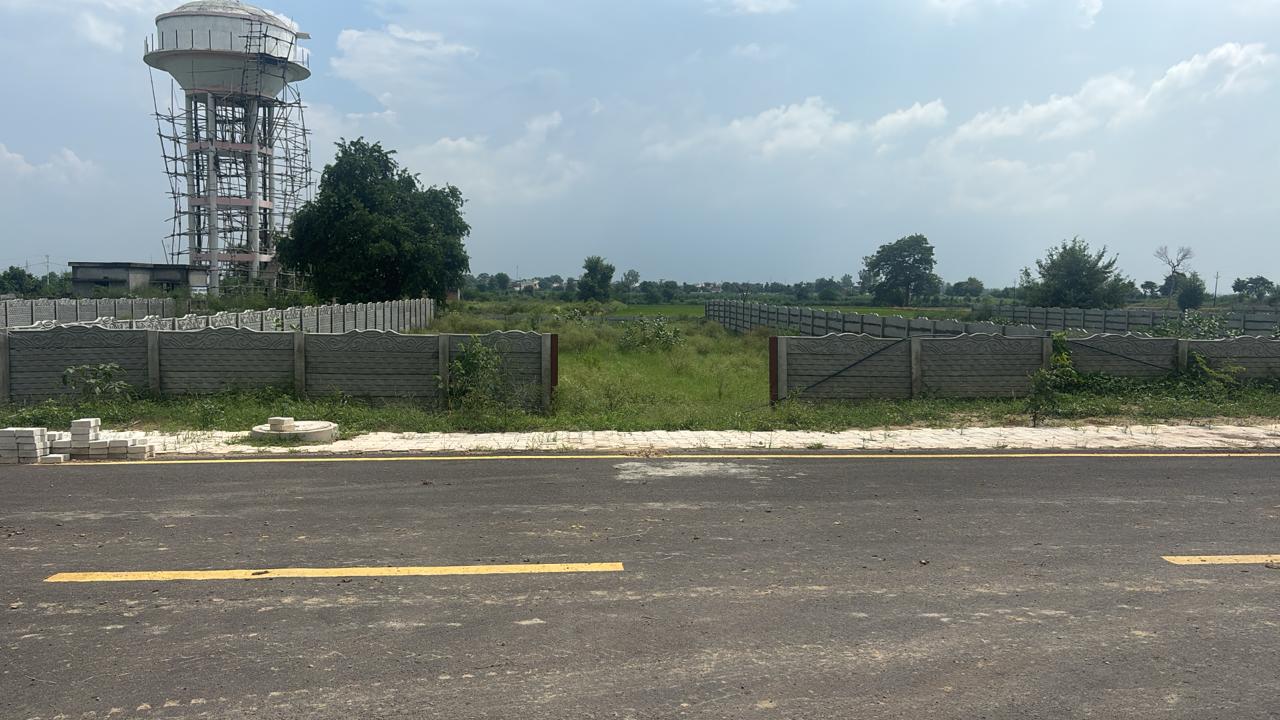
To facilitate this, VaEdifice currently holds an exclusive inventory of due-diligence cleared, freehold industrial plots tailored to the most liquid dimensions demanded by the market:
- Compact MSME Yield: 300 sq. yards & 358 sq. yards
- Mid-Tier Logistics: 550 sq. yards & 800 sq. yards
- Heavy Manufacturing Scale: 1,100 sq. yards & 1,500 sq. yards
These parcels are exclusively zoned for non-polluting factories, ensuring pristine regulatory standing and immediate operational deployment upon acquisition.
Corporate Validation: The Billionaire Land Grab
Smart money does not wait for the government to finish roads before buying land; it executes acquisitions years in advance to capture the infrastructure alpha. Baghpat development is already anchored by some of the largest conglomerates in the world. This influx of “Tier-1 capital” forces the rapid development of secondary infrastructure, generating a massive SME ecosystem that currently boasts over 3,500 operational units.
| Corporate Entity | Sector / Project | Investment Scale & Impact |
|---|---|---|
| Amul (Banas Dairy) | Greenfield Dairy Plant | ₹800 Crore. Processing capacity of 8 to 10 lakh litres per day (LLPD). Reduces transit decay to Delhi. |
| Grupo Bimbo (Harvest Gold) | Bakery / Logistics Hub | ₹550 Crore. Acquired 100 bighas of land for an integrated, rapid-distribution manufacturing network. |
| Baghpat Sugar Mill | Agro-Processing & Ethanol | ₹688 Crore expansion project, establishing a 5,000 TCD ethanol plant to support regional agriculture. |
| Goyal Precision Components | Engineering (Al/Zn Casting) | ₹90 Crore investment. Expected annual turnover of ₹500 Cr, signaling a move into high-value engineering. |
| Whitefield Chemicals | Formaldehyde Production | Capacity of 100 MT/day. Situated on prime UPSIDA plots (B-47 to 49) utilizing established area utilities. |
These acquisitions are not isolated events. They represent a coordinated institutional pivot toward UPSIDA Baghpat zones, proving that the region has achieved the critical mass necessary to function as a primary Delhi NCR industrial area.
Institutional Capital Deployment
Notified Corporate Acquisitions in Baghpat
Greenfield Dairy Plant
Agro-Processing & Ethanol
Harvest Gold Logistics Hub
The 2025 Baghpat Building Byelaws: A Technical Audit
To accurately calculate the Gross Development Value (GDV) of a prospective site, investors require unvarnished regulatory data. Industrial developments in the region are governed by the Uttar Pradesh State Industrial Development Authority (UPSIDA) and the Baghpat-Baraut-Khekra Development Authority (BBKDA). According to the 2025 Building Byelaws, the framework heavily favors maximum yield and high-density growth on wide access roads.
1. Worker Housing and Height Limits
Institutional operators require scale without bureaucratic friction. Under the 2025 regulations, there is no restriction on maximum building height, subject only to standard airport funnel zone clearances. Crucially, to address workforce logistics, developers are permitted to utilize up to 20% of the total FAR strictly for in-situ worker hostels and dormitories. Furthermore, necessary operational structures like Guard Rooms or Generator Rooms can utilize up to 5% of the plot area directly within the setback margin.
2. Floor Area Ratio (FAR) Matrices
The FAR in Baghpat is exceptionally generous, with maximum ground coverage permissible after ensuring mandatory setbacks. The Base FAR (BFAR) serves as the foundation, but the Maximum Permissible FAR (MFAR)—which includes Purchasable and Premium Purchasable FAR—scales dynamically based entirely on the width of the approach road. This is why premium developments exclusively utilize 12-meter to 24-meter avenues to maximize their vertical footprint.
| Facility Type | Road Width Limit | Base FAR (BFAR) | Max Permissible FAR (MFAR) |
|---|---|---|---|
| Industrial (Other than MSME) | Up to 12 meters | 2.00 | 2.00 |
| Industrial (Other than MSME) | ≥ 12 to 24 meters | 2.50 | 5.00 |
| Industrial (Other than MSME) | ≥ 24 to 45 meters | 2.50 | 8.75 |
| Industrial (Other than MSME) | ≥ 45 meters | 2.50 | Unrestricted (UR) |
| MSME Units & Data Centers | All Standard Widths | 3.00 | Scales from 6.00 to UR |
*Note: In certified green buildings, additional FAR over and above the maximum permissible limit is legally provided.
3. Structural Setback Requirements (Height up to 15m)
To guarantee fire compliance and ensure logistics fleets have adequate maneuvering space, the authority dictates strict setback margins. These margins scale dynamically based on the total acquired plot area, forcing large-scale developers to account for adequate peripheral movement.
| Plot Area (sqm) | Front Setback (m) | Rear Setback (m) | Side-1 Setback (m) | Side-2 Setback (m) |
|---|---|---|---|---|
| < 150 | 2.0 | 0 | 0 | 0 |
| ≥ 150 to < 300 | 2.0 | 1.0 | 0 | 0 |
| ≥ 300 to < 500 | 3.0 | 2.0 | 0 | 0 |
| ≥ 500 to < 1000 | 3.0 | 2.5 | 1.5 | 0 |
| ≥ 1000 to < 2000 | 4.5 | 3.0 | 3.0 | 0 |
| ≥ 2000 to < 6000 | 6.0 | 4.5 | 4.5 | 4.5 |
| ≥ 6000 | 7.5 | 6.0 | 4.5 | 4.5 |
Ground Reality: The Delhi Exodus
The Freehold Asset Class Advantage
To build a resilient real estate portfolio, institutional investors require diversification. While Authority-allocated leaseholds serve specific operational purposes in other sectors of the NCR, Baghpat introduces a highly sought-after alternative into the matrix: Sovereign Freehold Land.
Acquiring freehold property offers a fundamentally distinct financial architecture. It allows corporate investors and MSMEs to capture 100% of the capital appreciation generated by the new expressway without the complexities of recurring lease rents or long-term deed expirations. It serves as an unencumbered, multi-generational hard asset that provides absolute operational sovereignty for the proprietor.
Future Supply: The 1,000-Hectare Mega Park
The state government is moving aggressively to formalize Baghpat’s status as a Tier-1 logistics hub, aligned with the broader Baghpat new project initiatives mapped out in the Master Plan 2031. The Uttar Pradesh Expressways Industrial Development Authority (UPEIDA) is currently executing directives to identify land for a massive 1,000-hectare Integrated Manufacturing and Logistics Park directly along the Delhi-Dehradun Greenfield Highway.
As this state-led mega-project comes online, it will trigger a secondary wave of investments in Third-Party Logistics (3PL) and Grade-A warehousing. Consequently, the surrounding independent, ready-to-move freehold plots will experience a violent secondary re-rating in value as available supply evaporates entirely.
Acquire Sovereign Freehold Plots with VaEdifice
At VaEdifice, we specialize in institutional land banking and fiduciary-grade due diligence. We are principal analysts managing an exclusive inventory of due-diligence cleared, freehold industrial plots in Baghpat. Connect with our advisory board to secure your freehold allocation before the institutional enclosure completely prices early-stage capital out of the market.
 Consult VaEdifice: +91 92205 94889
  Secure Your Allocation: info@vaedifice.com