
If a broker in Delhi NCR, Lucknow, Pune, or Bengaluru attempts to sell you “Section 143 approved” agricultural land to build a farmhouse today, terminate the meeting immediately. They are attempting to hand you a legally dead document.
The regulatory mechanics of land conversion across India—and specifically within the highly active state of Uttar Pradesh—have fundamentally mutated. With the aggressive expansion of Tier-1 peripheries and multi-thousand-crore expressway corridors, retail buyers and corporate land bankers alike are pouring immense capital into agricultural parcels. Their goal is to build premium country homes, logistics hubs, or residential plots.
While the specific nomenclature changes depending on your target market—whether you are dealing with Section 80 in Uttar Pradesh, NA Plotting in Maharashtra, or DC Conversion in Karnataka—the underlying statutory physics remain identical. Failing to understand land classification rules will effortlessly freeze your capital across any state borders.
In India, agricultural land is rigorously protected. You cannot simply acquire a scenic piece of farmland, erect a boundary wall, and commence construction. To legally lay a single brick, the land’s fundamental classification within the government’s sovereign revenue ledgers must be legally severed from “Agricultural” and formally converted to “Non-Agricultural.”
Relying on outdated bureaucracy or empty broker promises in 2026 is a mathematical guarantee for catastrophic capital loss. This is the ultimate, institutional-grade guide to land conversion, Master Plan zoning, the critical difference between Section 143 and Section 80, and the landmark March 2026 Ordinance.
Executive Summary: The 2026 Brief
- Section 143 is legally dead. It was formally repealed in 2016. Section 80 is the only active, mandatory conversion law recognized by banks and courts today.
- The March 2026 Ordinance changes the game. “Dual Approval” is dead in authority zones. If your map is sanctioned by the development authority, your land is deemed converted.
- Buying blind will trap your capital. Purchasing in an O-Zone (floodplain) or failing to verify the specific Khasra number guarantees loan rejections and authority demolitions.
1. Master Plan & Zoning: The Absolute Blueprint
The most dangerous misconception among retail land buyers is the belief that any piece of agricultural land can be converted if you simply pay the requisite government fees. This is an absolute fallacy. The physics of land conversion are completely subordinate to the statutory Master Plan of the city or district.
A Master Plan (such as the Noida Master Plan 2031 or Lucknow Master Plan 2031) is a legally binding blueprint engineered by urban development authorities. It dictates exactly how every square meter of land will be utilized over the next two decades. The Master Plan divides the geography into strict color-coded zones.
Residential (Yellow)
High conversion probability. Land here is officially earmarked for future housing colonies and residential plotting.
Commercial (Blue)
Permissible for commercial conversion (retail, offices). Section 80 here yields massive capital appreciation.
Green Belt (Green)
Conversion strictly prohibited. Zoned as a city lung or ecological buffer. Files will be rejected by the Lekhpal.
O-Zone / Floodplain
Lethal Trap. Absolutely banned by the NGT. Any structures built here will face unappealable demolition.
*Disclaimer: Master Plan color codes (like Yellow for Residential or Red for O-Zone) can vary slightly depending on the specific urban development authority. Always verify the official legend of the Master Plan you are analyzing.
Before you apply for a Change of Land Use (CLU) or revenue conversion, you must execute a strict coordinate check against the gazetted Master Plan. If the agricultural land you intend to purchase falls outside a designated “permissible” development zone, the state will never allow you to convert it. No amount of paperwork can override a formalized Master Plan.
2. The Exclusion Zones: The Floodplain Death Trap
The government actively preserves specific geographic corridors for ecological survival and future civic infrastructure. If you acquire land in these restricted sectors, the asset is effectively frozen. Institutional land bankers immediately scan for the following lethal traps:
The O-Zone (Floodplains)
When selecting land for a premium farmhouse, buyers are naturally drawn to scenic, river-adjacent parcels. Brokers exploit this by selling riverfront agricultural land at massive discounts. In official urban planning, river floodplains (such as the Yamuna and Hindon floodplains in Delhi NCR) are designated as the O-Zone.
An O-Zone is a designated ecological expansion basin for rivers. Because building here disrupts natural hydrology and causes catastrophic urban flooding, construction of any permanent nature is strictly, unconditionally banned by the National Green Tribunal (NGT). If you attempt to buy here, the Sub-Registrar will instantly reject your registry. If you manage to build a farmhouse through compromised channels, the authority will detect it via drone telemetry and execute immediate demolitions without any legal obligation to provide financial compensation.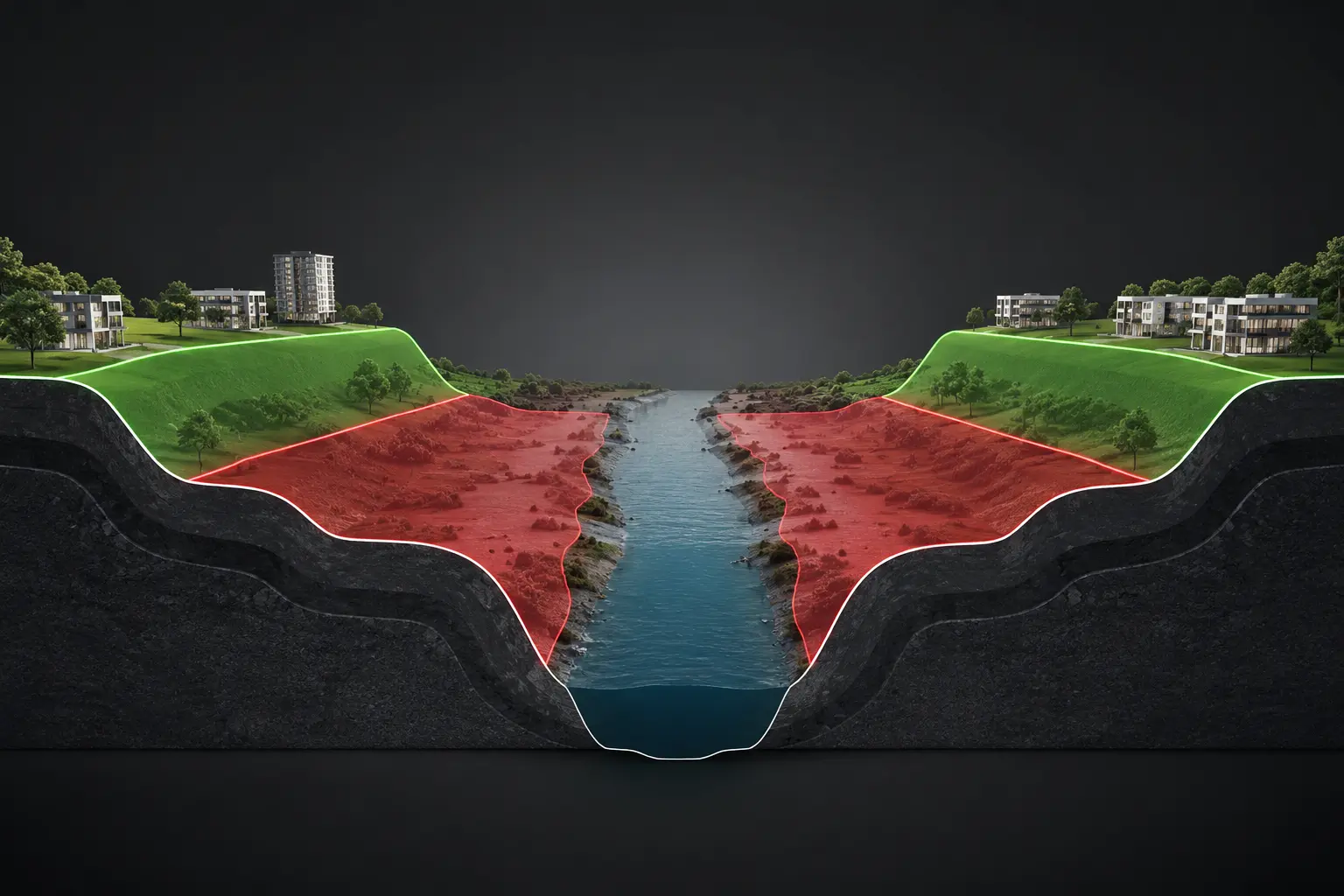
Green Belts, ROWs, and Gram Sabha Land
- The Master Plan Green Belt: Land specifically designated as a “city lung.” Revenue officers are strictly forbidden from clearing conversion files here.
- Infrastructure Right-of-Way (ROW): If your chosen Khasra (plot number) overlaps with a proposed highway alignment or future metro depot, the state will lock the land for eminent domain acquisition.
- Gram Sabha & Ceiling Land: Land that belongs to the village council (Gram Sabha), pasture land, or pond land cannot be legally transferred to private developers. The registry itself is void.
3. The Legal Physics: Section 143 vs. Section 80
To navigate land intelligence successfully, you must aggressively filter out market noise. Local syndicates still use archaic terminology to confuse retail buyers. You must understand the exact statutory distinction between Section 143 and Section 80.
Section 143 (Obsolete & Void)
Legislative Origin: UPZA & LR Act, 1950.
Section 143 is legally dead. While the modern UP Revenue Code was drafted in 2006, it was not fully enforced until 2016, which is when the old UPZA & LR Act was formally repealed. Today, Section 80 is the only active, mandatory conversion law recognized by banks and courts.
Section 80 (Active & Mandatory)
Legislative Origin: UP Revenue Code, 2006.
The obsolete act was replaced by the modernized UP Revenue Code. Under this statutory framework, the provision for changing land use was migrated to Section 80. This is the absolute, singular legal provision recognized by the government, the High Courts, and Tier-1 banking institutions today to convert agricultural land (Krishi) to non-agricultural status (Gair-Krishi).
Looking to acquire premium, verified land in Delhi NCR or Baghpat?
Navigating statutory zoning laws requires absolute precision. We offer 100% legally cleared, Section 80 converted freehold plots ready for immediate development.
Explore Verified Plot Inventory4. The March 2026 Ordinance: The End of “Dual Approval”
Historically, the land conversion process in Uttar Pradesh was a grueling, capital-draining bureaucratic nightmare known as “Dual Approval”. If an investor or developer bought land in an area overseen by a development authority, they were forced to fight a two-front war.
First, they had to approach the Revenue Department (either the SDM or Tehsildar) and fight for a Section 80 conversion. Second, they had to take that conversion order and petition the local development authority to pass their building map. This dual-clearance loop caused project delays ranging from six months to over a year.
The Historic Reform: On March 23, 2026, the Uttar Pradesh State Cabinet completely shattered this bottleneck. In a landmark legislative move for “Ease of Doing Business,” the cabinet cleared an ordinance amending Section 80 of the UP Revenue Code 2006.
Dual Approval System
- Developers forced to manually apply to the SDM for Section 80.
- Months of revenue department inspections and red tape.
- Cannot apply for building map approval until revenue conversion is fully completed.
“Deemed Approval” Matrix
- For lands under Industrial Development Authorities, UPAVP, and local Development Authorities.
- Requirement to apply to the SDM for land use change is entirely eliminated.
- The moment the building map is approved by the authority, land conversion is automatically deemed approved.
The Critical Caveat: This “deemed approval” exemption only applies to land within statutory master-planned authority zones where layout maps are officially sanctioned. If you are purchasing agricultural land in an unapproved village, a Zila Panchayat zone, or intend to build a standalone farmhouse outside municipal limits, you must still physically execute the grueling Section 80 conversion process.
5. Fiduciary Verification: Sanctioned Maps & The Khasra Audit
Retail buyers analyze glossy PDF brochures; institutional investors analyze sovereign revenue records. If a developer approaches you claiming a residential project is “100% Authority Approved,” you must execute a ruthless verification protocol. Fraudsters routinely acquire a legal map for a small one-acre patch of land, but illegally sell adjacent, unconverted agricultural plots under the exact same project name.
Phase A: Digital Bhulekh Verification (5 Crucial Checks)
Before you hand over a single rupee, you must verify the land’s digital reflection on the official state revenue portal (e.g., UP Bhulekh). Do not rely on printed copies provided by brokers. Execute these mandatory digital checks:
-
- Verify the ‘Khatedar’ (Ownership Legitimacy): Check the Khatauni (Record of Rights) for the current owner’s name. If multiple names are listed, the property is co-owned, and you need the registered consent of every single co-owner.
- Check the ‘Pravishthi’ Column for Bank Liens: The Remarks column will list if the land is mortgaged. Look for the word “Rahannama” or a bank’s name. If a lien exists, demand a No Objection Certificate (NOC) from the bank.
- Check ‘Plot Sale Status’ for Court Disputes: Use the Revenue Court Management System (RCMS) link to check if there are ongoing stay orders, Gram Samaj disputes, or government attachments on that specific Khasra number.
- Land Use Classification: The official category must explicitly state “Gair-Krishi” (Non-Agricultural) or “Abadi” (Residential). If the portal still reads “Krishi”, the land is unconverted.
-
- Verify Plot Geometry & Registered Liens (Bhu Naksha & IGRSUP): Bhulekh only reflects the revenue ledger. You must independently cross-reference your Khasra number on the state’s digital Bhu Naksha portal to confirm the exact physical dimensions and boundaries of the plot. Furthermore, always run an Encumbrance Certificate (EC) check via the IGRSUP portal. Bhulekh shows revenue status, but IGRSUP reveals the actual registered financial history of the asset.
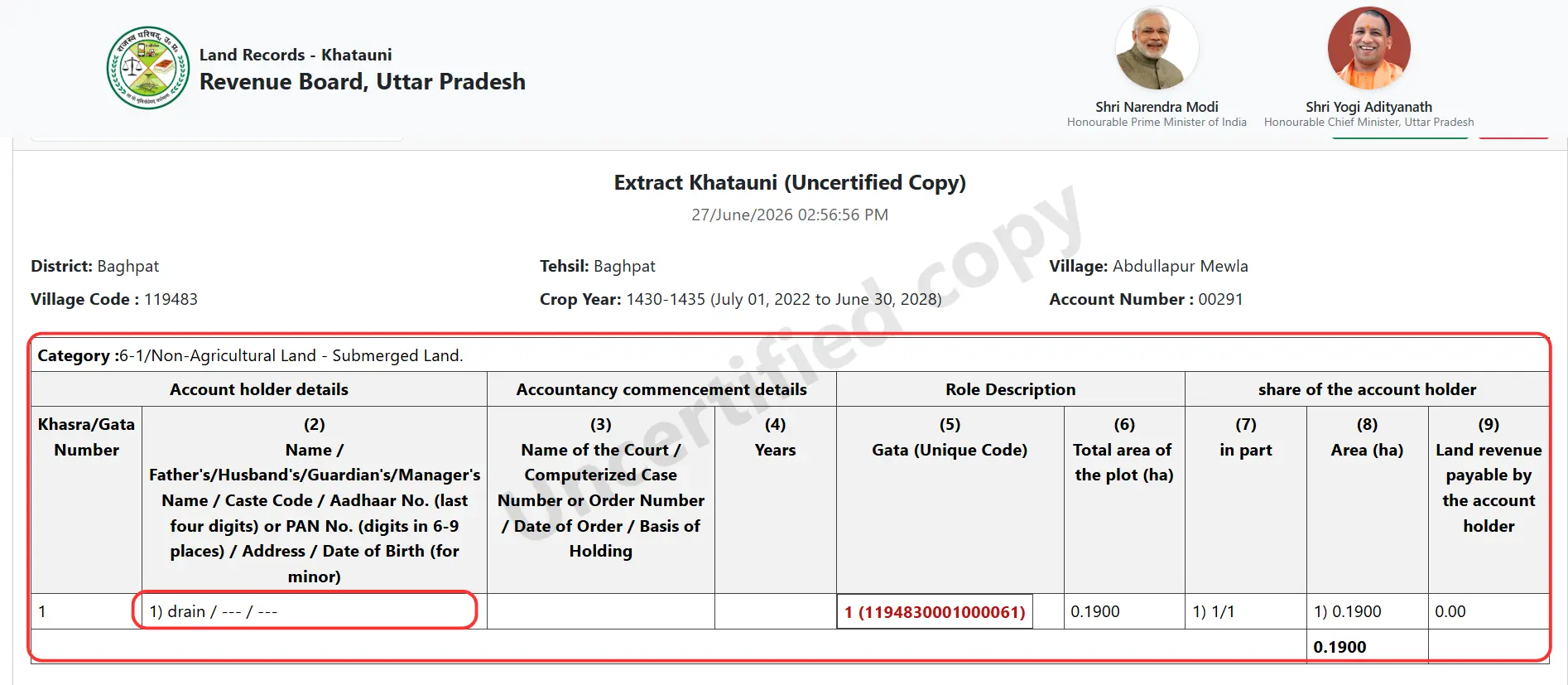
A sovereign UP Bhulekh Khatauni extract. The red boxes highlight “Category 6-1: Submerged Land”—the exact digital signature of an ecologically protected floodplain or drainage trap that cannot be legally converted.
| Record Type | What It Tells You | Why It Matters |
|---|---|---|
| Khatauni | List of all current owners and land type. | Confirms if the seller is the actual legal owner on record. |
| Khasra Number | The unique identity number of the specific plot. | Ensures you are buying the exact piece of land shown on site. |
| Dakhil Kharij (Mutation) | Date when ownership was last updated. | Proves the seller successfully completed the transfer from the previous owner. |
Phase B: Cross-Reference the Sanctioned Authority Map
Go directly to the official website of the local development authority or the state’s RERA (Real Estate Regulatory Authority) portal. Download the digitally signed, master-sanctioned layout map directly from the government server.
The Fiduciary Rule: The specific Khasra numbers listed on the government’s sanctioned map must align flawlessly with the Khasra numbers printed on your draft sale agreement. If the authority map shows Khasra 550 and 551 are officially approved for development, but the plot being sold to you is being carved out of Khasra 552, your plot is illegal, unconverted, and subject to immediate demolition. You are buying a mirage.
6. How to Apply: The Step-by-Step Section 80 Conversion Pipeline
If you are acquiring sovereign land that falls outside the March 2026 “Deemed Approval” zones, you must independently push the Section 80 file through the revenue bureaucracy. To eliminate physical corruption and enforce strict Service Level Agreements (SLAs), the UP Government has digitized this pipeline via the Nivesh Mitra 3.0 and Vaad portals. Here is the exact five-step execution mandate:
Digital Filing & Telemetry
The process begins entirely online. You must file the application through the state’s Nivesh Mitra or Revenue Department Vaad portal. Crucial prerequisite: The land must already be mutated (Dakhil Kharij) in your name in the tehsil records before you apply.
The Lekhpal Field Audit
This is the absolute most critical filter in the pipeline. The Sub-Divisional Magistrate (SDM) orders the area Lekhpal (local revenue officer) to conduct physical site telemetry. They verify the land is free of litigation, outside Green Belts or O-Zones, and not government/Gram Sabha property. A flawless ground report pushes the file forward.
Capital Assessment (The 2% Fee)
Upon receiving a clean Lekhpal report, the SDM calculates the statutory conversion tax. In Uttar Pradesh, as of 2026, the standard fee is calculated as exactly 2% of the prevailing government Circle Rate for that specific village geometry. This capital must be deposited directly into the government treasury via an official digital challan.
The Formal SDM Declaration
Once the treasury confirms receipt of the conversion fee challan, the Sub-Divisional Magistrate formally issues the Section 80 Declaration Order. Under the new 2026 Service Level Agreements (SLAs), this entire process must be completed within 45 days from the application date. This legally detaches the asset from agricultural restrictions.
Dakhil Kharij (The Ledger Update)
Never bypass this final action. Holding the physical SDM order in your hands is meaningless if the central database is blind to it. You must ensure the Dakhil Kharij (revenue record mutation) process is completed. This forces the government ledger to physically update the asset’s status. Extract a fresh Khatauni two weeks later to empirically verify the change.
7. Pan-India Applicability: Different States, Same Physics
While “Section 80” is terminology specific to the UP Revenue Code, the structural physics of land conversion apply unilaterally across every major state in India. Whether you are a corporate land banker in Bengaluru or a private investor in Pune, the process is fundamentally governed by the Master Plan (CDP) and state revenue codes. Institutional investors building portfolios across state borders must be fluent in the localized terminology:
- Maharashtra (NA Order): The process is governed by Section 44 of the Maharashtra Land Revenue Code (MLRC). If land falls under a finalized regional plan or draft development plan, the state has moved toward automated NA certification, though the “collector’s premium” calculation remains highly technical and dependent on the plot’s proximity to arterial roads.
- Karnataka (DC Conversion): Known as DC Conversion (Deputy Commissioner Conversion), governed by Section 95 of the Karnataka Land Revenue Act. The state has digitized the pipeline through the ‘Bhoomi’ portal. The conversion is strictly contingent on the land’s alignment with the city’s Comprehensive Development Plan (CDP). Without CDP alignment, conversion is physically impossible.
- Haryana (CLU – Change of Land Use): Controlled by the Town and Country Planning (TCP) Department, this is arguably the most stringent framework in India. The CLU process in Haryana is a high-capital endeavor designed specifically to maintain a massive agricultural buffer around the high-velocity urban zones of Gurugram and Faridabad.
8. The Capital Cost of Compliance Failure
Attempting to circumvent the system to save the 2% conversion fee, or attempting to bypass bureaucratic friction by building a high boundary wall directly on agricultural land, is financial suicide. In 2026, the enforcement infrastructure in Delhi NCR, Lucknow, and other Tier-1 hubs is digitized, aggressive, and utterly ruthless.
Case Study: The Floodplain Demolitions
In the recent enforcement drives across the Yamuna and Hindon river floodplains (O-Zones), authorities utilized high-altitude drone mapping to identify illegal farmhouse structures that had bypassed revenue records. Because the construction violated the National Green Tribunal’s O-Zone mandate, the authority executed a 100% demolition of these multi-crore assets within 72 hours. The owners had no recourse in civil court, as the structures were legally non-existent.
- Institutional Blacklisting: Tier-1 financial institutions (SBI, HDFC) conduct rigorous title searches. If the Khatauni reads “Krishi,” your construction loan application is instantaneously rejected. You are immediately isolated from cheap capital.
- Total Denial of Exit Liquidity: Educated, high-net-worth buyers will not touch unverified land. If you attempt to exit the investment by selling an unconverted farmhouse, you will suffer a massive 30% to 40% capital penalty against the true market value of legally compliant properties.
- Succession Law Traps: The inheritance of agricultural land is stringently governed by rigid state Revenue Codes, which often conflict with modern testaments. Converting the land brings it under the much cleaner provisions of standard civil succession laws (like the Hindu Succession Act).
9. Corporate Due Diligence: The 10-Point Institutional Checklist
Before committing institutional capital to a land parcel, conduct a fiduciary-grade audit using these ten parameters:
Acquire Premium Sovereign Land with VaEdifice
Real estate portfolio expansion is predicated on acquiring land with absolute legal accuracy. Whether you are seeking to acquire institutional-grade industrial plots in Baghpat or premium freehold land across Delhi NCR, VaEdifice delivers assets that are 100% legally cleared, Section 80 converted, and Title-verified. Call us directly at +91 92205 94889.