
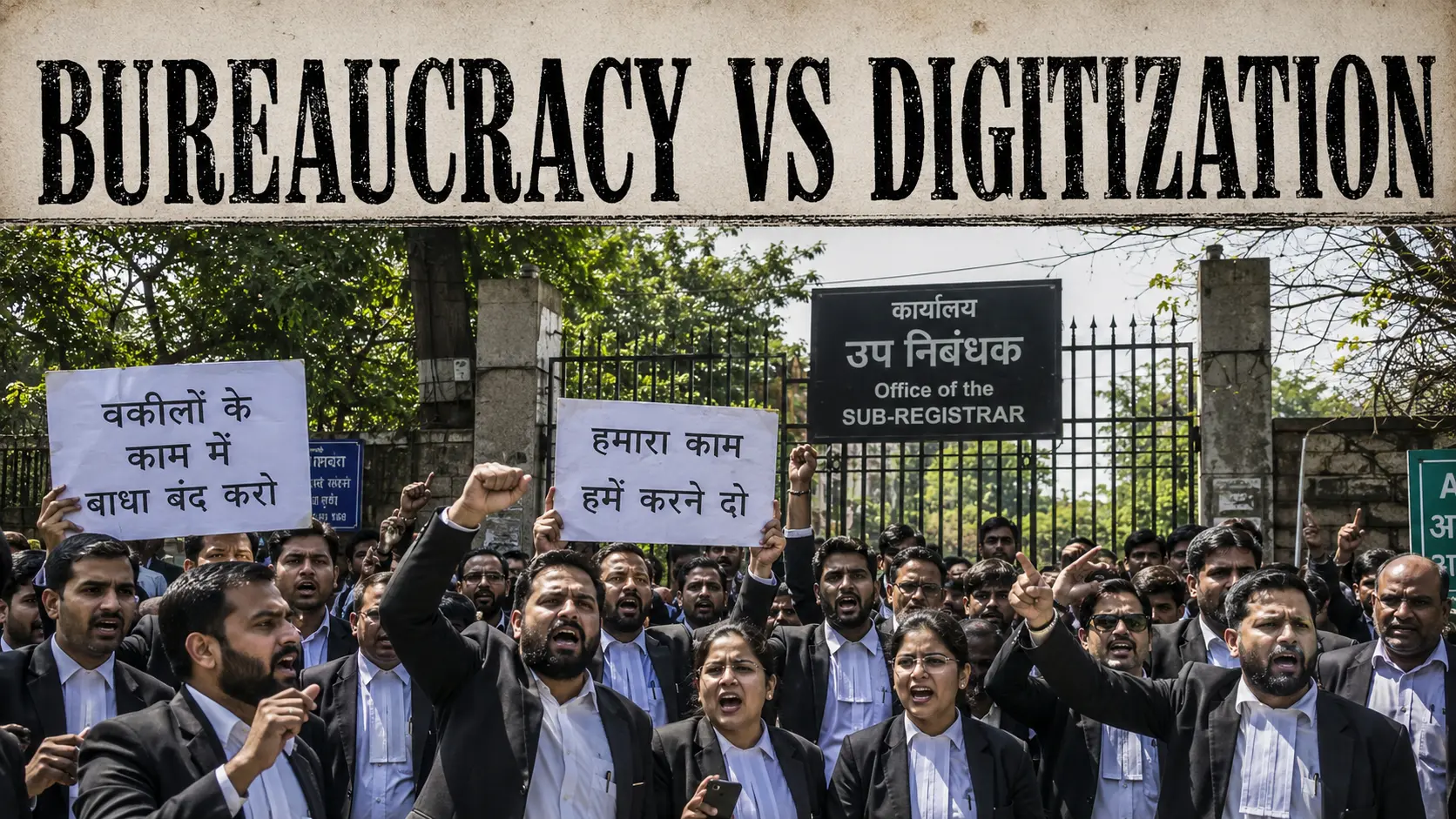
If you are buying a resale plot or an apartment in Noida, you cannot use the government’s new online e-registration system. You are still going to the local registry office.
Following an aggressive indefinite strike by local advocates and deed writers across Greater Noida, Dadri, and Jewar, the Uttar Pradesh registration department was forced to issue an urgent rollback circular. While the state government initially planned to take the entire property registry process online to eliminate corruption and heavy paperwork, intense pressure from local administrative unions forced a sudden compromise. Today, the market has been split into a confusing, parallel two-track system that every property buyer must understand.
Direct Authority Allotments
100% Online E-Registry: This applies strictly if you win a plot via an official e-auction or secure a fresh allotment directly from the Noida Authority, GNIDA, or YEIDA. The paperwork is entirely paperless and executed remotely on the IGRSUP portal.
Secondary Market Resales
The Physical Hybrid: If you are buying a resale home or a plot from an individual owner, the digital route is blocked. You prepare the documents online, but you must physically visit the Sub-Registrar’s Office (SRO) to sign and execute the deed.
1. The Inside Story: Why the Digital Revolution Hit a Wall
The state’s original goal under the Uttar Pradesh Online Registration Rules was highly progressive: allow citizens to cryptographically sign and lock property transfers from the comfort of their homes. This would have completely detached real estate from the localized bureaucracy of land offices.
However, this pure digital approach immediately threatened the livelihood of thousands of local middlemen, stamp vendors, and deed writers who control the registry gates. Realizing their professions were on the verge of being made redundant, regional bar associations suspended work and completely paralyzed the local registry offices. To prevent a total standstill in state revenue collections, the Inspector General of Registration stepped in with a compromise circular, clarifying that the fully digital pipeline would be locked away from the public resale market.
2. Chronological Telemetry: The 2026 Registry Timeline
To understand why the system is structured this way today, you have to look at the rapid chain of events that unfolded across Uttar Pradesh over the last six months:
Unblocking Stalled Registries
Noida Authority relaxes ancient financial dues on developers, successfully clearing the path for 4,100 buyers trapped in stalled complexes to finally execute their registries.
The SRO Security Overhaul
The state heavily fortifies physical property transactions. Form 60 is entirely banned—making physical PAN cards and deep Aadhaar biometrics completely mandatory to track high-value land transactions.
Strict 60-Minute Windows Imposed
To handle crowds, the online SRO booking system locks appointments into tight, rigid 1-hour slots. If you miss your window, the system automatically cancels your booking.
The Digital Registry Order
The UP government launches its full e-registration platform, intending to move all property documents and sale deeds online to fast-track administrative processing.
The Rollback Circular Issued
Following an intense strike by Noida deed writers, the registration department issues an official clarification, rolling back the system for resales and restricting true e-registry only to government housing and industrial projects.
3. Navigating Track B: The New Rules for Resale Plots
Because the resale market remains physical, the government decided to make the in-person verification completely foolproof. If you are buying an independent plot or house from an existing owner today, you must cross four non-negotiable security checkpoints at the SRO:
- No More Form 60: Buyers and sellers can no longer skip tax declarations using standard forms. Having a verified physical PAN card is now an absolute constraint to complete the transfer.
- Biometric Fingerprint & Iris Scanning: To eliminate proxy signatures, everyone—the buyer, the seller, and two witnesses—must complete live identity cross-checks linked directly to federal identity databases.
- Instant Land Record Matching: The registry portal is digitally linked to the state’s official *Bhulekh* records. If the seller’s name on the deed matches the digital records perfectly, the slot opens. If there is even a minor character mismatch, the system halts the transaction instantly.
- The ₹20,000 Cash Cap: To eliminate parallel black economies, any peripheral token or deal payment above ₹20,000 must run through banking rails (RTGS/NEFT). Large cash handovers at the desk are strictly illegal.
4. Pan-Indian Reality: Why No Metro is Truly Digital
Noida’s technological compromise isn’t unique; it highlights a massive structural pattern across all major Indian tier-1 cities. Despite the central government pushing for a unified national registration system, every single metropolitan hub still demands human presence for the resale market.
In Bengaluru (Karnataka), the Kaveri 2.0 interface allows you to calculate dues and upload drafts smoothly, and the modern E-Khata grid traces plot geometries to stop illegal layouts. Yet, the final step requires you to stand in front of an SRO camera. In Mumbai and Pune (Maharashtra), the government allows fully remote digital closings, but strictly limits them to short-term rental agreements. The moment a commercial block or freehold house changes hands, you are booking a physical appointment slot. Across Delhi’s DORIS platform, the script is identical: digital preparation on the front end, mandatory physical verification on the back end.
5. Global Escrow Physics: How North America Solved the Loop
The deep friction embedded within the Indian property engine becomes incredibly clear when you look at how mature global markets handle property transfers. They have managed to take the physical office completely out of the equation by using decentralized trust systems:
Remote Online Notarization
The Process: Closings happen via secure video conference. The buyer, seller, and a certified eNotary never meet in person.
The Security: Identity is cleared instantly using Knowledge-Based Authentication (KBA)—automated security questions pulled from historic credit data—alongside digital credential scanning. The signed deed is e-recorded at the county level automatically.
The Lawyer Gatekeeper Model
The Process: Property title transfers run through a secure, encrypted network called Teraview, which is completely closed off from the general public.
The Security: The state delegates absolute legal liability to private, licensed attorneys. The buyer’s lawyer and seller’s lawyer verify their clients’ identities privately, log into the secure gateway, and complete a digital “double sign-off” to transfer ownership and escrow funds instantly.
6. The VaEdifice Take: What India Must Execute Next
From a corporate and investment standpoint, the UP government’s quick rollback to please local intermediary unions is a massive misallocation of priorities. If India genuinely intends to scale its trillion-dollar digital economy and draw unencumbered foreign direct investment, it cannot allow manual, localized monopolies to slow down the processing velocity of sovereign land assets. Giving in to regional guild strikes directly compromises international capital efficiency.
For high-net-worth investors and corporate treasuries, the current Track B hybrid registry is a frustrating operational bottleneck. Forcing cross-border buyers or corporate executives to physically sit inside local SRO environments, arrange for physical witnesses, and work around rigid hourly timelines opens the door to human error and bureaucratic delays. Modern capital demands frictionless execution—the seamless, remote conversion of funds into a verified digital land title.
The foundational technology to fix this is already active within our borders. India operates the most advanced biometric identity grid on earth, and the digital tracking of land ledgers proves we can index assets cleanly. The final leap requires the Union Government to completely separate land registration from geographic boundaries. By introducing secure digital notary networks, end-to-end cryptographic e-signing, and instant online land mutations across every major city, India can dissolve the SRO bottleneck forever. True title modernization requires absolute automation. To fully unlock the value of the nation’s land banks, the system must phase out the manual middleman and move to a unified, cloud-based transaction grid from coast to coast.
Execute Your Asset Audit with VaEdifice
Real estate portfolio expansion is predicated on evaluating regulatory frameworks with absolute accuracy. Whether you are seeking direct authority plots to maximize the benefits of Track A e-registrations, or require structured corporate advisory to bypass the complexities of Track B physical resales, VaEdifice analyzes land acquisitions through the lens of data integrity, supply chain mechanics, and legal telemetry. Call us directly at +91 92205 94889.
No. Following the June 2026 rollback, private builder handovers were explicitly excluded from the fully digital track. Even if it is a primary sale, if the asset is coming from a private developer, you must still physically execute the deed at the Sub-Registrar’s Office (Track B).
Absolutely not. As part of the 2026 anti-fraud overhaul, the Form 60 loophole has been banned for high-value property transfers. A verified physical PAN card is now a mandatory system constraint for both the buyer and the seller.
The SRO digital booking portal now operates on rigid 1-hour limits to prevent overcrowding. If your party (including both witnesses) is not present and processed within that exact window, the system automatically cancels the appointment, and you will be forced to re-book for a future date.
No. To suppress parallel shadow economies, any token consideration, fee, or payment exceeding ₹20,000 must be executed digitally via documented banking rails (RTGS, NEFT, or net banking). Desk cash transactions are strictly monitored and banned.
The full digital rollout in early June 2026 threatened the traditional livelihoods of local deed writers, advocates, and stamp vendors. They launched an indefinite strike across Greater Noida, Dadri, and Jewar. To end the strike and unblock state revenue, the government compromised by keeping the massive resale market offline (physical).