
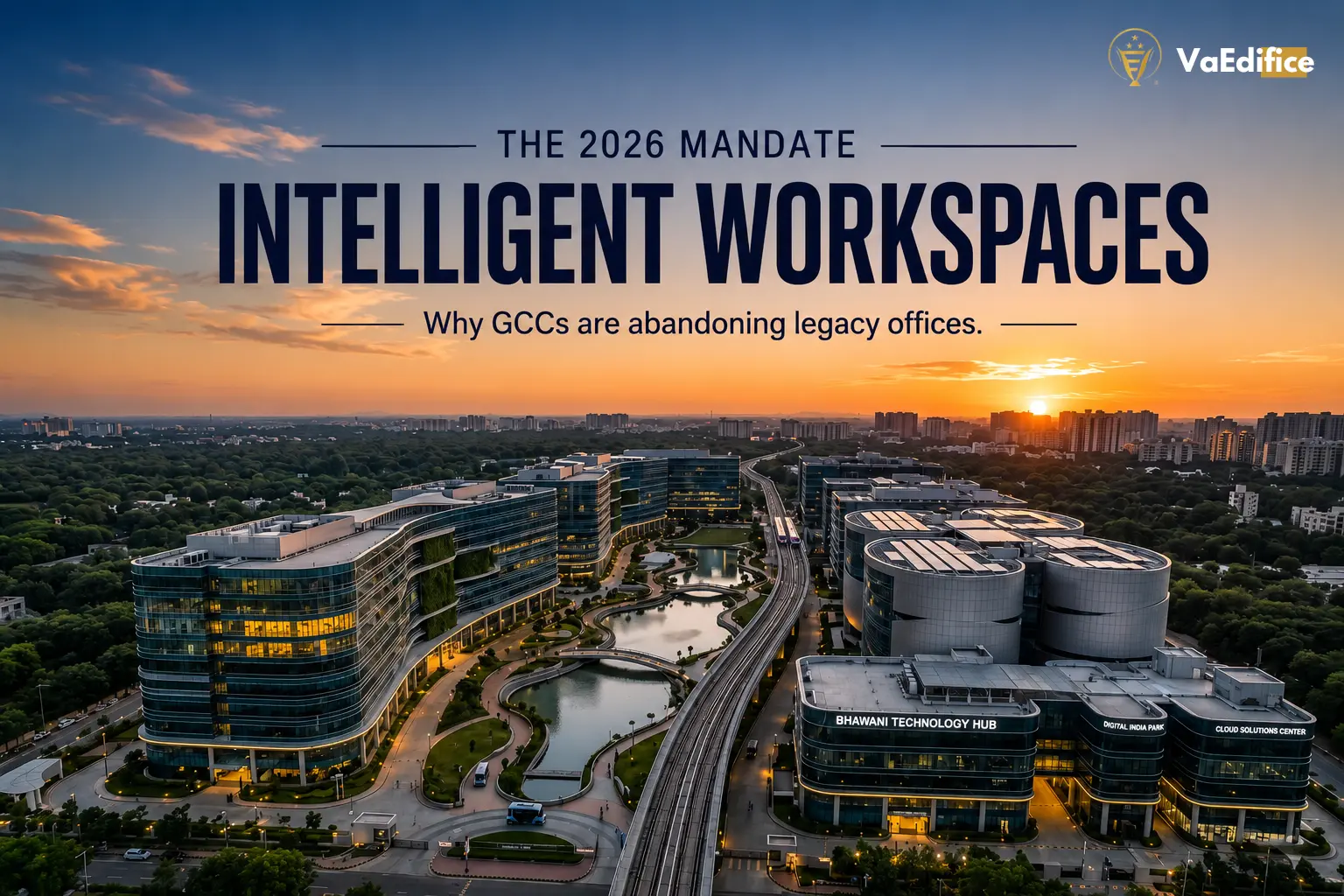
India’s commercial real estate market is undergoing a violent and irreversible transformation. Specifically, the era of leasing basic, four-walled square footage is officially over. We have entered a new macroeconomic phase dominated by tech-forward, high-value, and fiercely sustainable workplaces. Powerful economic fundamentals drive this evolution. For instance, India offers a robust economy and a globally competitive talent pool. Consequently, this market continues to attract Global Capability Centres (GCCs), institutional capital, and multinational investments.
The raw market telemetry from 2025 validates this structural shift. India recorded a historic net absorption of nearly 60 million square feet. Furthermore, gross commercial leasing crossed the 80 million square foot threshold. Exponential growth of GCCs acts as the primary catalyst behind this surge. Indeed, these entities accounted for approximately 40% of total leasing nationwide. As multinational corporations (MNCs) expand their presence, the commercial real estate landscape aggressively diversifies. Therefore, the market now favors high-growth segments such as Class-A office spaces, large-campus developments, flexible workspaces, and digitally-enabled environments.
Today’s modern workforce seeks intelligent, experiential environments. They demand spaces that seamlessly integrate smart technology, sustainability accents, wellness-focused design, and strong connectivity to urban transit networks. For institutional investors, family offices, and developers, the mandate remains absolute. Traditional, disconnected office buildings rapidly become obsolete, stranded assets. As a result, the future of capital appreciation lies entirely within the integrated, intelligent commercial ecosystem.
2025–2026 Commercial Real Estate Yield Metrics
The Institutional Shift Toward Grade-A+ Assets
Gross Commercial Leasing
80M+ Sq. Ft.
▲ Record-Breaking 2025 Absorption
GCC Market Share
~40%
Of Total National Leasing Demand
ESG Rent Premiums
Up to 28%
For LEED / WELL Certified Buildings
GCC Commercial Absorption Trajectory
Year-over-Year Growth in India (Millions of Sq. Ft.)
22M
31M
42M
55M+
2024
2025
2026 (Est)
Geographic Dominance: The Core Hubs of Expansion
This expansion is not merely a function of scale. Instead, it reflects a strategic response to market demand across India’s key commercial hubs. Institutional operators aggressively target Bengaluru, Chennai, Mumbai, and Delhi-NCR for distinct structural reasons.
- Bengaluru (The Silicon Anchor): Bangalore continues to lead India’s digital economy. Consequently, an experiential shift is occurring in real estate. Office infrastructure increasingly aligns with the modern workforce. In tech corridors like Hebbal, developers design bespoke Grade-A+ hubs to cater to advanced domains. These specifically include companies operating in artificial intelligence, cloud computing, and software engineering.
- Chennai (The Rising GCC Hub): Southern corridors have emerged as a premier destination for GCCs. They offer massive and future-ready workspace solutions. For example, megaprojects in Manapakkam span 40 acres and will deliver ~11.5 million sq. ft. of space. This reflects deliberate capital choices oriented toward emerging corridors.
- Mumbai (The Financial Transit Centers): Lower Parel remains one of India’s most distinguished business districts. Developers envision these developments as highly accessible, transit-centric destinations. Specifically, they position these assets merely minutes from major rail networks to connect seamlessly to transit highways.
- Delhi-NCR (The Capacity Market): The National Capital Region consistently captures a massive percentage of the nation’s net absorption. Expansive road infrastructure and satellite city connectivity drive this demand. Ultimately, NCR provides the immense geographic footprint required for large-scale corporate consolidation.
The “Innovation-Campus” Model & Hospitality Integration
The most significant paradigm shift in commercial real estate involves the death of the isolated office tower. The ‘Innovation-Campus’ model represents the dawn of the next evolution of multi-tenant development. Built on the philosophy of ‘Live, Work, and Play,’ these campuses transform the market. Specifically, they integrate commercial, executive residential, and upscale lifestyle spaces into a single, cohesive footprint.
Rather than functioning as detached buildings, they operate as vibrant communal environments. These spaces actively support productivity, collaboration, and well-being. Today, modern occupiers expect offices to offer top-tier functionality combined with comfort, service quality, and hospitality-inspired design. To capture elite tenant yields, developers seamlessly weave tailored offerings into daily operations. These premium services include concierge assistance, tech support, and integrated fine dining.
The Flex-Space Buffer: Hedging Against Vacancy
While million-square-foot GCC campuses dominate the headlines, institutional developers cannot ignore the coworking and flex-space sector. In recent quarters, flex-space operators accounted for roughly 15% to 20% of total commercial absorption. Furthermore, multinational corporations increasingly adopt a “Core + Flex” real estate strategy. They keep their permanent headquarters lean while simultaneously utilizing agile spaces. Consequently, this flexibility houses contract workers or temporary project teams efficiently.
For a developer, a true Grade-A+ asset requires proper structural engineering. It must feature floor plates that can seamlessly accommodate flex-space operators. Bringing a premium coworking brand into a commercial ecosystem acts as a vital buffer against vacancy. Ultimately, this integration ensures the building maintains foot traffic and dynamic yield generation even during corporate downsizing cycles.
The Fiduciary Checklist: Defining the Next-Gen Workspace
Before deploying capital or signing a decade-long lease, institutional investors and enterprise tenants must rigorously audit properties. They evaluate assets against the new ecosystem criteria. A true Grade-A+ asset must deliver on four non-negotiable pillars:
1. ESG Excellence and Wellness Certifications
Corporate governance now mandates strict environmental compliance. Therefore, premium commercial spaces must secure USGBC LEED Certification and WELL/IGBC-WELL Certification. This goes far beyond basic compliance. The infrastructure must utilize a standard sustainable landscape framework and advanced HVAC (MERV-13 filters) for superior indoor air quality. Properties securing these green certifications command massive rent premiums and drastically lower tenant turnover.
2. The PropTech & IoT Digital Backbone
A modern building must function as a digital command platform. This requires friction-free layouts integrated with an advanced IoT network. Driven by IoT sensors and real-time data analytics, this intelligent system monitors critical sustainability metrics. Specifically, it maximizes energy efficiency, water conservation, and indoor air quality. By transforming operational data into actionable insights, developers drastically minimize the environmental footprint. Furthermore, this ensures transparent, precision reporting across all operational areas.
3. Operational Resilience and Proactive Safety
Downtime proves fatal for companies operating in the AI and cloud infrastructure space. Consequently, standard layouts must provide on-site utility management systems to ensure 100% operational efficiency. This absolute demand requires robust infrastructure generation with premium utility backups and electric PV charging. Furthermore, developers build advanced safety system frameworks on modern infrastructure platforms. These systems utilize real-time feedback loops to ensure a comprehensive approach toward fire, life-safety, and general tenant security.
4. Transit-Oriented Development (TOD)
Location remains paramount, but the parameters have shifted entirely. Planners strategically locate campuses along key arterial roads and near major urban centers. This ensures seamless accessibility for employees and visitors. Furthermore, this transit-oriented planning philosophy minimizes commute times, which contributes directly to better work-life balance. High-speed metro and road connectivity remains absolutely non-negotiable for modern enterprise occupiers.
The Financial Reality: CapEx Premiums vs. OpEx Payback
While the aesthetic and operational benefits of an intelligent ecosystem appear obvious, the fiduciary question remains. What does it actually cost? Building a USGBC LEED-certified, IoT-enabled smart campus requires a Capital Expenditure (CapEx) premium. This initial cost runs approximately 10% to 15% over a traditional, legacy building. For a large-scale project, this represents a significant upfront financial burden.
However, institutional capital deploys based on long-term mathematics. The integration of smart resource management reduces total Operational Expenditure (OpEx). Specifically, it lowers energy and water consumption by 20% to 30% annually. When investors factor in the operational savings alongside the 15% to 28% ESG rent premium, the mathematics change favorably. As a result, the payback period for the initial CapEx premium typically truncates to just 3 to 5 years. Following this payback period, the increased yield translates into pure alpha for the asset holder.
The Brownfield Alternative: Retrofit or Face Obsolescence
This macro shift presents a severe dilemma for family offices and funds. Many investors currently hold legacy assets (buildings 15 to 20 years old) in saturated corridors like Gurugram or central Noida. As tier-one tenants migrate to new ecosystems, these older buildings face a severe valuation cliff. However, demolition is not the only viable recourse.
Smart money aggressively executes “Brownfield Retrofitting.” Instead of tearing the asset down to the concrete, owners inject capital to salvage the valuation. This process involves overhauling legacy HVAC systems for advanced air filtration. Furthermore, it means overlaying the building’s electrical grid with wireless IoT sensors to track occupancy and energy use. Finally, developers completely remodel ground-floor lobbies to meet modern hospitality standards. Ultimately, a successful retrofit repositions a stranded asset back into the competitive Grade-A matrix without the massive carbon footprint of a new build.
The VaEdifice Bottom Line
The bifurcation of the Indian commercial real estate market is accelerating rapidly. Assets integrating smart PropTech resource management, proactive safety cultures, and hospitality-centric amenities will experience high tenant retention. Furthermore, they will command premium asset valuations. Conversely, traditional buildings lacking structural flexibility, IoT backbones, and ESG credentials will inevitably become obsolete.
Audit Your Commercial Portfolio with VaEdifice
Are your commercial assets positioned to attract tier-one GCCs and tech enterprises, or are they sliding toward obsolescence? At VaEdifice, we provide unvarnished, fiduciary-grade intelligence to high-net-worth investors and family offices. Connect with our advisory board to explore retrofit strategies, future-proof your commercial land banks, and secure your real estate portfolios against the shifting market paradigm. Call us directly at +91 92205 94889.
📞 Consult VaEdifice: +91 92205 94889 ✉️ Portfolio Assessment: info@vaedifice.com
Older buildings face a severe valuation cliff, but demolition is not the only answer. Institutional investors are utilizing “Brownfield Retrofitting”—overhauling legacy HVAC systems, integrating wireless IoT sensors, and upgrading lobbies. This repositioning strategy salvages the asset’s valuation and upgrades it to Grade-A standards without the massive capital expenditure of a new build.
Constructing a USGBC LEED-certified, IoT-enabled smart building typically requires a Capital Expenditure (CapEx) premium of 10% to 15% over a traditional building. However, this premium is quickly offset. Smart resource management reduces Operational Expenditure (OpEx) by 20% to 30% annually, and these buildings command ESG rent premiums of up to 28%. The typical payback period for the initial premium is just 3 to 5 years.
The demand is heavily concentrated in tier-one IT and financial hubs. Bengaluru (specifically tech corridors like Hebbal) and Chennai (Manapakkam) are leading the southern expansion for GCCs. Mumbai (Lower Parel) remains the premier financial transit center, while the Delhi-NCR market continues to capture massive absorption due to its expansive infrastructure and satellite city capacity.
Multinational corporations are adopting a “Core + Flex” strategy. Instead of leasing excess permanent space for future growth, they secure a lean permanent headquarters (Core) and utilize on-site coworking spaces (Flex) to accommodate contract workers, temporary project teams, or sudden headcount surges. For developers, integrating a flex-space operator into the building acts as a vital buffer against vacancy.
GCCs operating in AI, cloud computing, and software engineering require frictionless, resilient environments. This includes advanced IoT networks for real-time energy analytics, MERV-13 air filtration systems, massive flexible floor plates, and absolutely robust utility backups (including electric vehicle charging and dual-feed power grids) to ensure 100% operational uptime.