
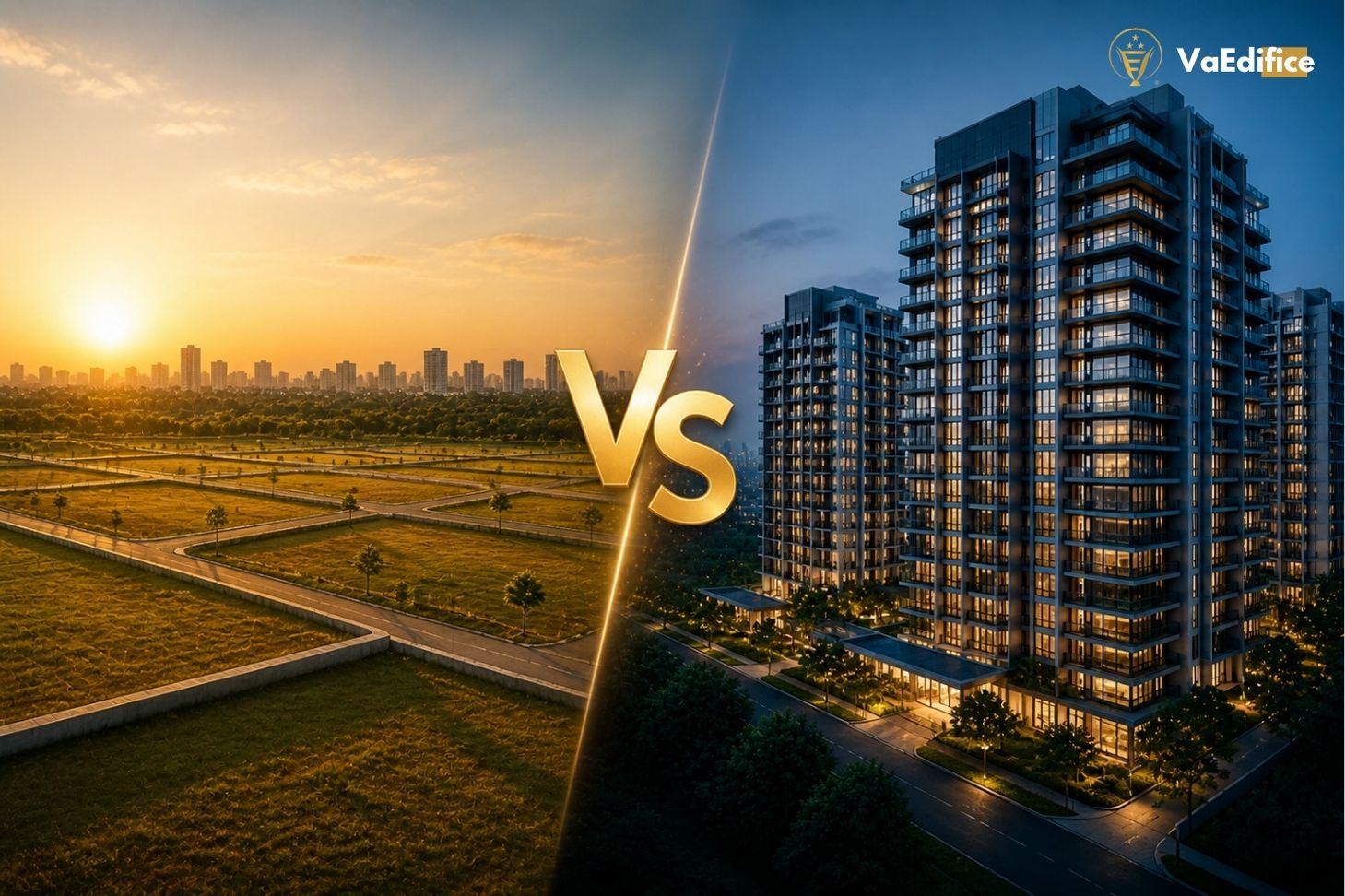
When allocating real estate capital in the National Capital Region (NCR), High-Net-Worth Individuals (HNIs) frequently face a core decision: investing in an independent freehold plot versus acquiring a luxury “branded” apartment. The Indian real estate landscape is undergoing a massive psychological shift, fueled by the rapid influx of international branded residences. While vertical luxury living dominates developer marketing channels and is positioned as the absolute pinnacle of living, a strict fiduciary analysis reveals a distinctly different financial reality.
For astute investors focused on multi-generational equity, understanding the underlying mathematical arbitrage of both asset classes is mandatory before deploying capital. This data-driven audit separates genuine real estate equity from temporary marketing premiums, analyzing long-term ROI, cash flow mechanics, and the underlying asset structures of plots versus high-rises in prime NCR micro-markets.
Which is better: a plot or a luxury apartment in NCR?
For long-term capital appreciation and wealth preservation, independent freehold plots generally outperform luxury apartments due to absolute land scarcity and zero structural depreciation. However, luxury apartments provide superior immediate rental yield and turnkey lifestyle benefits. The optimal choice depends strictly on whether your fiduciary objective is immediate passive cash flow or multi-generational asset growth.
Quick Comparison: Plot vs. Luxury Apartment in NCR
To provide immediate clarity for portfolio allocation, below is a structural breakdown of the fundamental mechanisms driving both asset classes.
| Investment Metric | Branded Luxury Apartment | Independent Freehold Plot |
|---|---|---|
| Primary Value Driver | Brand Equity & Turnkey Amenities | Absolute Land Scarcity |
| Asset Composition | 80% Depreciating Structure / 20% Land (UDS) | 90%+ Appreciating Land Equity |
| Ownership Control | Subject to RWA & Brand guidelines | 100% Sovereign Control |
| Exit Liquidity (10+ Years) | Moderate (Competes with newer launches) | High (Consistent demand for custom builds) |
The Mathematics of “Sticker Engineering”
India now ranks sixth globally in active branded residential projects, and the aggressive pricing strategy has thoroughly saturated the Delhi-NCR market. In Noida, partnerships with global luxury fashion houses are pushing benchmark pricing upward of ₹35,000 per square foot. However, the illusion of this value is maintained through a process we define as “Sticker Engineering.”
- The Logo Royalty Arbitrage: HNIs are routinely absorbing a 40% to 60% “Logo Markup” upfront. Developers typically pay a licensing fee ranging from just 2% to 5% of the total sales value to the global luxury brand. This means the buyer is directly funding the developer’s marketing budget rather than acquiring tangible real estate value.
- Undivided Share of Land (UDS): In high-density vertical developments, an investor’s Undivided Share of the actual earth is mathematically microscopic. The bulk of the capital is tied to the physical structure (which inherently depreciates over time) and the temporary brand premium.
- High-Fashion Skin, Low-Budget Skeleton: It is a critical misconception that the luxury brand acts as the developer. These global entities strictly provide design guidelines and lobby aesthetics; the actual physical construction is still executed by local sub-contractors.
When a Luxury Apartment Makes Fiduciary Sense
Despite the steep acquisition premiums, luxury high-rises serve a specific and valid utility profile. This asset class is mathematically ideal for investors who prioritize immediate rental yields and require a heavily managed, turnkey environment. For corporate executives, expatriates, and Non-Resident Indians (NRIs), a global logo acts as a proxy for safety, security, and standardized property management. If the primary portfolio objective is passive income without the logistical burden of construction or land maintenance, vertical luxury holds distinct operational merit.
When an Independent Plot is the Superior Asset
From a strict fiduciary perspective, sovereign land is mathematically superior for multi-generational wealth preservation. To secure true wealth, institutional capital bypasses sticker engineering entirely to focus on independent freehold plots in ultra-prime NCR sectors (such as Noida 15A, 44, 47, 15A, 108 and Sector 105).
The primary value driver of independent real estate is the absolute scarcity of the dirt. Because municipal master plans strictly cap horizontal development in central urban nodes, the supply is permanently restricted. In these sovereign micro-markets, 90% or more of your capital secures raw, appreciating land equity. You avoid inflated maintenance overheads and completely insulate your portfolio from fleeting fashion cycles.
Yield vs. Equity: The Quantitative Breakdown
To accurately assess which asset aligns with your portfolio strategy, we must look at the standard yield and appreciation metrics currently observed in the prime NCR market.
| Financial Metric | Independent Plot (Prime NCR) | Luxury Apartment (Prime NCR) |
|---|---|---|
| Avg. Capital Appreciation (10 Yrs) | 12% – 15% CAGR | 4% – 7% CAGR |
| Annual Rental Yield | 0.5% – 1.5% | 2.5% – 4.0% |
| Annual Maintenance Burden (CAM) | Low (Owner Controlled) | High (3x-5x Standard Rates) |
Key Risks Investors Must Consider
Every asset class carries vulnerabilities. HNIs must rigorously audit these structural risks before finalizing an acquisition strategy.
- The Brand Divorce Clause (Apartments): Brand partnerships are legally bound by 10 to 15-year licensing agreements, not perpetual rights. If a local developer ceases royalty payments or the aging building fails to meet global standards, the brand name can be legally revoked. When the logo is removed, the premium secondary resale value is instantly destroyed.
- Maintenance Extortion (Apartments): To maintain the mandated international standards dictated by the brand, Common Area Maintenance (CAM) charges are routinely inflated to 3x to 5x higher than standard luxury high-rises. This escalating overhead severely chokes the secondary market, limiting exit liquidity.
- Zoning & Legal Verification (Plots): While mathematically superior in capital appreciation, independent plots carry initial acquisition risks. Investors must conduct rigorous due diligence to verify clear titles, check for encumbrances, ensure RERA compliance, and confirm strict adherence to localized master zoning plans to protect capital.
Conclusion: Structuring a Resilient Portfolio
Neither asset is inherently incorrect; they execute entirely different financial utilities. For lifestyle convenience, status, and immediate cash flow, luxury apartments fulfill a specific market demand. However, buyers must acknowledge they are purchasing identity and exclusivity while absorbing severe structural depreciation.
To anchor capital securely against inflation, avoid maintenance extortion, and bypass fashion obsolescence, independent freehold plots remain the apex asset. Badges rust and licensing deals expire, but the ground remains the only legacy that does not require a designer’s permission to double in value.
Secure Your Portfolio with Fiduciary Intelligence
At VaEdifice, we specialize in institutional-grade land intelligence. We separate genuine real estate equity from marketing mirages, identifying secure, high-yield sovereign land opportunities across prime NCR sectors.
Connect with our principal analysts for a confidential portfolio audit and data-driven acquisition strategy targeting sovereign NCR land.
 Request Private Consultation: +91 92205 94889
  Schedule Portfolio Audit: info@vaedifice.com