
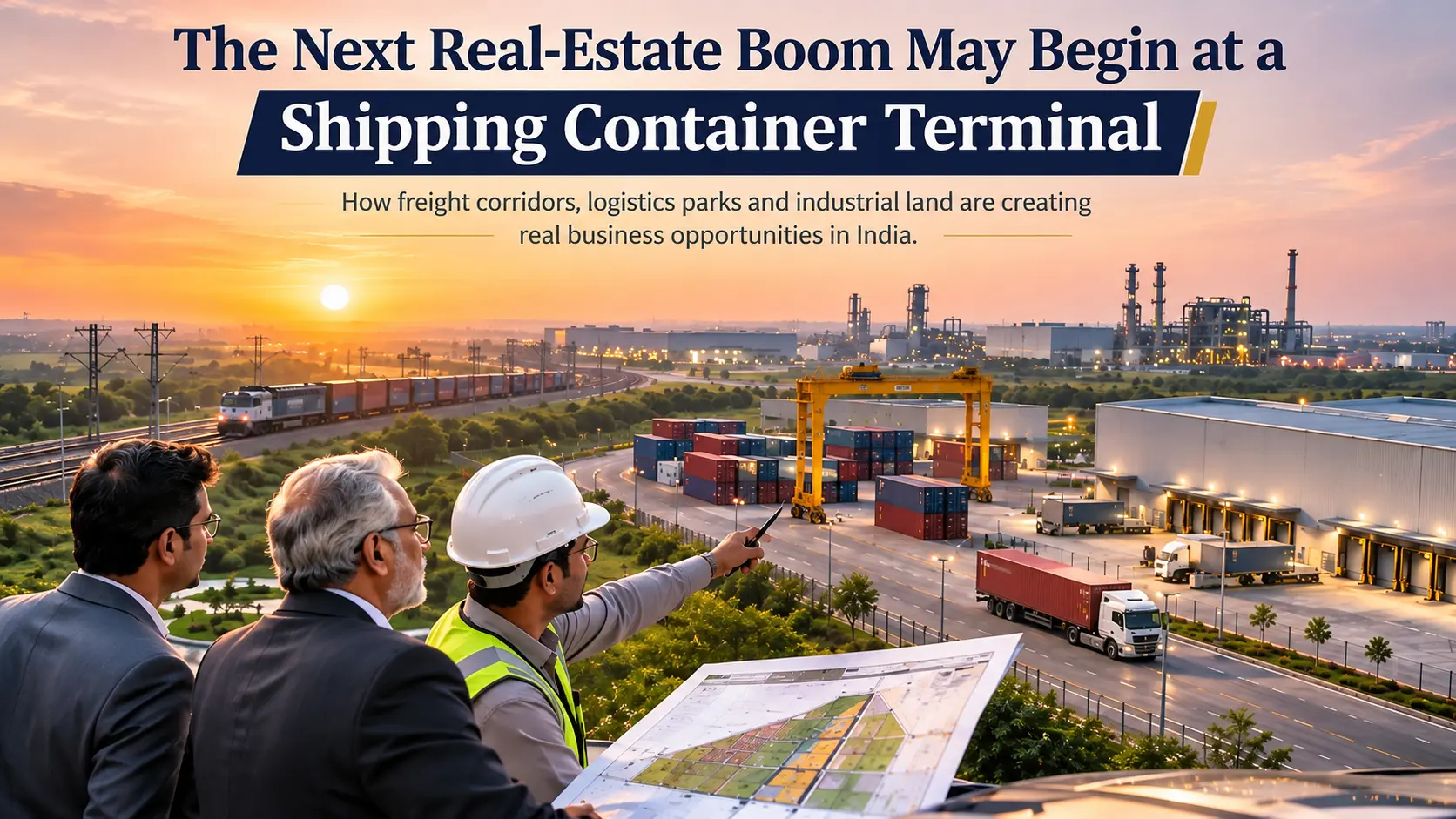
India is building the infrastructure to move goods faster. But while everyone is watching apartment launches and airport announcements, a quieter transformation is taking place in industrial land.
Imagine owning ten acres of land beside a proposed freight corridor.
A broker tells you the price will triple. A developer tells you a township is coming. A distant relative, suddenly an infrastructure expert, assures you that an international airport cannot be far behind.
Everyone seems remarkably confident about the future. There is just one problem.
Nobody has explained who will actually pay to use the land.
And that is where the story of India’s next real-estate opportunity begins. Not necessarily with a luxury apartment, a shopping mall or an artist’s impression of a township surrounded by suspiciously green lawns. But perhaps with something considerably less glamorous. A shipping container.
Follow the Cargo. The Capital May Follow.
Every economy needs somewhere to manufacture goods, somewhere to store them and a way to move them. Factories require raw materials. Distributors require warehouses. Exporters require access to ports. Transport companies require terminals, loading facilities and dependable roads.
None of these requirements disappears because residential property happens to be more fashionable.
India’s dedicated freight corridors, logistics parks, industrial clusters and inland container depots are changing the way businesses evaluate locations.
An inland container depot, or ICD, is effectively a freight-handling and customs facility located away from a seaport. It allows businesses to move containerised cargo through inland logistics networks rather than managing every stage at the coast.
Dedicated freight corridors are railway networks designed primarily for goods movement, helping separate freight traffic from passenger services.
These facilities can reduce transport friction, improve shipment planning and make certain industrial locations more attractive. But their significance extends beyond logistics. They can influence where factories are built, where warehouses are leased and where businesses are willing to commit capital.
A residential advertisement sells a future lifestyle. A functioning freight terminal helps businesses calculate today’s operating costs.
The Most Valuable Land May Be the Land Nobody Wants to Live On
For decades, much of India’s popular property conversation has revolved around residential appreciation. Buy a plot. Wait for development. Sell it to someone who believes the next five years will be even better.
Sometimes this works exceptionally well. Sometimes the investor spends ten years admiring a boundary wall.
Industrial land operates under a different set of considerations. A manufacturer does not choose a location because the brochure promises a magnificent sunset.
It asks practical questions. Can trucks enter and exit efficiently? Is the road wide enough for commercial movement? Is adequate electricity available? Are the required land-use permissions in place? Can workers reach the facility? How far away are suppliers, customers and freight terminals?
And perhaps most importantly, does the location reduce the cost or difficulty of operating the business?
The answers determine whether the land is commercially useful.
A beautiful plot with no practical access is not an industrial opportunity. It is an expensive landscaping project.
Dadri: Why a Port Does Not Need the Sea
Consider Dadri in the National Capital Region. Its importance is not based on a coastline. There isn’t one.
Its relevance comes from its freight connections, industrial surroundings and access to one of India’s largest consumer and manufacturing regions.
The convergence of major freight infrastructure in the wider Dadri area illustrates why inland locations can play important roles in international trade.
Containerised goods need not begin or end their journeys beside the ocean. They can move between inland terminals, factories, warehouses and ports through connected logistics networks.
This creates possibilities for industrial facilities well beyond traditional coastal manufacturing centres.
However, proximity to a freight terminal is not a guarantee of investment success. A property may be close to a major railway line but lack lawful access, appropriate zoning or the infrastructure required by industrial occupiers.
Being near a railway does not make your land a logistics hub any more than living near an airport makes you an airline.
The real question is whether businesses can use the location profitably.
Baghpat: Where Industrial Potential Meets the Reality of Land
Baghpat presents a useful case for examining emerging industrial locations in the wider NCR region.
Its appeal must be evaluated through road connectivity, permitted land use, industrial demand and the relationship between acquisition costs and development expenditure.
For a landowner, the opportunity may involve selling an industrial parcel to an end user. For an investor, it may involve developing a permitted warehouse or industrial building. For a manufacturer, the objective may be securing sufficient land for production and future expansion.
These are three different commercial decisions. They should not be confused.
At VaEdifice, our industrial land activities in Baghpat are approached with that distinction in mind. A parcel’s road frontage, corner configuration, planning status and access conditions may influence its suitability for particular uses.
But the existence of a master plan does not automatically mean every proposed industrial activity is permissible. Nor does an infrastructure announcement guarantee a future tenant.
Landowners must understand the applicable permissions, title, access rights, development conditions and actual market demand.
A government can draw an industrial corridor with a ruler. Unfortunately, factories require considerably more than stationery.
Sahibabad Site IV: The Value of an Established Industrial Address
Emerging corridors attract attention because of what might happen next. Established industrial areas deserve attention because of what is already happening.
Sahibabad Site IV offers a different perspective on industrial real estate. Here, the discussion is less about waiting for an industrial ecosystem to appear and more about working within an existing industrial environment.
For businesses, an established location may provide access to suppliers, workers, transport links and commercial networks.
For property owners, the opportunity may lie in constructing a suitable industrial building, improving an existing facility, redeveloping an underused property or completing a sale or purchase.
But industrial construction is not simply residential construction with a larger gate. A functioning factory or warehouse may require suitable floor loading, clear height, vehicle access, fire-safety provisions, electrical infrastructure, drainage and layouts appropriate to its intended operations.
Getting these decisions wrong can turn a seemingly attractive property into a costly compromise.
VaEdifice’s work in Sahibabad Site IV focuses particularly on industrial construction, alongside property transactions and liaisoning with the Uttar Pradesh State Industrial Development Authority, commonly known as UPSIDA, for relevant administrative and approval processes.
The objective is to help owners and businesses navigate the practical relationship between property, permissions and construction.
Because a factory building should be designed around what the business needs to do inside it. Not merely around what looks impressive from the road.
Freehold, Leasehold and the Fine Print Nobody Wants to Read
Industrial investors frequently encounter two terms: freehold and leasehold.
Freehold generally refers to ownership of the land itself, subject to applicable laws and restrictions.
Leasehold refers to rights held under a lease for a defined period, subject to the lease’s conditions.
Neither term, by itself, establishes whether a proposed factory or warehouse can legally be constructed.
A freehold property may still be subject to zoning restrictions, building regulations and other requirements. A leasehold industrial property may offer commercially useful rights, but transfer, construction and change-of-use conditions must be examined.
The important questions concern the actual title, permitted use, applicable authority requirements and development rights.
Freehold gives you ownership. It does not give you immunity from planning laws.
And a seller’s verbal assurance is not a substitute for documentary verification. This is particularly important where investors are purchasing land in anticipation of future industrial development.
The price of a legal misunderstanding can exceed the price of the land itself.
The Real Business Begins After the Land Is Purchased
Suppose an investor acquires an industrial parcel. The transaction is complete. The documents are signed. The photographs have been taken. Now what?
If the objective is rental income, the land must generally be developed into something an occupier can use. That may mean a warehouse, factory building, industrial shed or another permitted facility.
Development requires capital, design, approvals, construction management and a realistic understanding of potential tenants.
A warehouse that costs too much to construct relative to achievable rent may be a poor investment. A factory designed for one highly specialised occupier may be difficult to lease to another.
An industrial building with inadequate truck access may struggle to attract the very businesses it was intended to serve.
Buying industrial land is an investment decision. Building something businesses will pay to occupy is an entirely different discipline.
The second deserves at least as much attention as the first. A serious investor should examine total project cost, expected rent, likely vacancy, operating expenses, financing and future maintenance.
An impressive valuation is pleasant. A commercially sustainable cash flow is considerably more useful.
Why Landowners Should Understand Their Future Tenants
A landowner does not need to become a logistics expert. But understanding why businesses choose locations can materially improve investment decisions.
A distributor may prioritise highway access and proximity to customers. A manufacturer may require reliable power, specialised utilities and access to component suppliers.
A logistics operator may need large vehicle circulation areas, loading docks and efficient warehouse layouts. A smaller industrial business may place greater value on an established industrial neighbourhood than on a large parcel in an emerging corridor.
The same land can be attractive to one type of occupier and unsuitable for another.
That is why development should begin with a commercial question:
Who is this property for?
Not: How large a building can we squeeze onto it? And certainly not: What would look impressive on the brochure?
The objective is to align land, construction and occupier demand.
VaEdifice: From Industrial Land to Functional Industrial Property
The relationship between industrial real estate and construction is often fragmented. One party identifies the land. Another handles the transaction. A third assists with authority-related procedures. A fourth manages construction.
And somewhere between these stages, the original commercial objective can become surprisingly difficult to recognise.
VaEdifice brings these connected services together.
In Baghpat, our activities include industrial land opportunities, property transactions and development-related services. In Sahibabad Site IV, our focus includes industrial construction, sale and purchase, and UPSIDA-related liaisoning.
Across these activities, the underlying principle remains the same: land should be evaluated not only for what it is worth today, but for what can lawfully and commercially be done with it.
Our role is to support landowners, investors and businesses in connecting property decisions with practical development requirements.
Authority liaisoning means assistance with applicable procedures and coordination; statutory approvals remain subject to the relevant authority’s requirements and decisions.
We do not believe that every industrial plot is a guaranteed investment opportunity. Nor should any serious property adviser make such a claim.
The objective is to identify commercially sensible possibilities, understand the constraints and help clients move from a property decision toward an appropriate development outcome.
Land is the beginning of the story. What you build on it determines much of what happens next.
The Next Boom May Be Quieter Than You Expect
India’s industrial and logistics infrastructure is changing the economic geography of certain regions.
But the benefits will not be distributed evenly.
Some locations will attract manufacturers, warehouses and supporting businesses. Others may experience rising asking prices without corresponding commercial occupancy.
Some landowners will develop productive industrial assets. Others may spend years waiting for an infrastructure announcement to justify the price they already paid.
The difference will not be determined by optimism alone. It will depend on connectivity, permissions, infrastructure, construction economics and genuine demand.
The next generation of industrial real-estate investors will need to think less like spectators at a property auction and more like the businesses that might eventually occupy their land.
Because roads are built to move vehicles. Freight corridors are built to move goods. Factories are built to manufacture products.
And industrial properties become valuable when they help those activities happen efficiently.
The next real-estate boom may not announce itself with a luxury apartment launch.
It may arrive quietly, on the back of a container truck.
VaEdifice
Industrial Real Estate | Sale & Purchase | Industrial Construction | UPSIDA Liaisoning
Baghpat Sahibabad Site IV. NCR
From land opportunities to functional industrial spaces.