
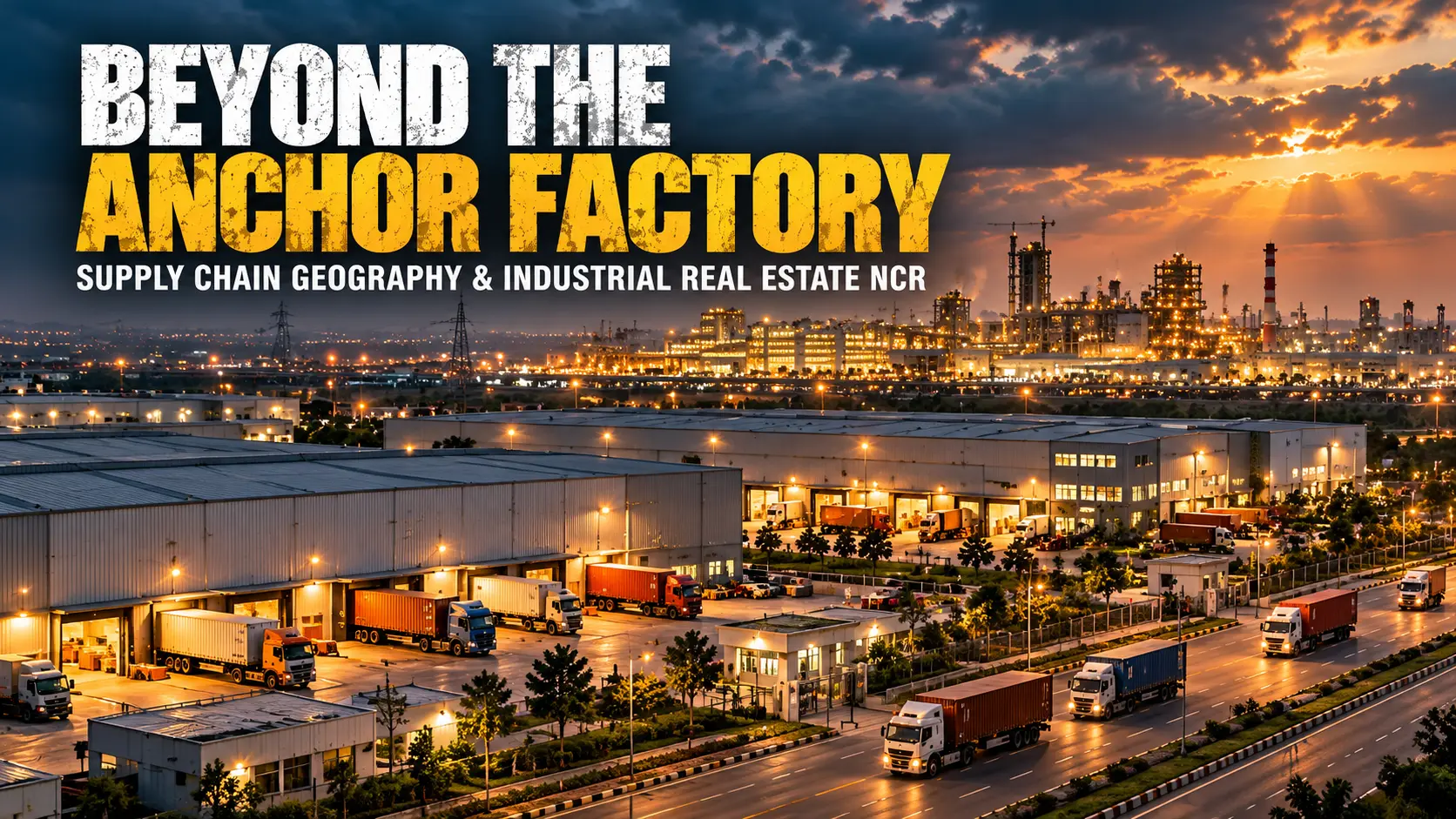
A major manufacturer announces a new factory. Thousands of crores in institutional capital are committed. Industrial land is allotted, sovereign infrastructure plans are unveiled, and market attention aggressively pivots to the surrounding property market.
The retail assumption is dangerously straightforward: a large factory will automatically attract suppliers, those suppliers will blindly require adjacent industrial space, and nearby land will instantly appreciate. But institutional land bankers know there is a critical, multi-crore question hidden inside that sequence.
Where will those tier-1 and tier-2 suppliers actually establish their operations?
Will they purchase land immediately beside the new manufacturing facility? Will they migrate into an established industrial estate twenty kilometers away to leverage existing infrastructure? Or will they bypass land acquisition entirely and lease a ready-built factory where electricity, heavy-vehicle access, and labor are already operational?
A headline manufacturing investment does not automatically translate into uniform demand for surrounding land. Across the National Capital Region (NCR), three distinct industrial markets—Kharkhoda, Greater Noida, and the Yamuna Expressway Industrial Development Authority (YEIDA)—offer a masterclass in the true physics of industrial real estate NCR. Together, they prove that the next phase of manufacturing land allocation in India will be dictated by operational networks, not just geographic proximity.
Executive Summary: VaEdifice Industrial Intelligence
- The Anchor Fallacy: A mega-factory establishes a reason for suppliers to enter a region; it does not determine which parcels of land they will occupy. Supply-chain geography governs demand.
- Market Distinctions: Kharkhoda demands proximity for tightly integrated auto components. Greater Noida leverages the immense economic value of a pre-existing ecosystem. YEIDA requires tracking the conversion from speculative land allotment to operational reality.
- Factory Leasing vs Buying: Escalating land costs are forcing MSMEs and tier-2 suppliers to critically weigh the capital trade-off between owning freehold industrial property and preserving liquidity for core manufacturing operations.
1. The Anchor Factory is Only the Beginning
Large manufacturing facilities serve as gravitational anchors for industrial development. An automotive assembly plant, for example, requires far more than sovereign land for its own production lines. Its daily operations depend on a massive network of component manufacturers, fabricated assemblies, electrical systems, and logistics hubs.
However, not all suppliers are bound by the same geographic physics. Some must operate immediately adjacent to the assembly plant because their components are delivered in a tightly coordinated “just-in-time” production sequence. Others have absolute flexibility. A manufacturer supplying standardized fasteners to multiple clients across North India will prioritize national highway connectivity and lower land costs over physical proximity to a single customer.
The Fiduciary Reality: The presence of an anchor manufacturer generates regional momentum, but predicting exact industrial property demand requires analyzing the specific operational requirements of the incoming supply chain.
2. The NCR Industrial Matrix: Kharkhoda, Greater Noida, and YEIDA
To understand how supply-chain geography actively shapes real estate valuations, we must audit three distinct industrial theaters currently dominating the NCR investment cycle.
Kharkhoda: When Proximity is an Operational Mandate
IMT Kharkhoda in Haryana is the definitive model for anchor-led industrial development. Maruti Suzuki’s massive manufacturing investment has instantly converted the location into a primary automotive production ecosystem. Major players like Jay Bharat Maruti and UNO Minda are securing industrial activity footprints here.
For automotive body and chassis components, proximity is non-negotiable due to high freight costs and sequenced assembly requirements. Kharkhoda proves that highly integrated suppliers will pay a premium to establish facilities within the immediate gravitational pull of the anchor factory. However, it is a localized demand spike, typically restricted to a tightly connected tier-1 vendor network.
Greater Noida: The Premium on Established Ecosystems
While new corridors attract headlines, established ecosystems command premiums. Greater Noida’s industrial sectors (including the Ecotech zones) represent the economic value of operational readiness. A business entering an established cluster immediately taps into heavy-duty power grids, functional drainage, an existing technical labor pool, and established transport networks.
For an MSME, the cost of industrial land is only the first line item. Delays in obtaining building approvals, laying utilities, or waiting for highway access destroy invested capital. A slightly more expensive plot in an established Greater Noida sector often offers superior unit economics compared to cheaper land in an undeveloped zone, simply because it accelerates the timeline to commercial production.
YEIDA: The Delta Between Allotment and Production
The Yamuna Expressway region represents the speculative frontier, driven by Noida International Airport and massive infrastructure pledges. However, analyzing YEIDA requires distinguishing between a paper allotment and an operational facility.
According to a late-2025 Invest UP survey, construction had not commenced on over 3,200 of the roughly 3,400 industrial plots allotted in the YEIDA region. While some delays are structural (awaiting possession or essential utilities), it highlights a critical reality in manufacturing land allocation in India: an allotted plot measures the development pipeline, but only an active factory under construction measures realized economic demand. Until those plots enter production, the secondary supplier market remains theoretical.
3. Supply-Chain Geography: Why Maps Deceive
These three locations validate a broader thesis: supply-chain geography does not respect administrative boundaries or the shortest distance on a map.
A parcel of land perfectly adjacent to a mega-factory might suffer from a narrow approach road incapable of handling multi-axle freight trucks, or it might be restricted by local zoning laws. Conversely, a plot 15 kilometers away located directly on an expressway interchange might offer flawless logistics efficiency, making it the superior operational asset.
The next phase of industrial property demand in Uttar Pradesh and the NCR cannot be predicted merely by drawing concentric circles around announced mega-projects. It requires forensic analysis of freight movement, infrastructure readiness, and the distinct real estate requirements of specialized sub-sectors (warehousing vs. precision engineering vs. heavy fabrication).
4. Capital Strategy: Factory Leasing vs. Buying
As baseline freehold values across the NCR (such as the Baghpat logistics corridors) surpass ₹40,000 per sq. yard, corporate occupiers face a fundamental capital allocation dilemma: Do we buy land and construct, or do we lease ready-built facilities?
The Ownership Model (Freehold)
Secures long-term sovereign control, allows for highly specialized structural design, and captures 100% of the underlying land appreciation. Ideal for heavy machinery operators who cannot risk lease non-renewals.
The Leasing Model (Plug & Play)
Preserves massive amounts of working capital. Funds that would be trapped in concrete can be deployed directly into manufacturing output, inventory, and labor. Accelerates speed-to-market from 18 months down to 30 days.
The dynamic of factory leasing vs buying NCR is shifting. As state policies encourage private developers to construct “Plug and Play” industrial sheds, we anticipate a massive influx of tier-2 manufacturers adopting the leasing model to preserve liquidity. Institutional investors should take note: developing compliant, ready-to-move MSME sheds on freehold land is rapidly becoming one of the highest-yield real estate plays in Northern India.
5. The Institutional Fiduciary Checklist
If manufacturing investment is only the spark, evaluating an industrial location requires a forensic set of metrics. To separate speculative noise from operational reality, industrial land bankers must ask these five questions:
- 01. Is the investment operational or merely announced? An allotted plot is a development intention; a functioning factory is an economic reality.
- 02. Which exact sub-sectors are driving demand? Precision engineering requires entirely different infrastructure (clean power, skilled labor) than heavy logistics (axle loads, turning radius).
- 03. Where are the service providers physically settling? The true economic footprint of a mega-factory bleeds into neighboring micro-markets based on highway access.
- 04. Is the land statutorily ready? Permitted land use (Section 80), RERA layouts, and unencumbered possession dictate the timeline to revenue.
- 05. Is there ground-level occupancy? Completed leases and active construction sites offer a superior dataset than government MOUs.
The next major industrial opportunity in India will likely not be the parcel closest to a headline mega-project. It will be the strategically positioned, legally cleared asset that allows the complex web of businesses supporting that project to operate with maximum efficiency.
*VaEdifice Industrial Intelligence examines the relationship between macro-infrastructure, manufacturing activity, and land economics. This analysis is an institutional framework and not a direct recommendation to purchase or sell specific property.*
VaEdifice — Real Estate. Better Understood.
Deploying capital in the NCR industrial sector requires absolute precision. We offer 100% legally cleared, Title-verified freehold industrial and residential plots ready for immediate development across the NCR and Baghpat corridors.
Frequently Asked Questions (FAQs)
Does a new anchor factory guarantee industrial land appreciation nearby?
No. While an anchor factory creates regional momentum, appreciation is dictated by supply-chain geography. Highly integrated suppliers (like auto components) may require proximity, but secondary suppliers often prioritize established infrastructure, highway access, and lower land costs over physical closeness to the anchor plant.
What is the difference between an allotted industrial plot and an operational facility in YEIDA?
An allotment indicates development intention and speculative pipeline capacity, whereas an operational facility represents deployed capital, active manufacturing, and realized economic demand. For accurate real estate analysis, institutional investors measure actual factory construction and ground-level occupancy over pure allotment metrics.
Is it better for an MSME to lease a factory or buy freehold industrial land in NCR?
It depends entirely on the company's capital strategy. Buying freehold land captures long-term asset appreciation and ensures sovereign operational control. Leasing a ready-built "plug and play" shed preserves working capital for core manufacturing and drastically accelerates the speed-to-market, which is increasingly favored by growing tier-2 suppliers.