
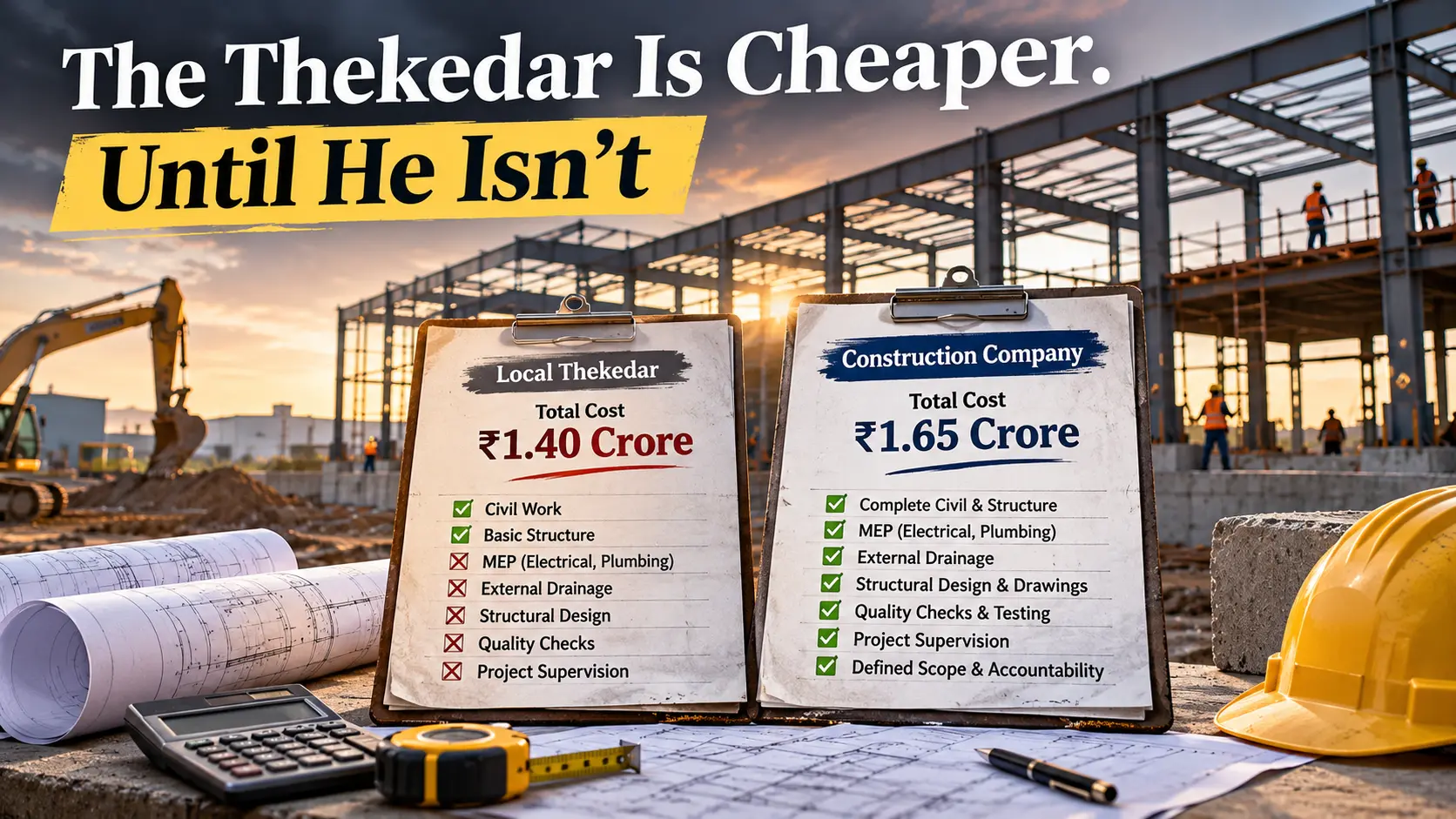
The uncomfortable economics of hiring a local contractor versus a construction company.[cite: 14]
The first contractor arrived on a motorcycle.[cite: 14] He looked at the plot, spoke to the owner for fifteen minutes and announced that the entire building could be completed for 1.40 crore.[cite: 14]
The second arrived with drawings, an engineer and a quotation running to several pages.[cite: 14] 1.65 crore.[cite: 14]
Same plot. Same proposed building. A difference of 25 lakh.[cite: 14]
The owner looked at the two quotations and asked the most reasonable question in Indian construction: “Why should I pay 25 lakh more for the same building?”[cite: 14]
An excellent question.[cite: 14] Unfortunately, nobody had yet established whether he was being offered the same building.[cite: 14] And that is where construction becomes interesting.[cite: 14]
The Great Indian Quotation Competition
India has a remarkable talent for reducing complicated construction projects to a single number.[cite: 14] “Kitne mein bana doge?”[cite: 14] The question sounds straightforward.[cite: 14]
It is rather like asking a restaurant how much dinner costs without mentioning whether you want a plate of dal or a wedding reception for four hundred guests.[cite: 14]
A construction quotation is not merely a price.[cite: 14] It is a promise about what will be delivered, using which materials, under whose supervision, within what timeframe and subject to which conditions.[cite: 14]
Two quotations can appear to describe the same building while including entirely different work.[cite: 14] One might include excavation, foundations, structural steel, roofing, flooring, electrical installation and drainage.[cite: 14] The other might include only civil work and a reassuring amount of optimism.[cite: 14] Both may be presented as complete construction.[cite: 15]
The difference often becomes apparent when the owner asks about the first item that was never discussed.[cite: 15] And then the second.[cite: 15] And then the third.[cite: 15] By this stage, the cheaper quotation may have developed an unexpectedly sophisticated personality.[cite: 15]
The Thekedar Is Not Necessarily the Villain
Before we begin prosecuting the neighbourhood contractor, a little fairness is in order.[cite: 15] India has many exceptionally capable local contractors.[cite: 15] Some have spent decades building factories, warehouses, homes and commercial properties.[cite: 15] They understand local labour, know suppliers personally and can solve practical site problems with impressive speed.[cite: 15]
They may also operate with lower overheads than a larger construction company.[cite: 15] For a relatively straightforward project, supported by complete drawings, a clear contract and competent independent supervision, a good local contractor can offer excellent value.[cite: 15]
A company with an expensive office does not automatically produce better concrete.[cite: 15] And a contractor who arrives on a motorcycle may know considerably more about construction than an executive who arrives in a luxury SUV.[cite: 15]
The problem is not the thekedar.[cite: 15] The problem begins when trust is expected to perform the duties of engineering, documentation and accountability.[cite: 15]
“Don’t worry, sir. We’ve been doing this for twenty years.”[cite: 15] That may be true.[cite: 15]
But experience does not tell the owner which grade of concrete will be used, who will inspect the reinforcement or what happens when the work fails to meet specifications.[cite: 15] Those questions deserve answers before construction begins.[cite: 15] Preferably written ones.[cite: 15]
The Construction Company Is Not Automatically the Hero
Now for the other side.[cite: 16] A registered construction company may offer engineers, project managers, procurement systems, quality checks and formal reporting.[cite: 16] These can be valuable advantages, particularly on complicated projects.[cite: 16]
But the words Private Limited are not a structural engineering qualification.[cite: 16] Some companies subcontract most of their work. That is perfectly normal when responsibilities are properly managed.[cite: 16] Others advertise professional project management while leaving the site almost entirely in the hands of a subcontractor.[cite: 16]
A client may discover that the person who confidently explained the construction methodology during the sales meeting has not visited the site since the advance payment cleared.[cite: 16] A glossy company profile cannot compensate for absent supervision.[cite: 16] Nor does a higher quotation automatically mean better materials, stronger engineering or fewer delays.[cite: 16]
A construction company charging more must demonstrate what the extra money buys. Otherwise, the client may simply be financing better stationery.[cite: 16]
The sensible comparison is not local contractor versus construction company.[cite: 16] It is an accountable construction arrangement versus an unaccountable one.[cite: 16] Either type of provider can fall on either side.[cite: 16]
The 25-Lakh Question
Return to our hypothetical factory owner.[cite: 16] The local contractor has quoted 1.40 crore.[cite: 16] The construction company has quoted 1.65 crore.[cite: 16] Before choosing, the owner requests detailed, comparable quotations.[cite: 16]
Now the differences begin to emerge.[cite: 16] The first quotation excludes external drainage and certain electrical works.[cite: 16] The second includes them.[cite: 16] The first leaves structural design to an engineer appointed separately by the owner.[cite: 16] The second includes structural engineering and specified inspections.[cite: 17] The first does not clearly define who pays for additional excavation if unexpected ground conditions are encountered.[cite: 17] The second includes a procedure for evaluating and approving variations, though unforeseen conditions may still increase the final cost.[cite: 17]
Suddenly, the 25-lakh difference is no longer a simple premium.[cite: 17] Some of it may represent work that the first contractor has not priced.[cite: 17] Some may represent supervision and documentation.[cite: 17] And some may still represent additional overhead or profit.[cite: 17] The owner must distinguish between them.[cite: 17] This does not prove that the construction company is cheaper overall. It may not be.[cite: 17]
It proves something more useful: You cannot compare two construction prices until you have compared two construction scopes.[cite: 17]
The number at the bottom of a quotation is only meaningful when the work above it is understood.[cite: 17]
The Most Expensive Sentence in Construction
There is a sentence that has probably financed more rework than anyone cares to calculate:[cite: 17] “We’ll figure it out on site.”[cite: 17]
Occasionally, a site condition genuinely requires an engineering decision during construction.[cite: 17] That is normal.[cite: 17] What is not normal is treating incomplete planning as a construction strategy.[cite: 17]
Imagine beginning an industrial building without properly coordinating the structural drawings, machinery requirements, drainage layout and electrical services.[cite: 17] The foundations are cast.[cite: 17] Then the owner discovers that a particular machine requires a different foundation arrangement.[cite: 17] Or that the loading area cannot accommodate the vehicles expected to use it.[cite: 17] Or that a proposed mezzanine introduces loads the original structure was not designed to carry.[cite: 17]
Corrections may require demolition, strengthening, redesign or expensive changes to completed work.[cite: 17] None of these outcomes is inevitable.[cite: 18] Many are avoidable with appropriate planning and coordination.[cite: 18]
Concrete is wonderfully obedient when poured. It becomes considerably less cooperative once it has hardened in the wrong place.[cite: 18]
A good construction team understands that the cheapest time to resolve many design conflicts is before they become physical structures.[cite: 18]
The Factory That Looked Perfect—Until the First Truck Arrived
Industrial construction deserves particular attention because a factory is not simply a large building.[cite: 18] It is a working environment.[cite: 18]
Consider a warehouse with an attractive exterior, adequate roof height and neatly finished floors.[cite: 18] On paper, it appears successful.[cite: 18] Then the first fully loaded commercial vehicle arrives.[cite: 18] The entrance is awkward.[cite: 18] The turning space is inadequate.[cite: 18] The loading arrangement slows material handling.[cite: 18]
Suddenly, a building that looked excellent in photographs becomes inconvenient to operate.[cite: 18] Depending on the intended use, industrial buildings may require carefully considered floor loads, column spacing, vehicle circulation, fire protection, ventilation, utilities and future expansion provisions.[cite: 18] These decisions affect both construction cost and commercial usefulness.[cite: 18]
A cheaper building that cannot efficiently accommodate its intended operations may become an expensive asset to own.[cite: 18] Conversely, overspecifying a facility with features that no occupier needs can also destroy investment returns.[cite: 18] The objective is not to build the most expensive factory.[cite: 18] It is to build the right factory.[cite: 18]
A beautiful industrial building with nowhere to park a truck is an architectural achievement of questionable commercial value.[cite: 18]
Sahibabad Site IV: Where Construction Meets Industrial Reality
Established industrial locations such as Sahibabad Site IV present a particular set of construction decisions.[cite: 19] An owner may be considering a new industrial building, modifications to an existing facility or redevelopment of an older property.[cite: 19] The question is not always whether to construct.[cite: 19] Sometimes it is whether the existing building should be retained, strengthened, altered or replaced.[cite: 19]
That decision may require structural assessment, examination of applicable development permissions and a realistic comparison of costs.[cite: 19] There may also be procedures involving the Uttar Pradesh State Industrial Development Authority, or UPSIDA, depending on the property and proposed work.[cite: 19]
This is where the difference between simply arranging labour and coordinating an industrial construction project becomes important.[cite: 19] Construction drawings, engineering, statutory requirements, site execution and commercial objectives must work together.[cite: 19] A contractor may be highly competent at executing work.[cite: 19] A construction company may be equipped to coordinate several disciplines.[cite: 19] But in either case, the owner should establish exactly who is responsible for each stage.[cite: 19]
Because when something goes wrong, a building owner needs more than a collection of people explaining that the problem belongs to somebody else.[cite: 19]
The Contract Is Not an Insult to Trust
In India, construction arrangements sometimes begin with personal relationships.[cite: 19] A friend recommends a contractor.[cite: 19] A relative knows a supplier.[cite: 19] Someone has worked with someone for twenty years.[cite: 19] These connections can be useful.[cite: 19] But a construction contract should not be viewed as an expression of distrust.[cite: 19] It is a practical record of expectations.[cite: 19]
A proper agreement should establish the scope of work, specifications, payment milestones, timelines, variation procedures, responsibilities, defect obligations and dispute-resolution arrangements.[cite: 20] The precise provisions should reflect the project and be reviewed appropriately.[cite: 20] The owner should also know who is responsible for obtaining required approvals and who is authorised to approve additional expenditure.[cite: 20]
Without clear procedures, disagreements can become surprisingly expensive.[cite: 20] The contractor says the work was extra.[cite: 20] The owner says it was included.[cite: 20] Both remember the original conversation differently.[cite: 20] Neither has written it down.[cite: 20] And now the project has acquired a fifth stakeholder: the argument.[cite: 20]
A handshake may begin a construction project. It should not be the only document keeping it together.[cite: 20]
Five Questions Worth Asking Before Signing
Whether the quotation comes from a local thekedar or a construction company, the owner should ask five questions.[cite: 20]
- ✓ What exactly is included? Request a detailed scope, drawings, specifications and measurable quantities wherever appropriate.[cite: 20]
- ✓ Who is responsible for engineering? Identify the qualified professionals responsible for design, review and necessary technical approvals.[cite: 20]
- ✓ Who will supervise the site? Establish who will inspect work, coordinate trades and maintain quality records.[cite: 20]
- ✓ How will changes affect the price? Require a transparent method for pricing and approving additional work before it proceeds.[cite: 20]
- ✓ Who is accountable after completion? Understand contractual defect obligations, warranties where applicable and the process for resolving deficiencies.[cite: 20]
A capable contractor should not be offended by these questions.[cite: 20] A credible construction company should welcome them.[cite: 20] And an owner should be concerned about any provider who treats basic documentation as an unnecessary inconvenience.[cite: 20]
Where VaEdifice Fits
At VaEdifice, we work across industrial real estate and construction, including industrial land opportunities in Baghpat and construction-focused services in Sahibabad Site IV.[cite: 21] Our activities also include property sale and purchase and relevant UPSIDA liaisoning, connecting property-related decisions with the practical requirements of industrial development.[cite: 21]
The underlying philosophy is straightforward.[cite: 21] A building should be planned around its intended use, appropriate engineering, applicable permissions and the owner’s commercial objectives.[cite: 21] Whether an owner is developing a new industrial facility or evaluating work on an existing property, the important decisions begin before the first concrete truck arrives.[cite: 21]
No construction company can eliminate every risk.[cite: 21] And no responsible firm should promise that every project will finish without changes or unexpected conditions.[cite: 21] What matters is how those risks are anticipated, documented, managed and addressed.[cite: 21] That is where professional accountability should earn its price.[cite: 21]
So, Should You Hire the Thekedar or the Construction Company?
The answer is rather inconvenient.[cite: 21] It depends.[cite: 21]
A capable local contractor working with good drawings, a clear contract and independent engineering supervision may be the right choice.[cite: 21] A construction company with a competent project team, documented procedures and a well-defined scope may offer better value for a more complex project.[cite: 21] A poorly managed company can waste money just as effectively as a poorly managed contractor.[cite: 21]
The correct decision requires examining competence, scope, supervision, contractual responsibility and total project cost.[cite: 21] Not merely the name printed on the quotation.[cite: 21] And certainly not the vehicle parked outside the meeting.[cite: 21]
Our hypothetical owner began with two prices: 1.40 crore and 1.65 crore.[cite: 21] He thought he was choosing between saving 25 lakh and spending it.[cite: 21] In reality, he was choosing between two sets of promises that needed to be understood.[cite: 22] That is the lesson.[cite: 22]
The most expensive mistake in construction is not always hiring the wrong contractor.
Sometimes it is signing a contract without understanding what you have actually bought.[cite: 22]
VaEdifice[cite: 22]
Industrial Construction | Industrial Real Estate | Sale & Purchase | UPSIDA Liaisoning[cite: 22]
Baghpat • Sahibabad Site IV • NCR[cite: 22]
Building with purpose. Developing with perspective.[cite: 22]
Editor’s note: The project, quotations and costs in the opening scenario are illustrative, not accounts of an actual VaEdifice project.[cite: 22]