
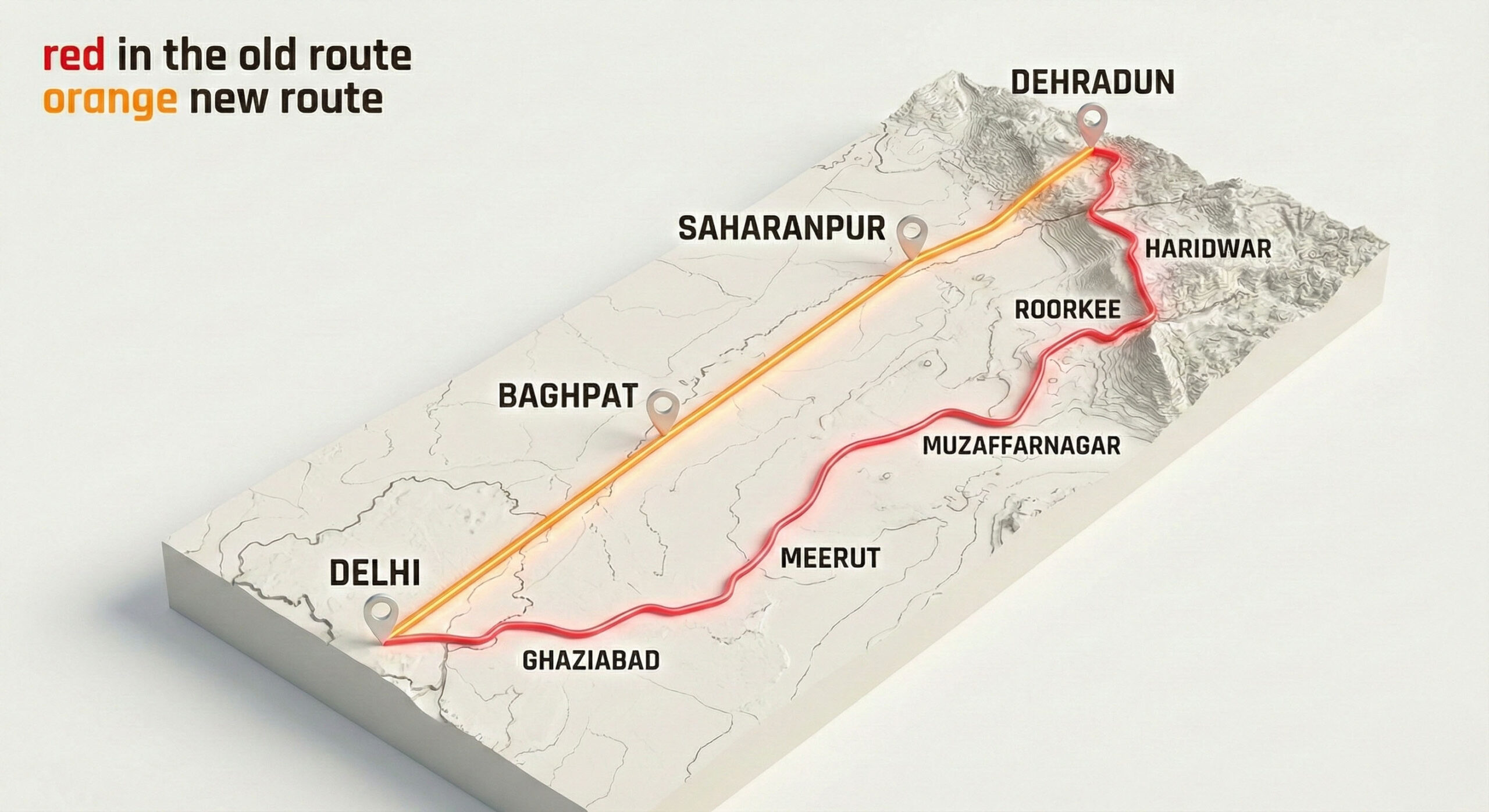
For decades, the northern logistics and tourism corridors of India were suffocating. National Highway 58, initially designed to handle a modest capacity of 20,000 vehicles per day, was buckling under the weight of 65,000 daily transits. This crushing volume—a complex mix of 37 million annual spiritual pilgrims heading to the Char Dham, heavy military convoys supplying the Line of Actual Control, and weekend tourism traffic—was routinely paralyzed at the notorious Muradnagar, Modinagar, and Muzaffarnagar bottlenecks. Recognizing that simply widening the existing concrete jungle was logistically impossible, the state engineered a radical ₹13,000 crore intervention: drawing a completely new line through the landscape to create the Delhi-Dehradun Expressway.
Designed to compress a grueling journey into a highly efficient 150-minute transit, this expressway stands as a monumental achievement in modern Indian infrastructure. However, the execution of this highway was anything but seamless. It was a project constantly besieged by external friction. During its initial phases, construction was paralyzed by the pandemic, with critical industrial oxygen diverted from steel welding to save human lives. It survived a grueling four-year legal war in Mandola village, where a single landowner utilized a 1998 court order over a mere 70-meter stretch of land to stall billions of rupees in state capital. Yet, the most formidable obstacle was not legal or viral; it was strictly ecological.
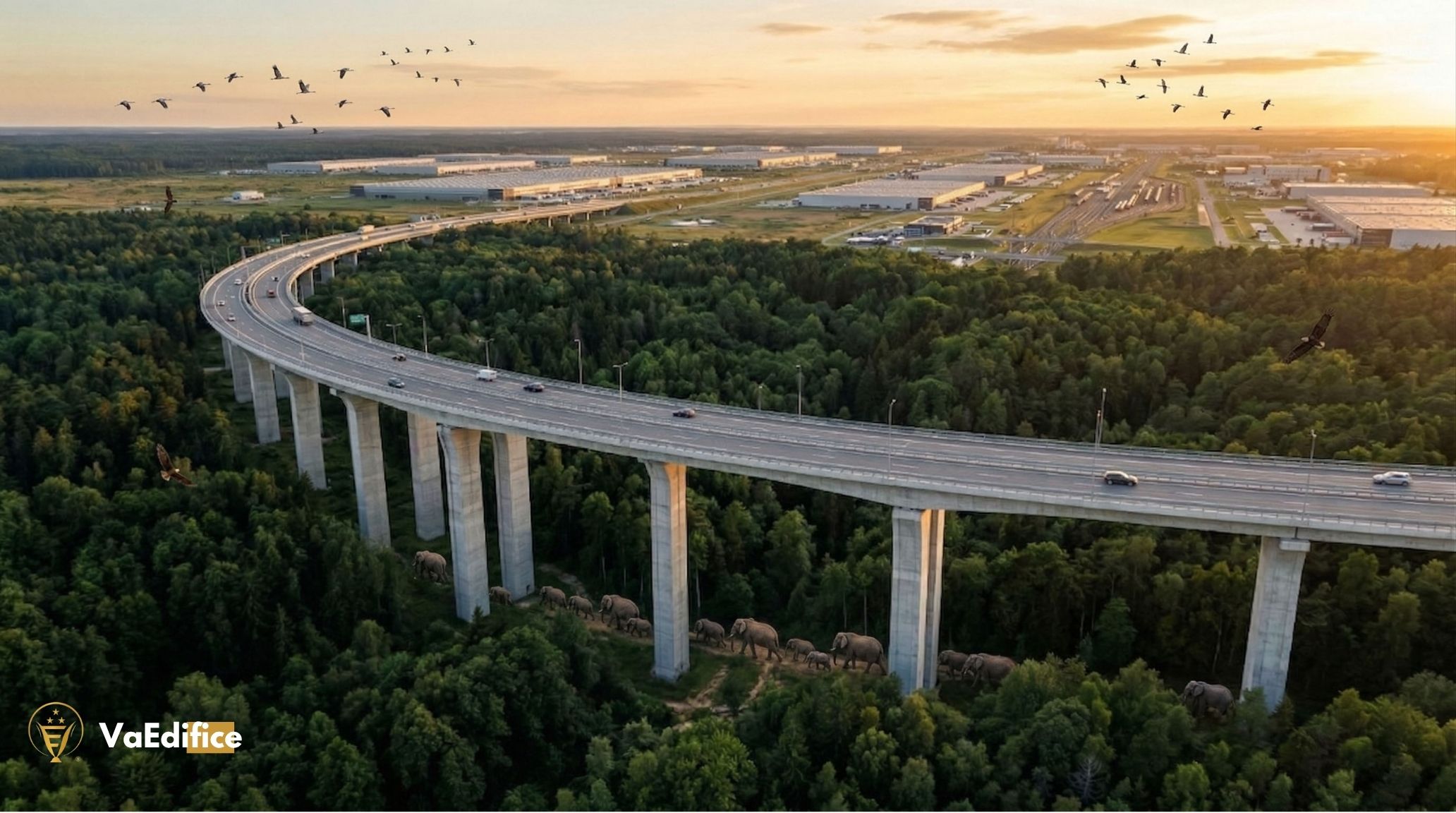
To reach the valley, the expressway had to bisect the Ganeshpur forest, a critical habitat for leopards and migratory elephant herds. Facing intense scrutiny from the National Green Tribunal and the Supreme Court over the proposed felling of 11,000 trees, engineers were forced to abandon traditional ground-level construction. Instead, they built a 12-kilometer road suspended in the sky—Asia’s longest elevated wildlife corridor. This structure was dictated entirely by biology: massive pillars spaced widely to allow unrestricted herd migration, a strict six-meter vertical clearance to accommodate bull elephants, specialized acoustic barriers to muffle engine roar, and directional lighting to protect nocturnal hunters. Coupled with the 340-meter Dat Kali Tunnel bored directly through the mountains, the state successfully stitched a severed ecosystem back together while simultaneously delivering unparalleled vehicular speed.
The retail market and mainstream media are currently mesmerized by these engineering feats. Retail investors are aggressively deploying capital to purchase weekend villas and hospitality assets in the hills, blinded by the convenience of a two-and-a-half-hour commute. But while the masses focus on the destination, smart money knows the real story isn’t about reaching the mountains faster. It is about the underlying infrastructure unlocking entirely different, highly lucrative asset classes along the transit route. Retail investors are driving blindly toward a systemic bottleneck, while institutional capital is quietly securing the high-yield production nodes left in their wake.
The “Bottleneck Transfer” and Destination Depreciation
In the realm of macro-economics, every structural solution inherently carries the seeds of a new crisis. For twenty years, the Dehradun valley was largely protected from terminal, catastrophic overcrowding simply because vehicular traffic was physically trapped in the Modinagar gridlock. The friction of the journey acted as a natural barrier to entry. Today, those floodgates have been completely removed.
By making it mechanically effortless to reach Dehradun, the state has inadvertently made it effortless to suffocate the destination. The infrastructure has essentially transferred the massive traffic bottleneck from the highway directly into the heart of a valley that was architecturally designed for a slower, lower-density era. Local analysts are already dubbing this impending saturation as “Dehra-Doomed.” For an institutional investor, purchasing premium real estate in an ecologically fragile, congestion-bound zone is a highly depreciating strategy. A hyper-fast logistics artery leading directly to a collapsing, overcrowded destination is a classic trap for uneducated capital.
The Infrastructure Effect: Where Smart Money is Deploying
Astute players do not look at the end of the road; they analyze the friction points and economic awakenings along it. The true wealth generation of the Delhi-Dehradun Expressway lies in the revitalization of former “flyover country.” Territories that were previously bypassed by premium developers have suddenly transformed into high-velocity transit hubs.
While retail buyers chase the volatile consumption economy in the congested hills, manufacturers, third-party logistics (3PL) providers, and warehousing giants are deploying heavy capital into the production economy. Securing Baghpat freehold land allows major enterprises to leverage the exact same 150-minute supply chain without absorbing the exorbitant land acquisition costs or the severe ecological restrictions of mountain development. In zones adjacent to these new interchanges, land values are structurally guaranteed to experience double-digit capital appreciation, driven by hard utility rather than tourism speculation.
The NCR Freehold Superiority
When deeply analyzing the Delhi-Dehradun Expressway investment landscape, one must critically acknowledge the absolute limitations of geography. You cannot aggressively scale a commercial real estate portfolio where you must legally negotiate with wildlife corridors and bore through solid rock. Compare this highly restricted environment to the master-planned expanses of the broader National Capital Region.
- The Ecological Ceiling: Mountain real estate development is strictly capped by biology and absolute law. The National Green Tribunal ensures that massive commercial scaling will always be suppressed in these zones.
- The Logistics Pivot: Institutional funds are utilizing these new northern expressways strictly as delivery arteries, turning midway points like Baghpat into highly lucrative backend warehousing goldmines.
- The Ultimate Safe Haven: True generational wealth scales in environments engineered for unrestricted expansion. The flat, sovereign, and highly regulated parcels of Noida and the Yamuna Expressway remain the superior holding grounds for large-scale capital.
The Delhi-Dehradun Expressway is a monument to human engineering and an undeniable engine of regional economic growth. However, for the high-net-worth investor, the operational mandate is clear and unforgiving: yields are great, but the regulatory environment is the throne. Do not buy into the heavily restricted destination. Secure the sovereign, unrestricted infrastructure nodes that feed it.
Deploy Capital with Grounded Intelligence
At VaEdifice, we help you navigate market complexities and avoid costly regulatory traps. We specialize in identifying secure, high-yield opportunities across Baghpat, Noida, and the Noida–Greater Noida Expressway.
Connect with our principal analysts to map out a highly compliant, domestic acquisition strategy that protects and aggressively scales your capital. Connect with us directly at +91 92205 94889.
📞 Consult VaEdifice: +91 92205 94889 ✉️ Secure Your Capital: info@vaedifice.com