
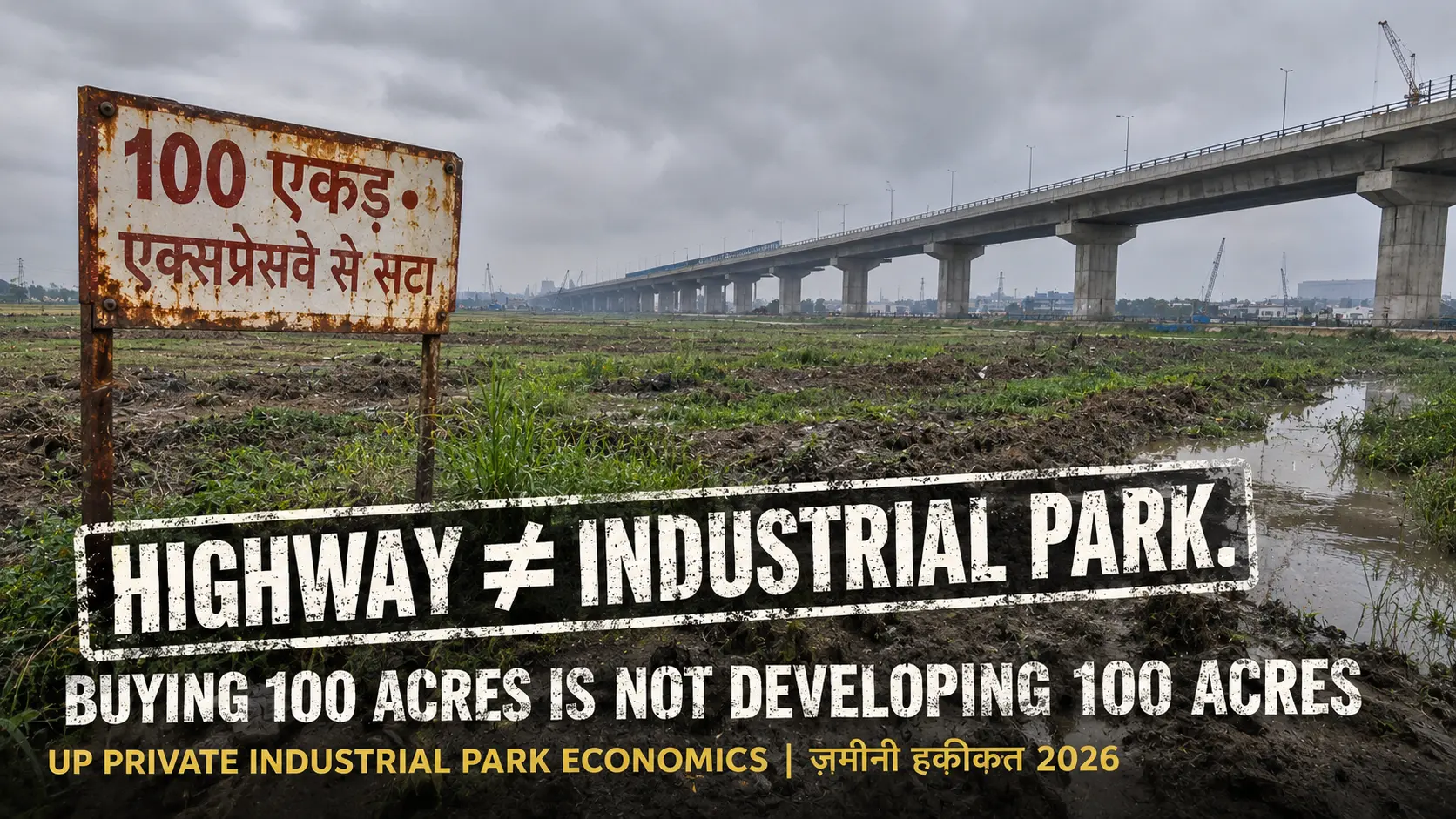
The complicated economics of land aggregation and Uttar Pradesh’s private industrial park opportunity.
Executive Briefing
Transaction vs. Operating Business: Assembling 100+ acres is measured in registered deeds; developing a private industrial park is measured in serviced, legally usable land that manufacturers can actually occupy, finance, and operate from.
Ceiling vs. Cheque: Under UP’s IIEPP 2022 framework, the 25% capital subsidy (capped at ₹80 crore for parks above 100 acres) excludes land acquisition and worker housing from its calculation base—and stamp duty exemptions require an equivalent bank guarantee.
The Holdout Sequencing Trap: Buying the easiest parcels first can be the most expensive sequence. Missing entrance strips or utility corridors break layout geometry long before aggregation crosses the 80% threshold.
The 36% Allocable-Area Shock: On an illustrative 120-acre, ₹240 crore project, a drop in allocable industrial area from 75% to 55% pushes required cost recovery from ₹2.67 crore to ₹3.64 crore per allocable acre—even before financing or redesign costs.
Imagine an investment committee approving a sprawling industrial park. The location looks promising, the landowners appear willing to sell, and the spreadsheet anticipates a handsome return. Then the engineers arrive. A drainage channel interrupts the layout, a crucial access parcel remains unsigned, and the proposed electricity connection requires infrastructure that nobody has budgeted for. The acreage has not changed. The investment has.
This hypothetical scenario illustrates a distinction that deserves more attention in industrial land acquisition in Uttar Pradesh: assembling land is a transaction; developing an industrial park is a business. The first can be measured in registered deeds. The second must be measured in land that businesses can actually occupy, finance, and operate from.
Assembling land is a transaction.
Developing an industrial park is a business.
An Opportunity, Not a Blank Cheque
The state’s Industrial Investment & Employment Promotion Policy 2022 gives private developers a clear reason to examine this market. For qualifying parks larger than 100 acres, the published policy offers support equal to one-quarter of eligible fixed capital expenditure, capped at ₹80 crore. Land and worker accommodation construction are excluded from that calculation, though a separate accommodation benefit may apply. A land-purchase stamp duty exemption is linked to an equivalent bank guarantee, and the framework requires at least five industrial units while limiting the share of allocable industrial area occupied by any one unit to 80%.[1]
The distinction between a ceiling and a cheque matters. A developer who spends ₹120 crore acquiring land has not thereby generated ₹30 crore of eligible infrastructure subsidy. Nor should an investment committee treat conditional benefits as cash already available for construction. Model the project without incentives first, then evaluate the upside separately.
The “Ceiling vs. Cheque” Policy & Feasibility Matrix
| Project Parameter | What the Spreadsheet Assumes | What Actually Governs the Project |
|---|---|---|
| ₹80 Crore Capital Subsidy (>100 Acres) | Treats 25% of total project spend—including land cost—as upfront construction liquidity. | Applies only to eligible fixed capex; land and worker housing construction are excluded, and disbursement is conditional. |
| Stamp Duty Exemption | Assumes zero working-capital drag on land purchase registration. | Linked to submitting an equivalent bank guarantee, impacting promoter credit lines and collateral. |
| Anchor Tenant Mix | Plans around selling or leasing the entire park to one mega manufacturer. | Policy mandates at least five industrial units, with no single unit exceeding 80% of allocable industrial area. |
| Expressway Access | Equates proximity to a major highway with ready-to-operate industrial viability. | External road connectivity does not guarantee internal power load, lawful water, drainage, or effluent infrastructure. |
The Last Acre Can Be the Most Expensive Acre
Land aggregation for industrial projects is not simply a negotiation repeated a hundred times. Each parcel changes the value of the others. A small holding at the entrance may matter more than a much larger parcel at the edge. A missing strip can interrupt a utility corridor or force an expensive redesign. Buying the easiest parcels first may therefore be the most expensive sequence.
The state’s published facilitation framework recognises this challenge. For eligible parks above 100 acres outside specified authority and notified areas, it provides a staged facilitation mechanism—where pooling agreements count towards specified later milestones:[2]
The 4-Stage UP Private Industrial Park Aggregation Ladder (>100 Acres)
Stage 01
25%
Initial Licensing
Triggered after registered acquisition of 25% of the proposed project area.
Stage 02
60%
Project Report (18 Mos.)
Project report due within 18 months with 60% assembled (pooling counts toward specified later milestones).
Stage 03
75%
Layout Approval
Formal layout approval is linked to reaching 75% aggregation across the proposed parcel.
Stage 04
80%+
UPSIDA Assistance
Potential UPSIDA acquisition assistance for holdout gaps after 80% aggregation, backed by a bank guarantee.
*Applies to eligible parks above 100 acres outside specified authority and notified areas. Always confirm operative licensing conditions and deadlines with the competent authority.[2]
These provisions are not a substitute for commercial planning. Before the first purchase, map ownership, access, contiguity, and the parcels that determine whether the whole scheme works. Confirm the applicable licensing conditions and deadlines with the competent authority.
The price of a plot is negotiable; the geometry of a missing road is rather less so.
The Acres That Never Appear on a Sale Invoice
Every greenfield industrial project needs land for more than factories. Internal roads, turning areas, drainage, utility corridors, common facilities, and applicable open-space requirements consume part of the site. Topography, easements, and statutory restrictions may reduce usable land further. The actual layout must be established by qualified professionals under the applicable rules, not by a broker’s estimate of the saleable percentage.
Consider an illustrative 120-acre development with an assumed total project outlay of ₹240 crore, before incentive receipts. The following is a sensitivity analysis, not a market valuation or prescribed planning ratio:
Allocable Share vs. Required Cost Recovery per Acre (120 Acres | ₹240 Cr Outlay)
| Allocable Share | Allocable Acres | Cost / Allocable Acre | Break-Even Cost Pressure (Visual Impact) |
|---|---|---|---|
| 75% | 90 Acres | ₹2.67 Crore |
Baseline (1.00x)
|
| 65% | 78 Acres | ₹3.08 Crore |
+15.4% Cost / Acre
|
| 55% | 66 Acres | ₹3.64 Crore |
+36.3% Required Cost Recovery
|
A decline from 90 to 66 allocable acres increases the required cost recovery per acre by roughly 36%, even before any additional financing or redesign expense.
The developer still owns 120 acres.
The customer, inconveniently, pays for the portion that can be used.
An Expressway Is Not an Industrial Utility
A well-connected industrial park can still be a poor manufacturing location. Prospective occupiers need dependable electricity, lawful water arrangements, drainage, effluent management where applicable, and access suitable for their vehicles. External connectivity and internal service capacity are different questions. An assessment should identify who builds each connection, who bears the cost, and when it can realistically become operational.
The same discipline belongs in title and regulatory due diligence. A registered instrument should be examined alongside the ownership chain, encumbrances, revenue records, boundaries, access rights, and relevant land-use permissions. The appropriate approvals depend on location, proposed activities, and the governing authority. A neat satellite image cannot establish transferable title.
Develop for the Occupier, Not the Brochure
Private industrial parks in UP should be planned around identifiable manufacturing demand. A logistics operator, a food processor, and an engineering business may require quite different plot dimensions, utilities, and environmental arrangements. An anchor tenant can improve confidence, but concentration, phasing, and the cost of common infrastructure must still be tested against the applicable industrial park development policy.
For institutional investors, the useful question is not how many acres can be acquired this quarter. It is how much serviced, legally usable land can be delivered at a cost that prospective industrial occupiers can justify. A good acquisition mandate therefore integrates title review, technical feasibility, commercial demand, and a phased capital plan before negotiations become irreversible.
The investment begins before the first deed. The industrial park begins when the land can do what the investor bought it to do.
Industrial Land & Development Advisory — VaEdifice
Industrial real estate consultancy must earn its place by coordinating the questions that connect a land purchase to a viable development—rather than merely introducing a buyer to a seller.
At VaEdifice (Vasudev Edifice Private Limited), we advise developers, institutional buyers, and industrial operators across Noida, Greater Noida, Yamuna Expressway (YEIDA), Baghpat, and NCR on land aggregation, feasibility, and industrial construction. Speak directly with our advisory desk.
Sources & Verification
- Government of Uttar Pradesh, Industrial Investment & Employment Promotion Policy 2022, Section 4.3 (final policy dated 4 November 2022). Read official policy PDF.
- Invest UP, Official Policy Summary & Government-Order Index (IIEPP 2022). Read official summary & GO index.
- Invest UP, Policy Highlights (March 2025). Read official highlights PDF.
Verification Note: The published policy and official summaries support the stated framework. The full June 2023 private industrial park implementation order and any later amendments have not been independently reviewed. Official summaries also differ on certain timing and disbursement details; these have been omitted where reconciliation was not possible. Confirm operative conditions before relying on incentives or acquisition assistance. The financial example is hypothetical; it excludes any separately modelled financing, tax, and incentive effects.