
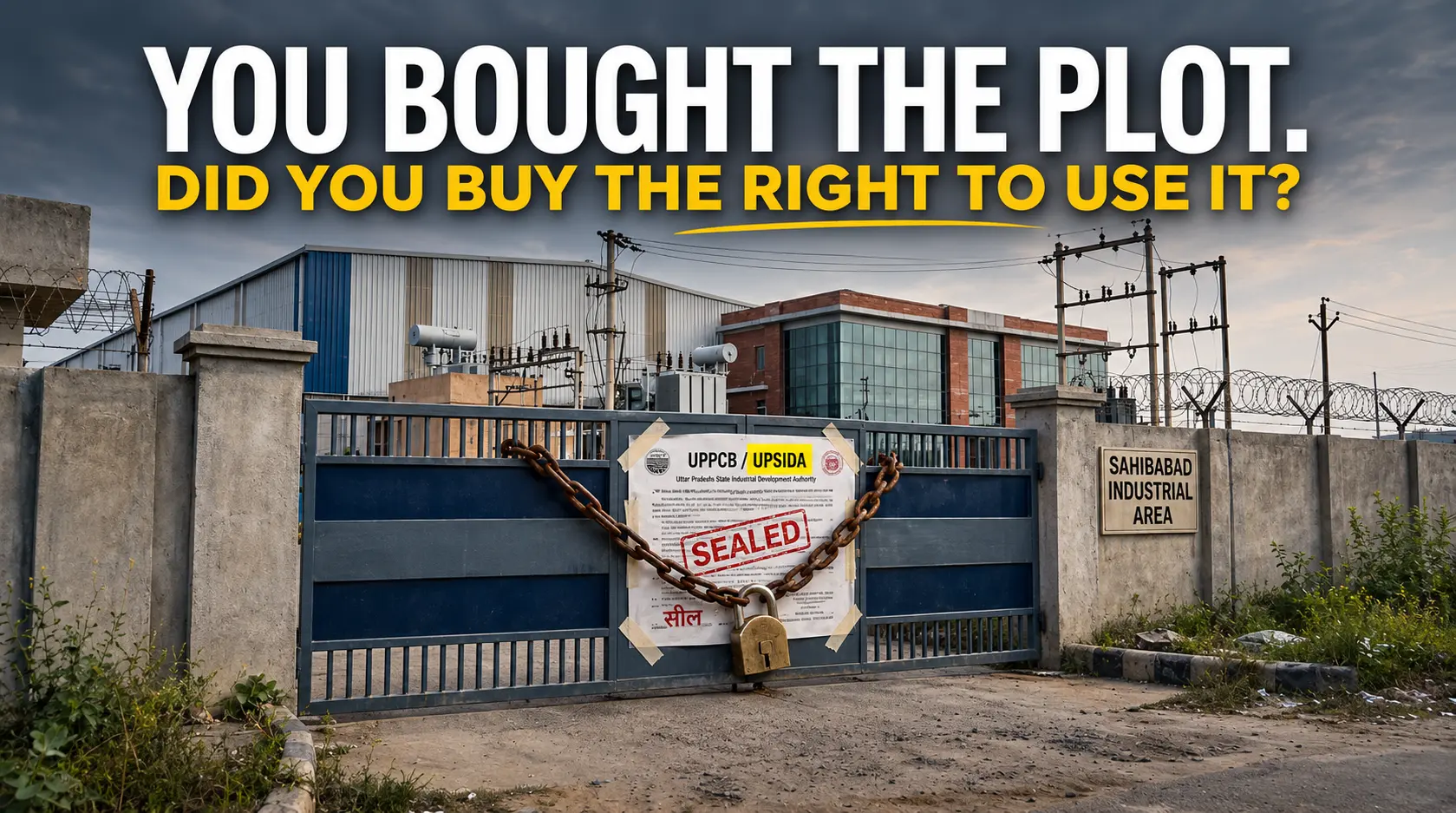
The uncomfortable difference between acquiring an industrial property and being legally entitled to build, manufacture, and operate the business you had in mind.[cite: 24]
Executive Briefing
The Valuation Illusion: A property can be worth ₹5 Crore and still be the wrong property for a ₹50-Crore business.[cite: 24] Buying an industrial plot does not automatically grant permission to establish any type of manufacturing unit.[cite: 24, 25]
The Environmental Trap: UPPCB pollution consents (CTE/CTO) are tied to specific activities and capacities.[cite: 25, 26] The previous owner’s permission to manufacture one product is not your permission to manufacture another.[cite: 26]
Leasehold vs. Freehold Realities: In UPSIDA areas like Sahibabad Site IV, outstanding dues, transfer charges, and strict lease conditions dictate your actual property rights.[cite: 26, 34] A registry office records a transaction; it does not approve your production line.[cite: 27]
The Hidden CAPEX Shock: Discovering unapproved structural modifications, inadequate road access for trucks, or effluent treatment requirements post-purchase can add 10% or more to your initial capital budget.[cite: 27, 28, 29, 30]
Imagine a businessman looking for an industrial property in Sahibabad Industrial Area, Site IV, Ghaziabad.[cite: 24] The location is established, the roads are familiar, and factories operate on neighbouring plots.[cite: 24] The asking price is ₹5 Crore.[cite: 24]
His broker discusses the location. His accountant discusses the tax implications. His banker discusses the loan.[cite: 24]
Almost nobody discusses the factory he actually intends to establish.[cite: 24] To safely navigate a purchase in UPSIDA-managed areas, industrial buyers must evaluate the asset across three distinct phases: the physical illusion of the property, the strict regulatory realities, and the subsequent capital expenditure shock.[cite: 24, 32]
Phase 1: The Illusion of the Asset
Sahibabad Site IV is an established industrial area, making it highly attractive for expansion within the NCR.[cite: 25] However, buyers frequently treat “industrial designation” as a blanket permission to manufacture whatever they choose.[cite: 25] It is not.[cite: 25] A packaging operation, an engineering workshop, and a metal-finishing unit have drastically different regulatory and infrastructure requirements.[cite: 25]
Whether you are evaluating a vacant plot or an existing facility, the physical appearance often conceals regulatory constraints.[cite: 27, 28] An older industrial structure may have acquired unapproved additional floors or enclosed loading areas.[cite: 27] Similarly, a vacant 1,000-square-metre plot does not guarantee a 1,000-square-metre factory floor once permissible ground coverage, setbacks, and fire provisions are applied.[cite: 28]
The Industrial Property Audit: Assumption vs. Reality
What The Buyer Sees
“The factory has been standing for 30 years. It must be completely legal.”[cite: 27, 28]
“The seller is running a factory here, so my factory will obviously be allowed.”[cite: 25, 26]
“The road outside the plot is wide enough for trucks.”[cite: 29]
The Legal & Structural Reality
Age does not establish compliance. A 30-year-old building may have unsanctioned extensions violating UPSIDA approved drawings.[cite: 27, 28, 34]
Permissions are process-specific. The seller’s permission for a low-impact unit does not authorize your metal-finishing operation.[cite: 25, 26]
A road outside is not proof that heavy delivery vehicles can turn, load, and unload safely within the site’s dimensions.[cite: 29]
A factory needs space to function, not merely space to exist.[cite: 28] The most expensive square metre in industrial construction is sometimes the one you discover you were never allowed to build.[cite: 29]
Phase 2: The Regulatory Reality (Leases & Pollution)
Buyers in UPSIDA-managed areas must distinguish between acquiring freehold ownership and acquiring a leasehold right.[cite: 26] The two are not interchangeable.[cite: 26] A seller may possess the keys and operate a business, but the buyer must investigate whether the lease remains valid, whether transfer requires UPSIDA permission, and whether any cancellation proceedings or hidden municipal dues exist.[cite: 26, 27, 29, 30]
Furthermore, environmental consent in Uttar Pradesh is strictly administered by the UPPCB.[cite: 25, 34] An existing factory’s permissions are not a universal licence.[cite: 26] Consent to Establish (CTE) and Consent to Operate (CTO) are tied to specific activities, categories, and capacities.[cite: 26, 34]
The Industrial Acquisition Sequence
1. Verify Business Compatibility
Confirm the intended manufacturing activity is permissible under the area’s industrial master plan.[cite: 25]
2. UPPCB Pollution Categorization
Determine CTE/CTO requirements based on emissions, effluents, and classification (Red/Orange/Green).[cite: 25, 26, 34]
3. UPSIDA Lease & Dues Audit
Investigate remaining lease term, transfer conditions, outstanding dues, and building plan compliance.[cite: 26, 27, 29, 30]
4. Execution & Transfer
Proceed with financial transaction only after safeguards and transfer obligations are explicitly documented.[cite: 30, 32]
A registry office simply records a transaction.[cite: 27] It does not approve your production line.[cite: 27]
Phase 3: The CAPEX Shock & Financial Reality
Return to our hypothetical buyer who negotiated hard and settled the property price at ₹5 Crore.[cite: 30] He prepares his budget around this figure.[cite: 30]
Then, post-purchase realities emerge: the existing building needs structural load upgrades, the electrical installation requires significant enhancement, and the new manufacturing process mandates specialized pollution-control infrastructure.[cite: 30] Suppose these modifications and undisclosed compliance charges amount to ₹50 Lakh.[cite: 30]
The True Capital Commitment of a “₹5 Crore” Plot
₹5.00 Cr
Unplanned CAPEX
Unplanned CAPEX
Unplanned CAPEX
₹5.50 Cr+
Illustrative model demonstrating how unchecked regulatory compliance adds immediate CAPEX.[cite: 30]
The original ₹5 Crore decision has quietly evolved into a ₹5.5 Crore commitment before any real operating or financing costs have begun.[cite: 30]
Every serious manufacturer understands capital expenditure.[cite: 31] The problem is discovering essential expenditure only after the purchase decision has become difficult to reverse.[cite: 31] A buyer who knows the additional cost in advance can negotiate, redesign, or walk away.[cite: 31] A buyer who discovers it afterwards is trapped.[cite: 31]
The VaEdifice Philosophy
A serious industrial property transaction does not begin and end with introducing a buyer to a seller.[cite: 32] The buyer’s intended project matters.[cite: 32] The property’s legal position matters.[cite: 32]
A buyer acquiring a building must consider its structural suitability before accepting the seller’s description.[cite: 33] The most useful property advice is not always an enthusiastic recommendation to buy; sometimes, it is a well-reasoned explanation of why a particular plot is unsuitable.[cite: 33]
Due diligence does not make an expensive property cheap.
It prevents a cheap-looking property from becoming an expensive surprise.[cite: 31]
About VaEdifice
This briefing is for factory owners, manufacturers, and investors evaluating industrial acquisitions in the National Capital Region. The objective is simple: identify commercial constraints before capital is locked in.
VaEdifice is an industrial real estate and construction advisory firm. We do not deal in residential apartments. We specialize strictly in sovereign land, independent freehold plots, and industrial leaseholds.
In Baghpat, we handle industrial land acquisition. In Sahibabad Site IV, we manage industrial construction, factory redevelopment, and UPSIDA liaisoning. If you are planning an industrial acquisition or require construction feasibility on an existing plot, speak directly with our desk.
Editorial Note: This advisory piece provides general information regarding industrial property acquisition with a focus on UPSIDA-managed areas. Buyers should verify current requirements with UPSIDA, UPPCB, and obtain independent technical/legal advice before committing to a transaction.[cite: 34]