
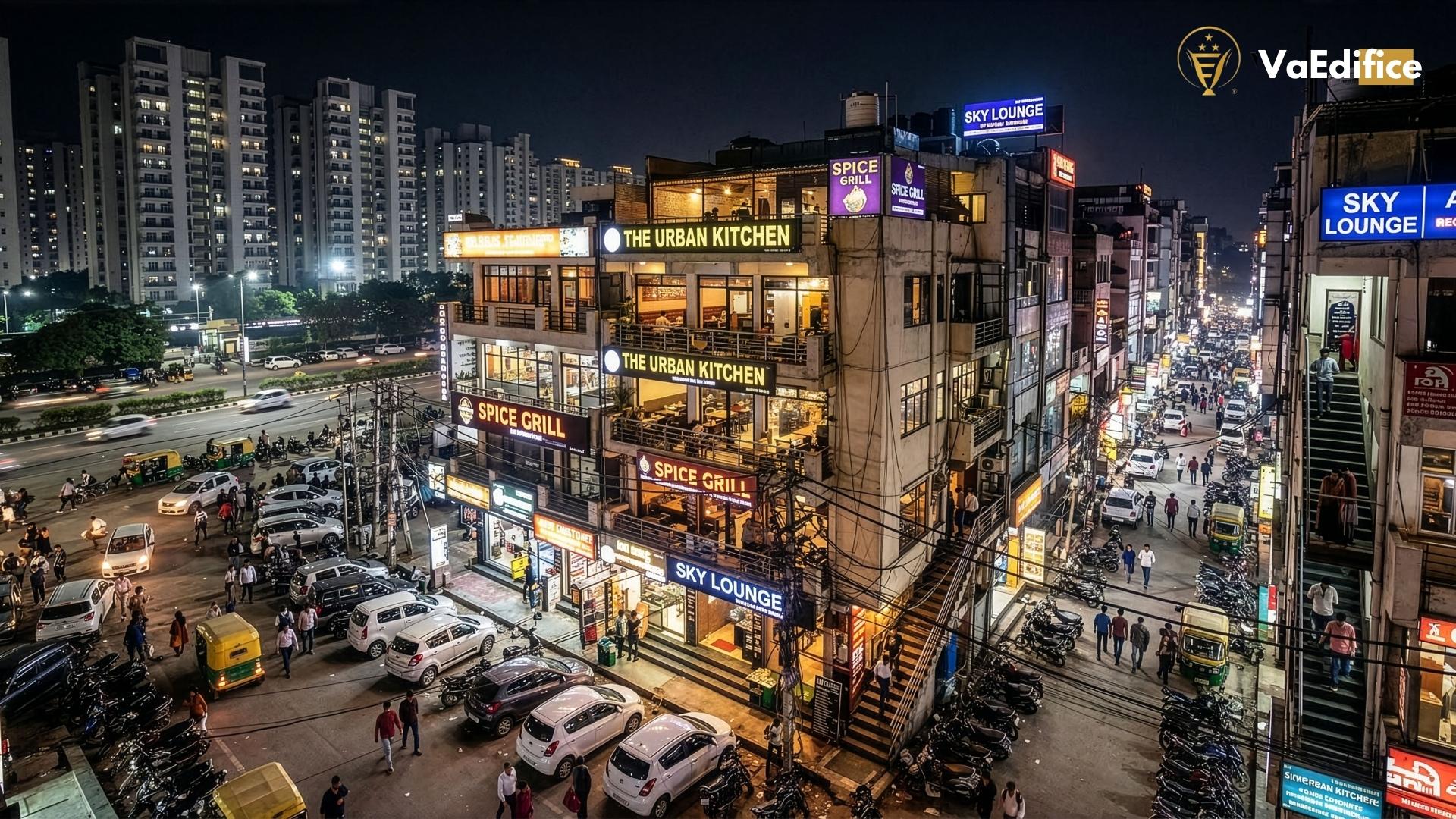
There should be a strict regulatory framework governing high-density commercial zones, but right now, a massive loophole is fueling unchecked and dangerous growth in Noida’s most popular nightlife hubs. While the city boasts world-class infrastructure on its main avenues, a parallel, unregulated commercial economy is thriving in its urban villages—and it is playing with fire.
The Ground Reality: Sector 104 and 144 on a Saturday Night
The scene in Sector 104 on a Saturday evening is nothing short of a chaotic fairground. Cars are parked haphazardly across every available inch of tarmac, pedestrians are forced to weave through crawling traffic, and crowds spill out of buildings housing cafes, high-end restaurants, wine shops, and small entertainment joints. Music blares from the upper floors while servers rush up and down cramped, single-file staircases carrying trays of food and liquor.
What the patrons don’t see is the tangled web of electrical wires strung between buildings. They don’t realize that the vast majority of these multi-story establishments have absolutely no fire safety clearance.
These bustling commercial pockets are built on 5% abadi (village population) lands. In exchange for the agricultural land given up to the administration for the development of modern sectors, farmers were paid compensation and allotted these ‘developed’ plots carved out of the village area. These plots come with special concessions—owners are legally allowed to build houses or run businesses on them. Over time, original allottees have rented or sold these spaces to retail and F&B operators looking for cheaper alternatives to the premium rentals of Sector 18 or traditional malls.
Today, in villages like Hajipur (Sector 104), buildings rise up to four floors in densely packed lanes. Wine shops and eateries sit side-by-side. Every restaurant operates a heavy-duty commercial kitchen relying on multiple LPG cylinders, makeshift exhaust systems, and overloaded power connections. Local residents live in constant fear. As one Hajipur local noted, “If there is a fire, there is no escape. The staircases are so narrow that even two people can’t pass at once. Fire engines will never reach here. Just one spark is enough.”
The 500 Sq. M Loophole: A Regulatory Grey Zone
How is this legally allowed to happen? The answer lies in a dangerous regulatory gap disguised as bureaucratic leniency.
According to existing norms aimed at promoting the “ease of doing business,” commercial establishments operating in a built-up area of less than 500 square meters are not mandated to obtain a strict Fire No Objection Certificate (NOC). Furthermore, fire department officials have been advised not to carry out coercive sealing drives against these “small” businesses.
Because these 5% abadi plots are inherently small, almost all the cafes and clubs in Sectors 104 and 144 fall comfortably under the 500 sq m threshold. They operate in a legal grey zone. Business owners admit that installing comprehensive, code-compliant fire suppression systems is prohibitively expensive for small plots, and without a legal mandate, they simply skip it.
The Hauz Khas Village Warning: How Bylaws Fixed the Crisis
Noida is not the first city to face the friction between master plans and unregulated urban villages. We only have to look across the border at Hauz Khas Village (HKV) in Delhi to see how this cycle ends—and how building bylaws are the only way to fix it.
Decades ago, Hauz Khas Village was an exempted Lal Dora (abadi) area that transformed into South Delhi’s premier nightlife hub. Unregulated by standard municipal laws, multi-story pubs with narrow staircases and massive commercial kitchens mushroomed. It became a ticking time bomb. Fire tenders physically could not enter the lanes.
When the crisis hit a boiling point, the Delhi High Court and municipal bodies didn’t just seal the village—they introduced retroactive mixed-use building bylaws.
- Seating Capacity Thresholds: Bylaws were amended so that any eatery crossing a 50-seat threshold instantly required a mandatory Fire NOC, regardless of plot size.
- Minimum Road Width Norms: The new bylaws dictated that commercial activity could only legally operate on roads wide enough (e.g., minimum 12 meters) to allow fire emergency vehicles to pass.
- Structural Retrofitting: Property owners were forced to pay “conversion charges” to legally change land use from residential to commercial, and that money was used to upgrade the local electrical grid and sewage infrastructure.
Hauz Khas survived because the government finally enforced specific, targeted bylaws for urban villages. Noida is currently accelerating toward the exact same crisis, but without the legal framework to manage it.
The Sector 145 Imperative: Regulate Before We Build
Fixing established hubs like Hajipur in Sector 104 requires complex, retroactive damage control. But the true test of Noida’s urban planning lies in the corridors that are developing right now.
The 5% abadi plots are not isolated to the city center. Look down the Yamuna Expressway toward Sector 145. This emerging sector features highly lucrative 5% plots that boast massive main road exposure. As the city expands outward to support the incoming Noida International Airport traffic, Sector 145 is uniquely positioned to become the next massive high-density commercial and nightlife hub.
If we do not address this regulatory gap today, the same tragedy will replicate itself. Sector 145 will develop with the same narrow single-staircases, the same overloaded power grids, and the same lack of fire safety compliance—all legally protected by the 500 sq m loophole. The administration must establish commercial safety infrastructure and specific building bylaws before the brick-and-mortar goes up.
The Path Forward
District Magistrate Medha Roopam has acknowledged the risks, recently instructing the fire department to audit these areas. But audits are not enough if the baseline rules are flawed.
Perhaps it’s time these growing nightlife pockets are looked at more closely — so business can grow, but safety grows with it. The government must introduce practical, bespoke building bylaws specifically tailored for commercial abadi plots. Even if a plot is under 500 sq m, if it houses a high-footfall F&B operation with commercial LPG and heavy electrical loads, mandatory fire-suppression mechanisms, secondary evacuation routes, and strict seating-capacity limits must be written into the law. We cannot wait for a disaster to force our hand.
Evaluating Commercial Investments in Noida?
Not all high-footfall areas make for secure investments. A high rental yield means nothing if the asset is exposed to sudden regulatory sealing or structural hazards. At vaEdifice, our core construction and land intelligence background allows us to evaluate the legal compliance and structural safety of a property before you deploy capital.
Whether you are analyzing a 5% abadi plot for a commercial venture or seeking fully compliant Grade-A retail space, connect with our advisory team to protect your investment. Call us directly at +91 92205 94889.