
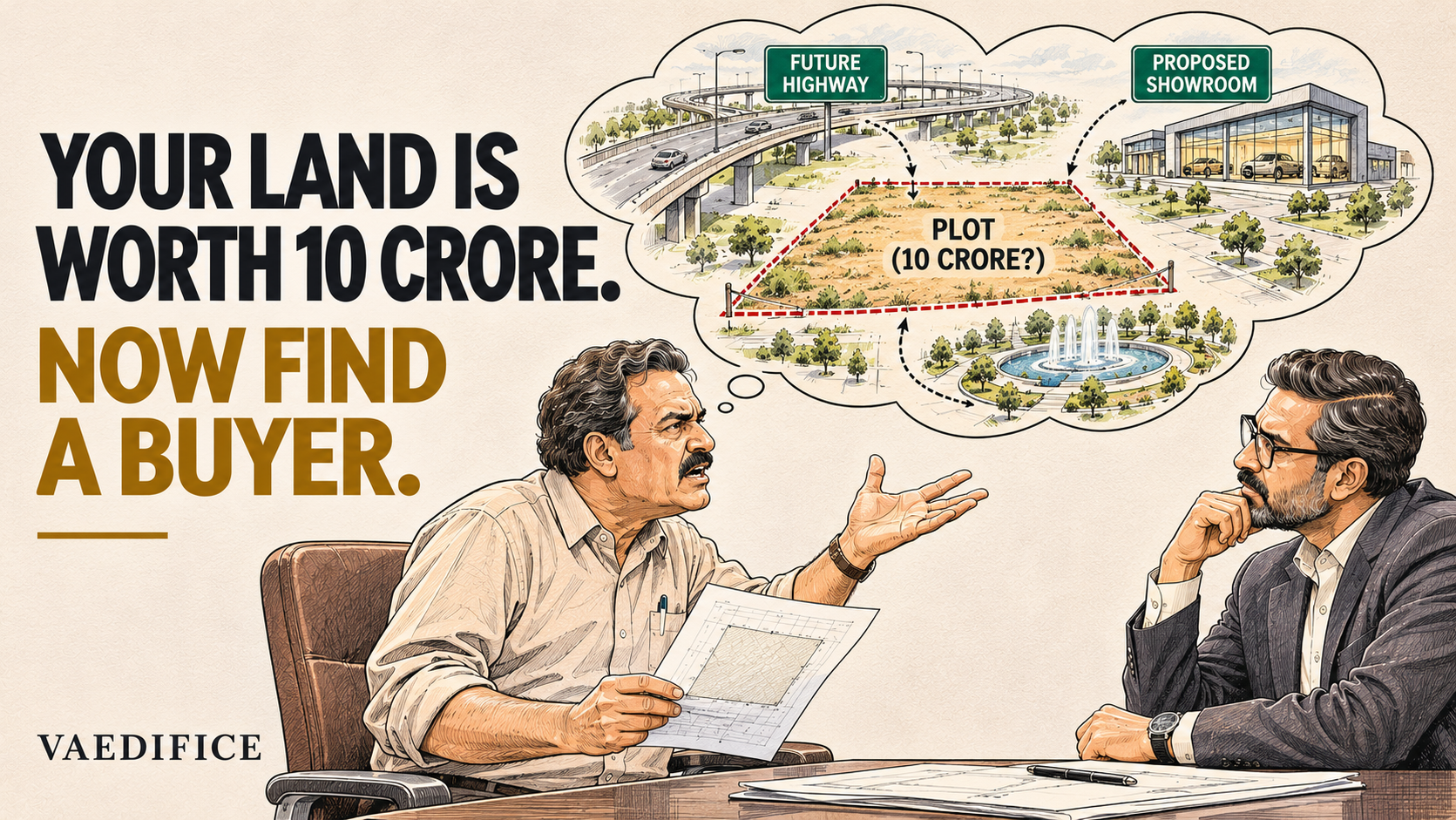
Your Land Is Worth ₹10 Crore. Congratulations. Now Find a Buyer.
How speculative valuations, commission-hungry intermediaries, and the business of selling optimism are turning valuable land into expensive waiting rooms.[cite: 27]
Executive Briefing
The Illusion of Wealth: A landowner can become richer on paper every year without becoming a single rupee more liquid.[cite: 32] An asking price is an invitation to negotiate, not a bank balance.[cite: 32]
The Commission Lottery: Opportunistic intermediaries commercialize reassurance, advising owners to hold out for theoretical prices without bearing the financial consequences of a failed transaction.[cite: 28, 29] They promise tomorrow’s price while the seller waits for tomorrow’s buyer.[cite: 34]
The Development Deadlock: When land valuations repeatedly exceed what viable projects can support, prime plots remain vacant.[cite: 32, 33] Buyers are not obliged to finance someone else’s imagination; they must balance acquisition costs with construction expenditure, approvals, and ROI.[cite: 34]
The Consultant’s Role: A professional’s responsibility is to provide verified transactions and executable demand, even if it means disappointing an owner with the truth.[cite: 33] Flattery disguised as market intelligence stalls transactions.[cite: 33]
The Land Appreciated by ₹3.75 Crore. The Buyer Didn’t Get the Memo.
Somewhere in Noida, a landowner has a 250-square-metre plot.[cite: 27] Four months ago, he wanted ₹3 lakh per square metre, making his property worth ₹7.5 crore according to his asking price.[cite: 27]
Then something extraordinary happened.[cite: 27] Developers were coming. Highways were coming. A showroom was coming. Even fountains were coming.[cite: 27] The landowner’s asking price climbed with enthusiasm—first to ₹4 lakh, then to ₹4.5 lakh per square metre.[cite: 27]
Within four months, his expectations rose from ₹7.5 crore to ₹11.25 crore.[cite: 27] An increase of ₹3.75 crore.[cite: 27] The land hadn’t grown by a single square metre, but the future had become considerably more expensive.[cite: 27]
Then a genuine buyer appeared, offering ₹4 lakh per square metre (₹10 crore).[cite: 27] The landowner declined, wanting ₹11.25 crore because brokers had “appraised” his property and promised the upcoming developments would justify it.[cite: 27]
Perhaps he is entitled to wait.[cite: 27] But if the property has already appreciated by 50% in four months based largely on expectations about the future, what exactly is the buyer purchasing today? The land? Or the seller’s optimism?[cite: 28]
The Most Expensive Words: “Sir, Rate Aur Badhega”
There is nothing unreasonable about a landowner wanting the best possible price for a significant family asset.[cite: 28] But he deserves honest advice, not the opportunistic intermediary whose market research consists of calling three brokers, adding a premium, and assuring the owner that prices are about to explode.[cite: 28]
The easiest way to win a landowner’s confidence is to tell him his property is worth more than he thought.
The difficult part is finding someone willing to pay it.[cite: 28]
This is not professional valuation; it is the commercialization of reassurance.[cite: 28] In the Noida example, the buyer brought ₹10 crore to the conversation.[cite: 29] The brokers brought tomorrow.[cite: 29] Tomorrow won.[cite: 29]
Tomorrow is a convenient negotiating partner: it never asks for documents, it never needs financing, and it never raises concerns about construction costs.[cite: 29] It simply promises to arrive.[cite: 29]
Welcome to the Commission Lottery
Land brokerage is a legitimate profession, and good consultants create genuine value.[cite: 29] But the “commission lottery” operates differently.[cite: 29] The participant doesn’t need a documented pricing analysis or an understanding of developer feasibility.[cite: 29] He circulates listings, quotes ambitious prices, and hopes one transaction closes to fund months of ordinary income.[cite: 29]
The problem is a business model where the person encouraging a price expectation bears no financial consequence if it fails.[cite: 29] He can promise ₹18 crore without having to produce it.[cite: 29] He can tell an owner to wait without paying the holding costs.[cite: 29]
The Dynamics of Speculative Brokerage
| The Actor | The Speculative Action | The Real-World Consequence |
|---|---|---|
| The Landowner | Rejects a legitimate, market-supported offer in favor of speculative future valuation.[cite: 27] | Asset liquidity freezes; decades of wealth remain tied up in a static holding pattern.[cite: 32] |
| The Intermediary | Promises inflated returns without verified comparable data or executable demand.[cite: 28, 29] | Bears zero financial risk while severely distorting local market expectations.[cite: 29, 34] |
| The Developer / Buyer | Cannot justify the acquisition cost against required ROI, construction, and financing.[cite: 34] | Walks away. Prime land remains vacant, and development halts.[cite: 32, 33] |
Some intermediaries don’t discover what the market will pay. They discover what the landowner would love to hear.[cite: 29] That is not land consultancy; it is optimism with a commission clause.[cite: 29]
One Plot. Three Prices. Three Different Markets.
Consider another 300-square-metre plot.[cite: 30] Its advertised prices range from ₹15 crore to ₹18 crore—a difference of ₹3 crore for the same parcel depending on which WhatsApp group you find it in.[cite: 30]
This confusion has consequences.[cite: 30] A serious buyer may question the seller’s credibility, and a potential negotiation collapses before the parties meet.[cite: 30] The highest advertised figure begins circulating as “evidence.”[cite: 30]
A listing becomes a reference. The reference becomes a comparable. The comparable becomes a benchmark. Nobody remembers whether the original property actually sold.[cite: 30]
An asking price tells us what a seller hopes to receive.[cite: 30] It does not tell us what the market has paid.[cite: 30] A price someone has quoted is a statement; a price someone has paid is evidence.[cite: 31]
The Fountains Are Coming. The Buyer Has a Budget.
Infrastructure creates genuine value, but a project announcement is not completion, and completion is not guaranteed commercial demand.[cite: 31] In the Noida example, the owner pointed to highways, developers, and fountains as reasons for his increasing expectations.[cite: 31]
The highway may be coming, but the buyer is already here—and he still has a budget.[cite: 31] If the seller prices in every anticipated future benefit, a developer must calculate if the acquisition cost, construction expenditure, and financing still justify the investment.[cite: 31] If not, the proposed project remains exactly that: proposed.[cite: 32]
The Illiquidity Trap
Theoretical Wealth
“My property is worth ₹18 Crore because the new highway was announced.”[cite: 31, 32]
An asking price is an invitation to negotiate. It is not a bank balance.[cite: 32]
Executable Demand
“I have a financially capable buyer willing to complete a transaction at ₹15 Crore.”[cite: 32]
Liquidity requires converting the asset into cash within a reasonable period.[cite: 32]
A 10-crore plot is not the same as 10 crore in the bank.[cite: 32] Land can be valuable without being immediately liquid.[cite: 32]
The Landowner Deserves Better Than Flattery
A landowner has every right to seek the best return on an asset he may have held through years of uncertainty.[cite: 33] The problem begins when he receives advice that reinforces his hopes without explaining the risks.[cite: 33]
A genuine consultant must sometimes deliver uncomfortable information: establishing current buyer interest, reviewing comparable transactions, and identifying what assumptions cannot be supported.[cite: 33]
A good consultant may occasionally disappoint a landowner with the truth.
A bad one can keep him delighted with a price nobody pays.[cite: 33]
The Market Does Not Owe Anyone Their Asking Price
Buyers are not obliged to finance someone else’s imagination.[cite: 33] A serious buyer who rejects a property is not showing disrespect; he is demonstrating financial discipline.[cite: 34] The landowner is entitled to his asking price, and the buyer is entitled to his calculator.[cite: 34]
A landowner can ask whatever he wants, reject every offer, and wait ten years.[cite: 35] But the market consists of actual participants making decisions under financial constraints.[cite: 35] An asking price does not become correct simply because an intermediary repeats it confidently.[cite: 35]
The tragedy is when someone turns belief into a business model, collects the owner’s confidence, and leaves the actual transaction to somebody else.[cite: 36]
Advisory & Representation with VaEdifice
At VaEdifice, we believe land transactions must be approached with an understanding of both property value and practical development feasibility.[cite: 35] India’s market deserves professionals who can tell the difference between speculation and evidence.[cite: 36]
VaEdifice is a strict industrial real estate and construction advisory firm. We do not deal in residential flats. We specialize in sovereign land, independent freehold plots, and industrial leaseholds across the NCR.[cite: 35]
In Baghpat, we handle structured land acquisition. In Sahibabad Site IV, we manage industrial construction and UPSIDA liaisoning. Better-informed decisions are worth considerably more than an enthusiastic prediction.[cite: 35] Speak directly with our advisory desk.
Editorial Note: The property examples are drawn from reported experiences. Prices and reported offers have not been independently verified and should not be treated as formal valuations. This article examines pricing practices, market incentives, and the distinction between asking prices and executable transactions. Buyers and sellers should obtain appropriate independent legal and technical advice.[cite: 36]