
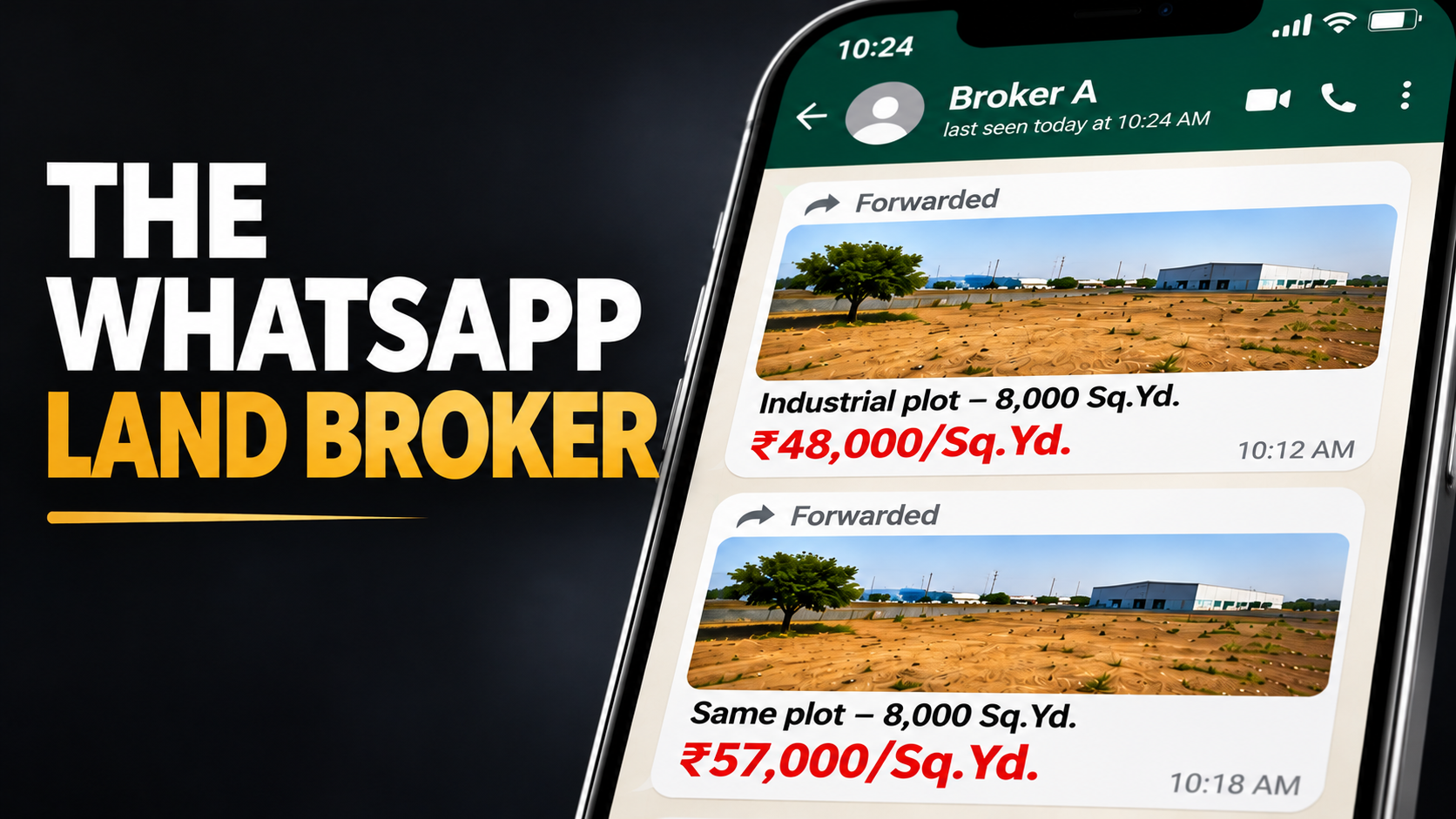
Everyone Is a Land Broker. Until Someone Asks a Real Question. How recycled listings, commission chains, and professional incompetence are eroding trust in India’s land market.[cite: 39]
Executive Briefing
The Forward Button Economy: Technology has made it remarkably easy to imitate property expertise.[cite: 39] Today, an intermediary can receive a photo, add the words “prime location,” and circulate a ₹10-crore asset he has never visited to hundreds of people within minutes.[cite: 39]
The Information Chain: Disclosed co-brokerage expands market reach, but undisclosed chains create confusion.[cite: 40] A single listing forwarded through multiple middlemen often results in inflated quotations, invented mandates, and buyers receiving three different asking prices for the same plot.[cite: 40, 41]
The “Papers Clear” Illusion: A location pin is not a title report, and the phrase “papers bilkul clear hain” is not a legal opinion.[cite: 40, 44] Serious buyers face massive risks when intermediaries present unverified assurances as established facts instead of coordinating with qualified professionals.[cite: 40, 42, 44]
The True Value of Consulting: Professional land consultancy requires understanding leasehold conditions, UPSIDA transfer rules, UPPCB categorizations, and zoning.[cite: 41] Unearned commission driven merely by a forwarded WhatsApp message damages the integrity of India’s land market.[cite: 43, 45]
A 10-Crore Property. Twelve Brokers. Not One Straight Answer.
At 9:15 on a Monday morning, a landowner shares the details of his industrial plot with a local intermediary.[cite: 39] The property is worth approximately 10 crore, has been in the family for years, and selling it is not a casual decision.[cite: 39]
The intermediary requests three things: Location, Area, and Asking price.[cite: 39] No questions about ownership history, land classification, access rights, or encumbrances.[cite: 39]
By lunchtime, the property has appeared in six WhatsApp groups.[cite: 39] By evening, twelve brokers are circulating it.[cite: 39] Three claim to have a direct relationship with the owner, two have increased the asking price, and another announces a buyer is ready with funds.[cite: 39]
Remarkably, not one has asked to examine the property documents.[cite: 39] The next morning, the landowner receives a call: “Sir, party ready hai. Commission kitna doge?”[cite: 39]
There it is. The first serious question anyone has asked.[cite: 39] Not about the land. About the commission.[cite: 39] Welcome to a market where information travels faster than competence.[cite: 39]
The Forward Button Has Become a Business Model
There was a time when a land broker’s value came from knowing the local market, understanding ownership, and navigating complicated transactions.[cite: 39] But technology has made it remarkably easy to imitate the appearance of performing them.[cite: 39]
WhatsApp itself is an excellent communication tool used daily by genuine land consultants.[cite: 40] The problem begins when forwarding information is mistaken for providing expertise.[cite: 40]
Having a landowner’s phone number does not make you a land consultant.
It makes you someone with a landowner’s phone number.[cite: 40]
The landowner brings an asset representing accumulated wealth.[cite: 40] He expects the person marketing it to understand its value and protect sensitive information.[cite: 40] Instead, the listing travels through a chain of intermediaries.[cite: 40] One forwards it to another, the third adds his margin, and the fourth claims exclusive availability.[cite: 40]
Anatomy of an Undisclosed WhatsApp Listing Chain
| The Actor | The Action & Market Consequence |
|---|---|
| 1. The Landowner | Shares genuine plot details with one local contact. Sets actual expected price at ₹28,000/sq. yd.[cite: 39, 41] |
| 2. Intermediary A | Copies the photos & location pin. Forwards to 5 broker WhatsApp groups without verifying any revenue records.[cite: 39, 40] |
| 3. Intermediaries B, C & D | Claim a “direct connection.” Add their own undisclosed margins. Repost the asset at ₹32,000 to ₹35,000/sq. yd.[cite: 40, 41] |
| 4. The Genuine Buyer | Receives three different asking prices for the exact same plot from three people. Assumes the deal is fraudulent and walks away.[cite: 41, 42] |
The landowner brings the asset, the buyer brings the capital, and the middleman brings a screenshot—and somehow expects to become the most important person in the transaction.[cite: 40]
Everyone Knows the Price. Nobody Knows the Land.
Land is not a standardised product.[cite: 41] Two plots on the same road may have entirely different legal, regulatory, and commercial characteristics.[cite: 41] One may have clear access; another may depend on a disputed passage.[cite: 41] The difference is not visible from the roadside, and it is certainly not visible in a forwarded photograph.[cite: 41]
Consider an industrial plot in Sahibabad Site IV.[cite: 41] Does the intermediary understand the leasehold conditions, UPSIDA transfer procedures, or UPPCB pollution consents required for a manufacturing process?[cite: 41] Or consider agricultural land in Baghpat.[cite: 41] Can the intermediary distinguish recorded ownership from mutation entries or investigate access restrictions?[cite: 41]
Knowing what land costs is useful. Knowing what can legally be done with it is considerably more useful.[cite: 41]
The Most Dangerous Words: “Papers Clear Hain”
It is easy for people within the property industry to complain that buyers negotiate too aggressively or ask too many questions.[cite: 42] But a buyer may be investing several crores, borrowing money, or liquidating assets to establish a factory.[cite: 42] What is unreasonable is asking a buyer to make an enormous financial commitment based on information that nobody has bothered to verify.[cite: 42]
Three words carry potentially catastrophic consequences: “Papers clear hain.”[cite: 44] Does that mean a lawyer has examined the chain of title? Does it mean the property is free from registered encumbrances? Does it mean the proposed use is permissible?[cite: 44] A single reassuring sentence cannot answer all of them.[cite: 44]
The Intermediary Audit
| The WhatsApp Broker | The Professional Land Consultant |
|---|---|
| Presents unverified assurances (“Papers clear hain”) as established facts.[cite: 40, 44] | Establishes source authority and coordinates with legal and technical professionals.[cite: 44, 45] |
| Focuses solely on location pins, photographs, and the commission payout.[cite: 39, 40] | Understands land classification, leasehold rules, and environmental permissions.[cite: 41] |
| Manufactures urgency and pressures buyers with imaginary competing offers.[cite: 42, 45] | Discloses uncertainty and knows exactly when to advise a client NOT to proceed.[cite: 44, 45] |
The most trustworthy person in a land transaction is not always the one with the quickest answer. Sometimes it is the one who knows which answer he is not qualified to give.[cite: 44]
Commission Is Not the Problem. Unearned Commission Is.
There is nothing wrong with charging a professional fee for a professional service.[cite: 43] A competent land consultant spends weeks identifying properties, arranging legitimate introductions, assisting negotiations, and bringing in specialists.[cite: 43]
But what exactly has been delivered when an intermediary merely forwards a listing obtained from another WhatsApp group?[cite: 43] Why should a buyer or landowner pay a substantial fee for an introduction whose origin, accuracy, and authority remain unclear?[cite: 43]
If your entire contribution to a 10-crore land transaction can be replaced by the Forward button on WhatsApp, perhaps your commission deserves some reconsideration.[cite: 43]
The Question That Ends the Conversation
The landowner has an asset worth crores and wants a genuine buyer.[cite: 45, 46] The buyer wants suitable land and confidence that his investment is approached seriously.[cite: 46] Between them stands an intermediary.[cite: 46] He may be experienced and genuinely valuable, or he may simply have received a forwarded message.[cite: 46]
The distinction becomes obvious when someone asks a real question:[cite: 46]
- Who owns the property?
- What restrictions apply?
- Has the listing been authorised?
- What documentation has actually been examined?
A competent professional will understand why those questions matter.[cite: 46] An unprepared one may become remarkably eager to discuss something else: the commission.[cite: 46]
Real estate is built on trust. But trust without knowledge is merely optimism.
If you want to earn a commission from someone’s land, first demonstrate that you understand what you’re selling.[cite: 46]
About VaEdifice
India’s land market deserves better than a forwarded message.[cite: 45] At VaEdifice, we believe land transactions must be approached with the seriousness their financial and legal consequences demand.[cite: 45]
VaEdifice is an industrial real estate and construction advisory firm. We do not deal in residential flats. We specialize strictly in sovereign land, independent freehold plots, and industrial leaseholds across the NCR.[cite: 45]
In Baghpat, we handle structured land acquisition. In Sahibabad Site IV, we manage industrial construction and UPSIDA liaisoning. We recognize that land transactions require more than access to a seller—they require informed decisions.[cite: 45] Speak directly with our advisory desk.
Editorial Note: The opening scenario, characters, and quoted property values are illustrative. This article critiques identifiable practices, not people based on education or background. It does not allege that all land intermediaries engage in these practices. Buyers and sellers should obtain appropriate independent legal and technical advice.[cite: 46]