
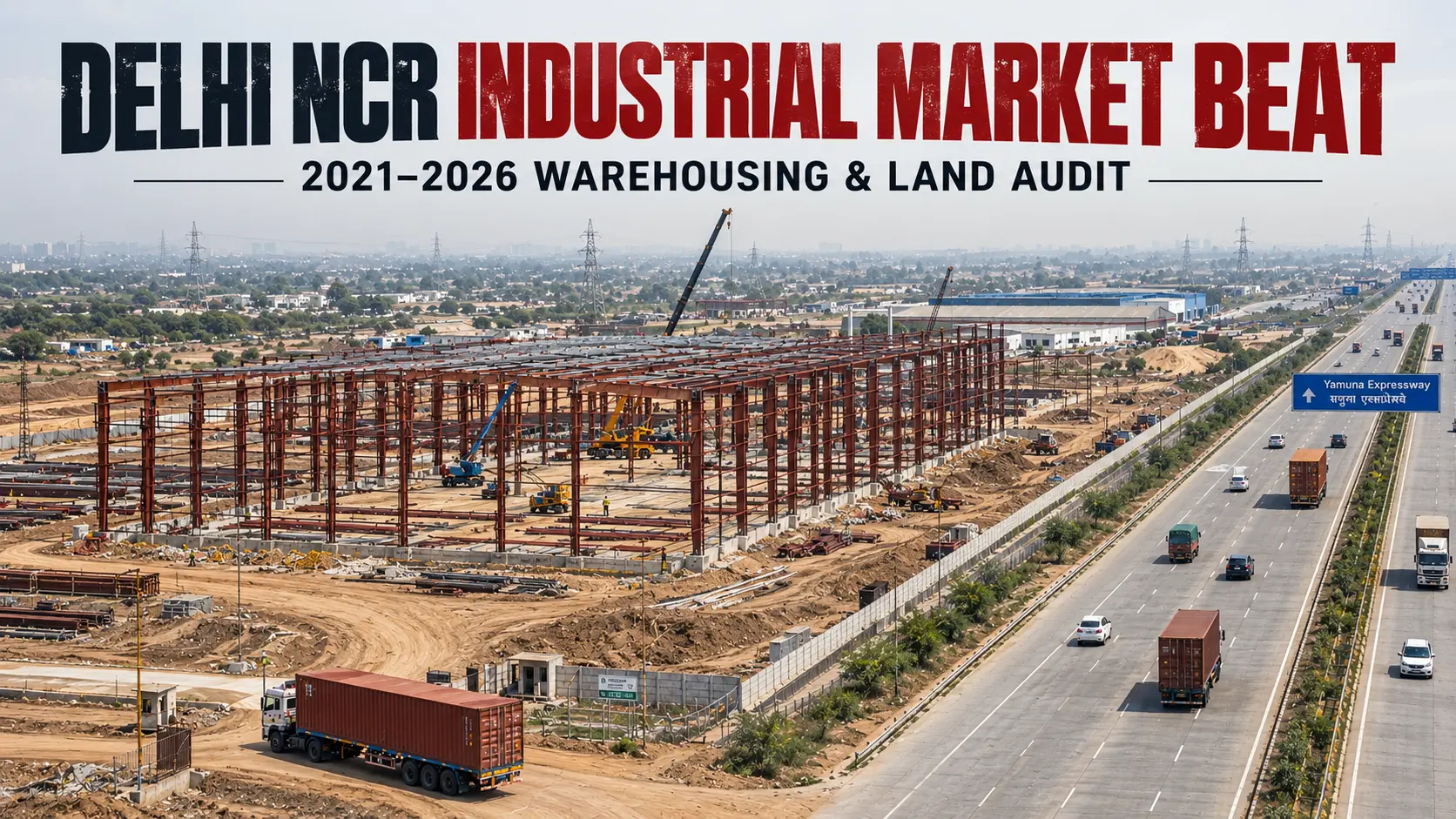
A 2021–2026 data audit on micro-market rental saturation, the manufacturing takeover, and the peripheral migration of industrial capital.
The era of viewing industrial real estate as a passive network of brick-and-tin godowns has quietly ended. Over the past five years, the sector has formalized into an institutional asset class driven by rigorous supply chain mathematics, national Production Linked Incentive (PLI) mandates, and multinational “China Plus One” hedging.
By the close of 2025, India’s consolidated industrial and warehousing stock across its primary markets crossed half a billion square feet, settling at 549 million square feet—a 13% expansion over 2024. Gross leasing across the country clocked 72.5 million square feet in 2025 alone, continuing its pace into the first half of 2026 with 36.8 million square feet transacted.
Yet the aggregate numbers mask a critical structural pivot: who is taking up this space has inverted. Historically, third-party logistics (3PL) firms absorbed the vast majority of volume, committing to over 110 million square feet between 2021 and early 2026. However, in 2025, manufacturing surged ahead to become the single largest occupier class, capturing 47% of all transacted space (nearly 34 million square feet) with a 55% year-on-year spike. Meanwhile, 3PL share adjusted to 27%, and e-commerce rebounded to 7.8 million square feet as quick-commerce scaled across urban hubs.
National Space Absorption Composition (2025 Benchmark)
47% (~34.0 MSF)
27% (~19.6 MSF)
11% (~7.8 MSF)
1. NCR’s Macro Balance: An Institutional Equilibrium
Within northern India, the National Capital Region remains the primary distribution engine, second nationwide only to the Mumbai Metropolitan Region. By the close of 2025, NCR commanded an inventory of 115 million square feet—representing roughly 21% of India’s institutional stock across Tier-1 markets.
What distinguishes NCR from earlier real estate cycles is the discipline between institutional developers and incoming tenants. Speculative, unbacked construction has largely disappeared. In 2025, NCR recorded an all-time high absorption of 13.0 million square feet, precisely matched by 13.1 million square feet of fresh completions. In the first half of 2026, the market added another 5.9 million square feet of transactions against 6.2 million square feet of supply, sustaining a healthy 17% year-on-year leasing expansion.
| Year | Absorption (MSF) | Supply Additions (MSF) | Primary Structural Catalyst |
|---|---|---|---|
| 2024 | 11.2 | 10.5 | Post-pandemic normalization; NCR captured 15% of national leasing. |
| 2025 | 13.0 | 13.1 | Peak record year; manufacturing space uptake surges 55% nationally. |
| H1 2026 | 5.9 | 6.2 | 17% YoY expansion; Tier-1 auto ancillaries and electronics anchor growth. |
2. The Western Core: Agglomeration Economics vs. Rental Saturation
To identify where capital is flowing, one must evaluate where it is being squeezed out. The Gurugram cluster—anchored by NH-48, Farukhnagar, Luhari, Pataudi Road, and Manesar—remains the region’s heavyweight. In 2025, this single sub-market accounted for 79% of new completions and 61% of all absorption in NCR.
This concentration is the result of decades of industrial clustering. The NH-48 belt houses India’s most entrenched automotive manufacturing core. Original Equipment Manufacturers (OEMs) demand Just-In-Time (JIT) and Just-In-Sequence (JIS) supply lines from hundreds of component makers, guaranteeing sustained tenant demand. Over time, Farukhnagar and Luhari grew into mega-box hubs where occupiers like Welspun leased 220,000 sq. ft. facilities to logistics providers, and players like DMart purchased 435,000 sq. ft. footprints in Kulana.
However, this maturity has created acute pricing bottlenecks. Grade A rentals in Farukhnagar and Luhari have escalated to ₹35–₹55 per square foot per month, while standard space commands ₹30–₹45. For low-margin distributors, raw material processors, and expanding MSMEs, these rental benchmarks—combined with elevated land acquisition values—mean capital yields have compressed significantly. The western core has evolved into an asset-holding territory for institutional yields rather than an aggressive growth play.
| Micro-Market Cluster | Standard Space (₹/sq.ft./mo) | Grade A Space (₹/sq.ft./mo) | Dominant Occupier Profiles |
|---|---|---|---|
| Gurugram / Luhari / Farukhnagar | ₹30 – ₹45 | ₹35 – ₹55 | Automotive OEMs, Tier-1 JIT ancillaries, enterprise 3PL. |
| Noida / Greater Noida / Yamuna Exp. | ₹15 – ₹35 | ₹25 – ₹45 | Electronics assembly, FMCG fulfillment, cold chain, air cargo. |
| Ghaziabad / Sonipat Corridors | ₹15 – ₹30 | ₹20 – ₹55 (Industrial) | Heavy fabrication, engineering, regional FMCG staging, displaced MSMEs. |
3. The Peripheral Realignment: Where Capital Is Setting Up Next
As rent and land friction push occupiers outward, two clear geographical alternatives have absorbed the spillover: the southeastern aviation axis in Uttar Pradesh and the northern heavy-manufacturing arc along the Kundli-Manesar-Palwal (KMP) Expressway.
The Yamuna Expressway & YEIDA Clustering
Noida and Greater Noida have evolved distinct operational identities. Unlike Gurugram’s heavy automotive focus, western UP has emerged as India’s primary electronics and appliance assembly hub. The impending commercial operation of the Noida International Airport at Jewar is fundamentally restructuring aviation logistics, pulling pharmaceutical, semiconductor, and high-value export warehousing into its orbit.
To capture this migration, the Yamuna Expressway Industrial Development Authority (YEIDA) has organized dedicated manufacturing clusters rather than leaving land allocation to haphazard private speculation. This includes the Apparel, MSME, and Handicraft Parks in Sector 29; the Toy Park in Sector 33; the Medical Device and Data Centre Parks in Sector 28; and the Electronic Manufacturing Cluster (EMC) in Sector 10. These organized sectors offer pre-planned high-tension power, wide access grids, and statutory compliance, functioning as an operational release valve for businesses seeking modern alternatives to legacy hubs.
Sonipat & The Kharkhoda Anchor Effect
North of the capital, Sonipat has leveraged the KMP Expressway to emerge as NCR’s new center of gravity for heavy fabrication and manufacturing. The decisive catalyst has been Maruti Suzuki’s greenfield plant in Kharkhoda, engineered to scale toward an annual output of four million vehicles by 2031.
An assembly facility of this magnitude instantly transforms regional land economics. Because the primary OEM relies on lean on-site inventory, dozens of tier-1 component suppliers—handling engine castings, wiring harnesses, and stamped panels—have been forced to acquire or lease industrial acreage within a tight transit radius. The facility also sets new environmental benchmarks for the corridor, incorporating an on-site 20 MWp solar park and a 1 MWh Battery Energy Storage System (BESS), setting an ESG standard that peripheral industrial parks now mirror to attract institutional tenants.
4. The Statutory Squeeze: NGT Directives and the Forced MSME Relocation
While corporate supply chains determine the movement of 200,000 sq. ft. facilities, the demand for small-to-midsize industrial plots (1,500 to 10,000 sq. ft.) across NCR’s borders is being accelerated by judicial intervention.
For decades, tens of thousands of unorganized MSMEs operated illegally out of non-conforming and residential pockets within Delhi—including Anand Parbat, Shahdara, Mandoli, Kirti Nagar, and Sadar Bazar. These units, spanning plastic extrusion, metal fabrication, and packaging, operated in dense environments without environmental clearances or fire safety protocols.
Following strict Supreme Court directives and National Green Tribunal (NGT) enforcement orders targeting severe air and water pollution, state authorities cracked down. Utility boards were mandated to permanently disconnect industrial electricity and water lines to non-conforming facilities. A formal survey submitted to the NGT by the Delhi State Industrial and Infrastructure Development Corporation (DSIIDC) confirmed 51,837 units operating in violation of zoning laws.
With total estimates of displaced enterprises running between 51,000 and 80,000, state-developed relocation estates within Delhi (such as Bawana and Narela) quickly faced capacity limits. The resulting shortfall triggered an exodus into the peripheral industrial belts of Ghaziabad, Sonipat, Greater Noida, and surrounding freehold corridors. Displaced business owners are purchasing or leasing compliant ground-level sheds equipped with 3-phase industrial power, adequate road clearance for commercial vehicles, and clean zoning titles. This has permanently formalized thousands of small manufacturers who were previously unmapped.
5. The Technical Divide: Grade A Specs & Urban Dark Stores
The structural shifts across NCR are mirrored by rising technical standards inside the warehouse perimeter. In 2025, Grade A facilities captured 63% of total national leasing. This preference is driven by hard operational economics:
- Vertical Density: Clear ceiling heights of 12 to 15 meters allow modern racking systems to multiply pallet capacity without requiring larger land footprints.
- Floor Load Engineering: The adoption of Automated Guided Vehicles (AGVs) and heavy Material Handling Equipment requires laser-leveled FM2 flooring capable of carrying localized loads between 5 to 7 metric tons per square meter. Standard legacy floors crack under these tolerances.
- Turnaround Velocity: Automated dock levelers, high-capacity fire suppression systems, and dedicated truck staging aprons directly reduce vehicle turnaround times, directly lowering per-unit throughput costs.
Simultaneously, a complementary logistics layer has emerged at the center of the consumption map: urban micro-warehousing. Driven by quick-commerce platforms promising 10-to-20-minute deliveries, demand for localized “dark stores” has surged. With national quick-commerce Gross Order Value projected to reach INR 2 trillion by 2028, operators are leasing 2,000 to 5,000 sq. ft. commercial and light-industrial ground-floor spaces embedded deep within high-density residential sectors across Delhi, Noida, and Gurugram. These urban hubs hold curated inventories of 2,000 to 4,000 fast-moving stock-keeping units, fed daily by the outer peripheral mega-parks.
Strategic Implications for Land Bankers and Occupiers
The movement of industrial demand across NCR is not a uniform outward sprawl; it is a segmented reallocation based on specific operational priorities:
• Consolidated Enterprise Logistics remains anchored in Gurugram, Farukhnagar, and Luhari, where institutional capital pays premium rates (₹35–₹55/sq. ft.) to secure established supply chains and connectivity to western consumer markets.
• High-Tech Assembly and Export Hubs are centralizing along the Yamuna Expressway, where planned infrastructure, airport integration, and YEIDA sector parks offer lower entry costs and streamlined compliance.
• Heavy Manufacturing and Automotive Ecosystems are consolidating north along the KMP corridor in Sonipat, pulled by mega-anchors like Kharkhoda.
• Displaced Non-Polluting MSMEs are purchasing and leasing modular, legally cleared industrial land on NCR’s peripheral transit spines to insulate themselves from future municipal zoning crackdowns.
For fiduciaries, developers, and corporate operators, navigating this landscape requires aligning capital with hard infrastructure milestones and local zoning mechanics. As land values reflect growing rental disparities, identifying high-connectivity corridors before they reach institutional saturation remains the foundational principle of long-term real estate outperformance.