
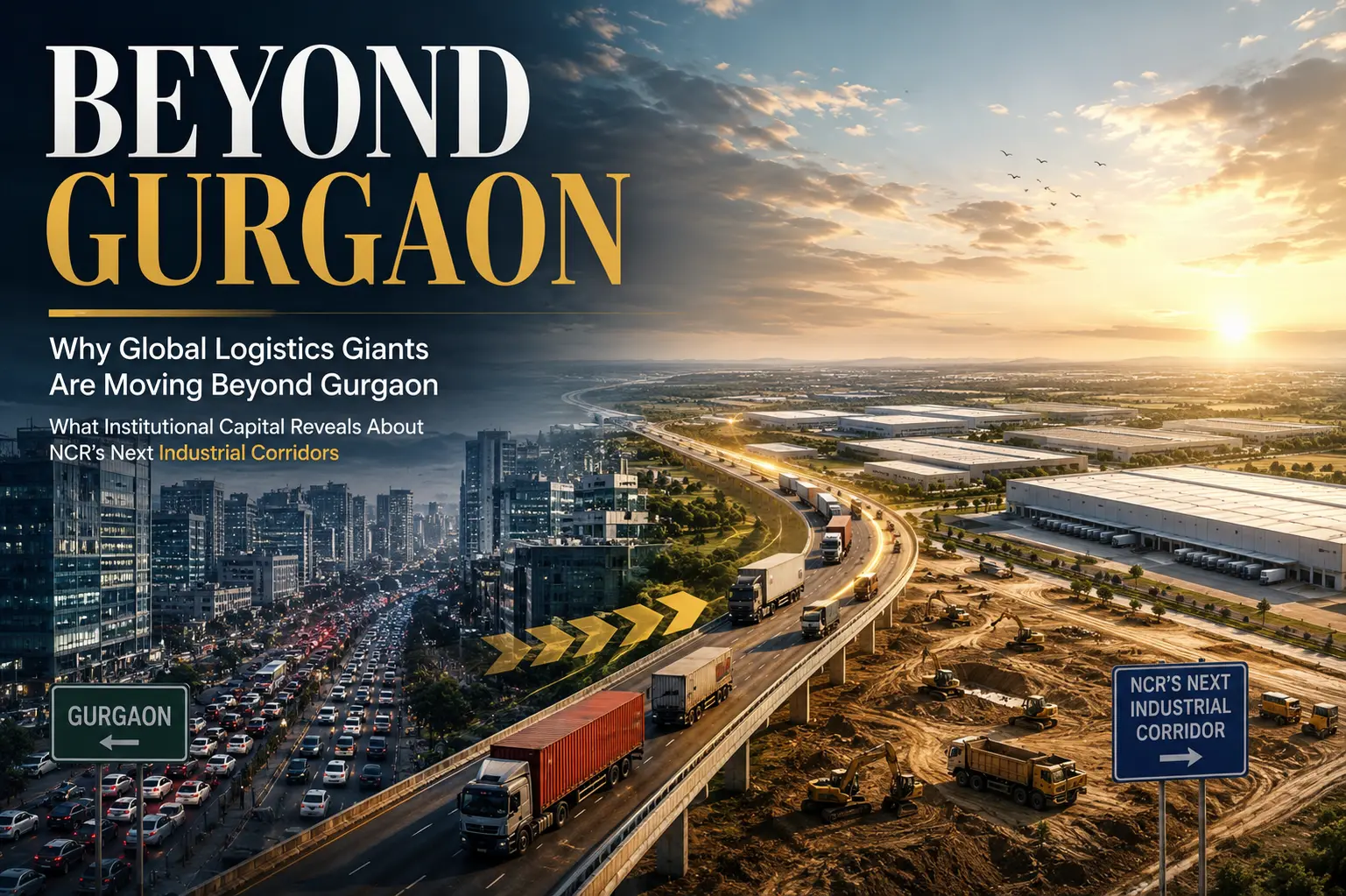
A decade ago, industrial land in places like Farukhnagar or the outer edges of the YEIDA corridor barely registered on global developer radars. The focus was firmly on established hubs such as Udyog Vihar and IMT Manesar.
Today, some of the world’s largest logistics developers are investing in those very corridors instead. Industrial land rarely makes headlines. But these investments reveal something far more interesting than a simple real estate transaction.
Taken together, these investments show how global institutions decide where industrial growth is likely to happen next.
“Land does not become valuable because institutions arrive. Institutions arrive because the land already satisfies a precise investment formula.”
Executive Summary
- Location Matters More Than Price: Major logistics investors are often willing to pay more for land if it reduces long-term transport costs.
- Transportation Drives the Decision: Moving goods is significantly more expensive than renting a warehouse, so connectivity often outweighs land price.
- Investment Attracts Infrastructure: Large corporate projects frequently attract further public infrastructure and private investment into surrounding areas.
The Investment Framework
How global trade changes ultimately trigger regional land appreciation.
1. Why the Map Is Changing
The catalyst for this change actually started far away from Delhi NCR. As global corporations began diversifying their supply chains, domestic production in India started to scale.
As manufacturing expanded and e-commerce accelerated, the demand for modern logistics space grew with it. High-throughput production lines and rapid fulfillment centers need large, modern logistics parks equipped with high-voltage power grids, 34-meter truck courts, and seamless highway access.
Traditional, land-locked urban nodes simply don’t have the space to support this new scale. As a result, developers have increasingly expanded into peripheral corridors where larger sites and better connectivity are available.
2. The Mathematics of Location
A common assumption is that developers move to the periphery simply because the land is cheaper. Cost certainly factors in, but it isn’t the primary driver. For a large industrial platform, the bigger question is whether a location can move goods faster, more reliably, and at a lower operating cost over the next twenty years.
Transportation
68%
Labour
18%
Rent
4%
Others
10%
A typical logistics operation spends far more on moving goods than it does on renting the warehouse itself. Transportation usually accounts for around 68% of total supply chain costs, while the actual rent paid for the facility sits near 4%.
Because transportation accounts for such a large share of operating costs, even small improvements in travel time can outweigh the savings from paying lower rent. This is why transport efficiency often matters more than land price when major logistics projects are planned.
Strategic Insight
Saving just 20 minutes of fleet travel time by locating near a major highway can reduce fuel costs, vehicle wear, and driver hours over the life of a lease. Those savings often outweigh paying more for the land itself.
3. The Site Selection Equation
As major logistics funds evaluate a new corridor, they aren’t guessing. Most global developers work through the exact same basic questions.
If a site fails one or two of them, it usually drops off the shortlist, regardless of price.
The Essential Checklist
- ✓ Expressway Access
- ✓ Freight Corridors
- ✓ Power Grid
- ✓ Contiguous Land
- ✓ Local Labour
- ✓ Clear Title & Approvals
This equation drives nearly every major land acquisition in the logistics sector. Here is a look at why each variable matters.
- Interchange Proximity: Being near a highway isn’t enough. The site needs direct, smooth access to an interchange so 40-foot trucks can enter and exit without navigating city traffic or getting stuck at municipal toll borders.
- Freight Integration: Many manufacturers depend on efficient rail and port connections to move raw materials and finished goods. A location becomes significantly more valuable if it sits near a Dedicated Freight Corridor (DFC) or an inland container depot.
- Land Size and Shape: Modern logistics parks need large, uninterrupted parcels of land. If the site is fragmented or irregularly shaped, designing efficient truck movement becomes difficult and the project quickly loses its appeal.
- Industrial Power Capacity: A modern warehouse operates like a heavy-duty machine. Between automated sorting belts, cold storage units, and charging stations for electric delivery fleets, the local grid must deliver reliable power.
- Labour Availability: Automation helps, but large fulfillment centers still need hundreds of workers during peak seasons. A site needs to be within a manageable commute for a large, blue-collar workforce.
- Clear Title and Approvals: Global capital does not buy litigation. They look for land with clear ownership records and straightforward zoning rules. If the paperwork is messy, they will walk away.
4. The Decision Tree
Mapping these requirements out reveals that site selection looks less like a real estate hunt and more like a rigid filtering process.
It is a process of elimination. If a parcel doesn’t pass the initial checks, the evaluation stops immediately.
Most land parcels fail this test early on. A plot might sit near a highway but lack the power grid. It might have the power grid, but the ownership is split between twenty different families who refuse to sell together.
Once a specific location actually passes every step of this decision tree, it stops being just agricultural land. It becomes a strategic asset. That’s one of the reasons places like Farukhnagar began attracting global capital.
5. Case Study: Why Farukhnagar Fits the Formula
A few years ago, Farukhnagar was primarily an agricultural belt on the western edge of the National Capital Region. Today, global platforms like Prologis, Horizon (backed by Blackstone), and Welspun One are building massive distribution hubs there. They didn’t choose the area by accident.
The location aligns closely with the investment criteria discussed earlier.
The Farukhnagar Advantage
- The KMP Bypass: It sits directly along the KMP Expressway, allowing transport fleets to bypass Delhi traffic and municipal entry restrictions entirely.
- Contiguous Land: Unlike core Gurgaon, the area still offers the large, flat, 20-to-50-acre parcels required for modern warehouses.
- State Support: State-backed agencies like HSIIDC are expanding public infrastructure, ensuring the area has the necessary power grids and road widening to support long-term growth.
This positioning allows logistics operators to serve the massive consumer market of Delhi and Gurgaon quickly, without getting slowed down by city congestion. They trade a slightly longer distance from the city center for a much faster, more predictable operating speed.
The arrival of global developers also drew wider attention to the corridor and reinforced confidence in its long-term potential.
6. Every Corridor Has a Different Role
Farukhnagar is a great example, but it isn’t the only corridor attracting attention. Different locations serve different operational needs across the region.
Investors looking at industrial land need to understand the unique advantage of each major corridor. What works perfectly for an e-commerce fulfillment center might not work at all for a heavy manufacturing plant.
Farukhnagar / Pataudi
The E-Commerce Hub
Driven by the KMP Expressway. Ideal for 3PL, e-commerce, and fast-moving consumer goods that need rapid access to Gurgaon without entering city limits.
YEIDA Corridor
The Aviation & Tech Hub
Anchored by the Noida International Airport. Attracting heavy investment for high-tech manufacturing, data centers, and time-sensitive air cargo logistics.
IMT Manesar
The Heavy Auto Hub
An established ecosystem for automotive and heavy manufacturing along NH-48. It has excellent supplier density, though large land parcels are now scarce and expensive.
Dadri
The Rail & Freight Hub
Sits at the junction of major freight corridors. It is the premier location for heavy bulk goods and inland container movement relying on rail networks.
Dharuhera / Bawal
The Manufacturing Extension
Located further down NH-48, offering cost-effective land for long-haul manufacturing and distribution connecting the Delhi-Mumbai transit routes.
Ultimately, there is no single “best” industrial corridor. The right location depends on what a business is trying to move, where it needs to deliver, and which transport network matters most.
7. The Ripple Effect
After global funds commit hundreds of millions to a peripheral corridor, they don’t just build a facility and close the gates. Their arrival anchors the entire micro-market and sets off a predictable chain reaction.
For private investors and businesses, understanding this sequence is crucial. You don’t need to acquire a 50-acre plot to benefit from warehouse developer movement. You just need to understand what happens next.
- The Infrastructure Acceleration: State governments want global capital. Once a major logistics park breaks ground, public agencies like HSIIDC or UPSIDA usually prioritize that specific corridor. Road widening projects get approved faster, ensuring the anchor tenant succeeds, which immediately benefits the surrounding land.
- The Vendor Ecosystem Arrives: A massive fulfillment center doesn’t operate in isolation. It needs packaging suppliers, maintenance crews, and smaller third-party logistics vendors. These secondary businesses quickly seek out 1-to-5-acre plots nearby, driving up secondary demand.
- Workforce and Residential Demand: Once facilities are operational, thousands of workers commute to the area daily. The area suddenly needs workforce housing and retail spaces. What started as an isolated warehouse matures into a functioning commercial ecosystem.
By the time residential developers start buying land in the area, the price discovery phase is already over. The real value was created years earlier, the moment the first major logistics fund decided the transport math made sense.
8. Strategic Perspective
The migration of global capital into places like Farukhnagar, YEIDA, and Dadri is not a random real estate trend. It is a calculated response to the changing economics of the global supply chain. Moving goods is simply too expensive to tolerate bad geography.
For business owners and investors looking at industrial land today, the lesson is clear. Stop asking where land is the cheapest. Start asking where infrastructure reduces friction. Land does not become valuable by accident; it becomes valuable when it solves a problem for the businesses operating on it.
Navigating these emerging corridors requires more than just looking at a highway map. It demands a deep understanding of state zoning laws, a strict verification of revenue records, and the ability to track where public infrastructure is actually moving. That is exactly how VaEdifice helps businesses and investors position themselves ahead of the curve.
Evaluating Industrial Land in NCR?
Whether you are a manufacturer looking to expand capacity, or an investor tracking the next major infrastructure corridor, VaEdifice provides the groundwork. We help businesses acquire properly zoned, title-verified land that aligns with long-term transport and infrastructure growth.
Frequently Asked Questions (FAQs)
Why are major logistics developers moving away from core areas like Gurgaon?
Core urban areas lack the large, contiguous land parcels required for modern warehouses. Additionally, heavy city traffic and municipal truck restrictions slow down delivery fleets. Developers prefer peripheral areas because they offer faster highway access, larger spaces, and lower operating friction.
What is the "Freight-to-Rent Ratio" and why does it matter?
In a typical supply chain, transportation accounts for about 68% of total operating costs, while facility rent is only around 4%. Because moving goods is so expensive, institutions are willing to pay a premium for land located on major interchanges to save on long-term transport costs.
What makes a plot of land "institutional grade"?
Institutional grade refers to land that passes a strict set of operational requirements. The site must have a completely clear legal title, sit near an expressway interchange, provide sufficient power grid capacity, and be physically flat and large enough to handle heavy truck movement.
Can any agricultural land near a highway be used for a warehouse?
No. Even if a piece of land touches a major highway, it must align with the government's official Master Plan. You cannot legally build a commercial warehouse without completing the mandatory land conversion process (like Section 80 in UP or CLU in Haryana). Building on unconverted or incorrectly zoned land can lead to immediate demolition by authorities.
Why did global developers choose Farukhnagar for distribution hubs?
Farukhnagar satisfies the exact requirements of the site selection equation. It offers large, contiguous land parcels, direct access to the KMP Expressway for bypassing Delhi traffic, and strong state infrastructure support to accommodate long-term growth.
How does the KMP Expressway impact Farukhnagar's land value?
The KMP Expressway allows transport fleets to entirely bypass the heavy congestion of Delhi. For e-commerce and logistics companies, saving time on every single truck run dramatically lowers fuel costs and improves delivery speeds. That high level of operational efficiency is what ultimately drives up the demand and value of the surrounding land.
What is the difference between the Farukhnagar and YEIDA industrial corridors?
Farukhnagar is heavily driven by the KMP Expressway, making it an ideal hub for 3PL and e-commerce companies that need rapid access to Gurgaon and Delhi. In contrast, the YEIDA corridor is anchored by the upcoming Noida International Airport, drawing investments for high-tech manufacturing, data centers, and air cargo logistics.
What is the "Ripple Effect" when a global logistics fund invests in an area?
When institutions invest, it sets off a chain reaction. State governments accelerate infrastructure upgrades to support the anchor tenant, secondary vendors (like packaging and maintenance) move into surrounding plots, and the influx of workers eventually drives demand for local residential housing and retail spaces.
Is cheap land the most important factor for logistics developers?
No. Cost is certainly a factor, but operational efficiency matters much more. If a piece of land is cheap but lacks sufficient power, a clear legal title, or direct expressway access, developers will reject it because the long-term transport and operational bottlenecks will outweigh any upfront savings.
Why is contiguous land so important for modern logistics parks?
Modern logistics parks often require 20 to 100 acres of flat, uninterrupted space. If the land is fragmented or irregularly shaped, it becomes impossible to design the wide 34-meter truck courts required for large 40-foot multi-axle trailers to turn and dock efficiently.
Do public infrastructure upgrades follow institutional investments?
Yes. State governments want to attract and retain global capital. When a major logistics park is announced, public agencies typically prioritize that corridor for road widening, high-voltage power extensions, and drainage upgrades to ensure the anchor project succeeds.
What role does power capacity play in selecting a warehouse site?
Modern warehouses operate like heavy-duty machines. They power automated sorting belts, large-scale cold storage units, and charging stations for electric delivery fleets. A site will be rejected instantly if the local grid cannot deliver reliable, uninterrupted industrial-grade power.